ASBU (Aviation System Block Upgrades)
ICAO Aviation System Block Upgrades — modular performance roadmap binding GANP objectives to deployable threads, blocks, and modules across global modernization
ASBU
Definition
ASBU stands for Aviation System Block Upgrade. It is the systems-engineering planning framework that ICAO uses to organize global air navigation modernization into time-phased, interoperable building blocks. Each block groups operational improvements, supporting technologies, procedures, and required regulatory and human-factors enablers, so that states can implement capabilities in a harmonized sequence rather than in isolation. The local ICAO library lists the abbreviation explicitly in Doc 8126: "ASBU Aviation system block upgrade", confirming its formal status as an ICAO term of art.
Regulatory Basis
The ASBU framework is anchored in the Global Air Navigation Plan (GANP), ICAO Doc 9750-AN/963. The fifth edition (2016-2030) embedded the ASBU methodology as the technical level of the GANP, and subsequent editions moved the detailed module catalogue onto the GANP Portal so it can be maintained dynamically. Assembly policy in Doc 9587 (consolidated statement of continuing ICAO policies in the air transport field) repeatedly invokes the "global plan for Aviation System Block Upgrades" as the reference point for infrastructure financing, business-case justification, oversight, and incentive design (see Doc 9587 lines 958, 974, 1996, 3544, 3560 in the local set). Doc 9626 (Manual on the Regulation of International Air Transport) records that the ICAO Air Transport Bureau supports CNS/ATM and ASBU implementation, situating ASBU inside the wider regulatory machinery. Doc 8126 (Aeronautical Information Services Manual) ties the AIS-to-AIM transition, Digital AIM, and SWIM directly to GANP objectives and to the ASBU modules, making ASBU a normative reference for AIM modernization planning.
Operational Meaning
Operationally, ASBU translates the abstract goals of safety, capacity, efficiency, environmental performance, and access into concrete operational improvements that can be procured, deployed, certified, and trained for. For a state or ANSP, an ASBU-aligned plan answers four questions per capability: what operational benefit is sought, what procedures and technology are required, what data and infrastructure dependencies exist, and by when the capability must be available. ASBU does not mandate a fixed shopping list; it provides a customizable menu so that each region or state can prioritize modules consistent with traffic profile, fleet equipage, airspace structure, and investment capacity. Dependencies between modules are explicit, which prevents premature deployment of capabilities whose prerequisites (for example PBN navigation specifications, data link, or SWIM services) are not yet in place.
Framework Structure
The framework is organized along two axes: Blocks and Threads.
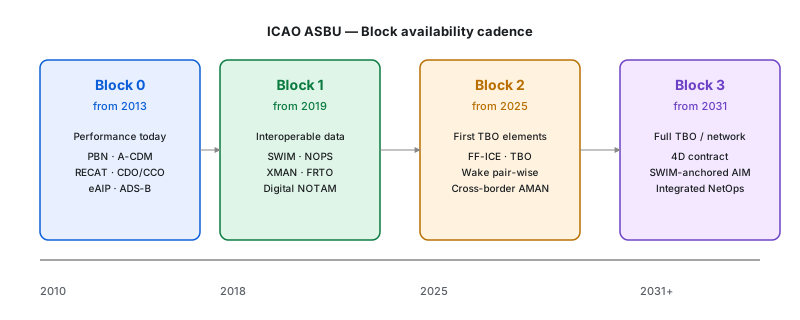
Blocks are six-year availability windows. Block 0 baselines proven capabilities available from 2013, Block 1 targets near-term improvements, Block 2 medium-term, and Block 3 long-term capabilities such as trajectory-based operations, performance-based surveillance, and full network-centric information sharing.
Threads are the feature areas in which improvements are grouped. Current GANP Portal taxonomy lists Operational threads (for example ACDM Airport-Collaborative Decision Making, APTA Optimization of Approach Procedures including Vertical Guidance, NOPS Network Operations), Information threads (SWIM System-Wide Information Management, AMET Meteorological Information, DAIM Digital AIM, FICE Flight and Flow Information for the Collaborative Environment), and Technology threads (COMS and COMI for surface and air-ground communications, NAVS for navigation, ASUR for surveillance).
Each cell in the Block-by-Thread matrix is a Module. A module carries a performance objective, an operational improvement description, the procedures and technology elements needed, the human-performance and training implications, and the linkage to specific Standards and Recommended Practices in the Annexes and PANS. The GANP Portal exposes these modules with cross-references to performance objectives, enablers, and KPIs, allowing planners to filter by region, by thread, or by block.
External Sources
- https://ganpportal.icao.int/ - ICAO GANP Portal landing page; authoritative live home of the ASBU framework.
- https://ganpportal.icao.int/asbu/thread - ASBU Threads catalogue with operational, information, and technology groupings.
- https://www4.icao.int/ganpportal/asbu/performanceobjective - Performance Objective catalogue mapping objectives to modules and KPIs.
- https://www4.icao.int/ganpportal/tutorial - ICAO tutorial on the global technical level of the GANP and ASBU methodology.
- https://www.iata.org/contentassets/1be2bec28b3d45f9ae7780d6ebea7be9/icao_ganp_doc209750_5ed_en.pdf - Doc 9750 fifth edition (2016-2030 GANP) PDF, the reference text introducing the ASBU framework.
- https://www.icao.int/global-air-navigation-plan-ganp - ICAO GANP overview page describing scope, governance, and review cycle.
- https://www.iata.org/en/training/courses/absu-implementation/tcvg02/en/ - IATA ASBU Implementation course outline summarizing planning workflow.
- https://www.eurocontrol.int/sites/default/files/2021-10/lssip2021-11-icao-asbu-monitoring.pdf - EUROCONTROL briefing on ASBU monitoring within the European LSSIP cycle.
References
Doc 8126 (Aeronautical Information Services Manual), List of Acronyms — formal entry "ASBU Aviation system block upgrade" establishing ASBU as an ICAO term of art.
Doc 8126 (Aeronautical Information Services Manual), Chapter 3, §3.3.1.1 — Digital AIM (DAIM) and SWIM elements of the ASBUs cited as the GANP-aligned drivers of AIS-to-AIM transition.
Doc 9587 (Policy and Guidance Material on the Economic Regulation of International Air Transport), Appendix C (A40-21/A39-15), Section I, preambular "Whereas" clause — global plan for ASBUs requiring business case justification for funding and financing.
Doc 9587, Appendix C, Section I, Operative Clause 7 — Council to refine guidance on funding mechanisms supporting operational improvements described in the ASBU modules.
Doc 9587, Recommendation 2.7/1 (Modernization of the air transport system), §31 a) — multi-disciplinary working group on operational and economic incentives for early benefits of ASBU module technologies and procedures.
Doc 9587, Appendix C (earlier A39-15 instance), Section I, preambular clause and Operative Clause 7 — duplicate codification linking ASBU implementation to charging policy and infrastructure financing.
Doc 9626 (Manual on the Regulation of International Air Transport), Chapter 5, §5.3.2 — Air Transport Bureau supports CNS/ATM and ASBU schemes as part of multi-disciplinary work.
Doc 9750 (Global Air Navigation Plan, GANP), 5th Edition (2016-2030), Appendix — ASBU framework, blocks, threads and modules as the technical level of the GANP (authoritative source: iata.org).
Doc 9750 (GANP), 6th Edition and later — ASBU module catalogue maintained dynamically on the GANP Portal (authoritative source: ganpportal.icao.int).
Related topics
Detailed working notes on the ICAO Aviation System Block Upgrades (ASBU)
framework. This folder expands the summary in topics/asbu.md into per-aspect
files so each can be read on its own.
Files in this folder
overview.md— what ASBU is, where it sits in the GANP, and how planners use it.blocks.md— definition of a Block, the four Blocks (0/1/2/3), and what each is for.threads.md— the Threads (feature areas) and the modules that sit under each thread.modules.md— anatomy of an ASBU Module: objective, procedures, technology, enablers, KPI links.components.md— the building components of the framework (Blocks, Threads, Modules, Enablers, Performance Objectives, KPIs, PIAs).enablers.md— supporting CNS infrastructure, procedures, training, regulation, certification.performance_objectives.md— KPAs, KPIs, and how performance objectives map to modules.timeline.md— historical evolution of GANP/ASBU editions and the Block availability windows.references.md— consolidated ICAO and external references for everything in this folder.
Reading order
Start with overview.md, then components.md, then blocks.md and threads.md,
then drill into modules.md, enablers.md, and performance_objectives.md.
Use timeline.md for date context and references.md for citations.
Source basis
Content is grounded in:
- ICAO Doc 9750 (Global Air Navigation Plan, GANP), 5th and 6th editions.
- ICAO Doc 8126 (Aeronautical Information Services Manual).
- ICAO Doc 9587 (Policy on the Economic Regulation of International Air Transport).
- ICAO Doc 9626 (Manual on the Regulation of International Air Transport).
- ICAO GANP Portal: https://ganpportal.icao.int/
What ASBU is
ASBU stands for Aviation System Block Upgrade. It is ICAO's planning methodology for organising global air navigation modernization into time-phased, interoperable building blocks. Each block groups operational improvements, supporting technologies, procedures, and the regulatory and human-factors enablers that must be in place before the capability can be delivered. The intent is that States, ANSPs, airports, airlines, and regulators sequence their investments in a harmonized way rather than in isolation.
Where ASBU sits in the GANP
ASBU is the technical level of the Global Air Navigation Plan (GANP), ICAO Doc 9750-AN/963. The GANP has three levels:
- Strategic level — vision, policy ambitions, performance ambitions.
- Conceptual / Operational level — the Global Air Traffic Management Operational Concept (Doc 9854) and operational improvement areas.
- Technical level — the ASBU framework with Blocks, Threads, and Modules, plus the supporting Performance Objectives and KPIs.
From the 6th edition of the GANP onwards, the detailed ASBU module catalogue is maintained dynamically on the GANP Portal (https://ganpportal.icao.int/) rather than printed inside the GANP volume. This keeps modules current without re-issuing the document.
What planners use ASBU for
For a State or ANSP, an ASBU-aligned plan answers four questions per candidate capability:
- What operational benefit is being sought (safety, capacity, efficiency, environment, access)?
- What procedures and technology are required (PBN specs, data link, SWIM services, AMAN/DMAN, ADS-B, etc.)?
- What dependencies must be in place first (enablers — fleet equipage, regulation, training, infrastructure, agreements with neighbours)?
- By when must the capability be available (which Block window)?
ASBU does not mandate a fixed shopping list. It is a menu. Each region or State picks the modules that match its traffic profile, fleet equipage, airspace structure, and investment capacity, and sequences them according to the dependency chain that ASBU makes explicit.
Why "Block Upgrade"
The word "Block" comes from systems engineering: a block is a coherent bundle of capability that becomes available together at a defined point in time. Calling it a "block upgrade" emphasises three things:
- Bundled — operational improvement, technology, procedure, training, and regulation arrive together; no half-deployments.
- Time-phased — Blocks have notional availability dates so investment cycles around the world can converge.
- Cumulative — each Block builds on the capabilities baselined in the previous Block, so global interoperability is preserved.
Relationship to other initiatives in this repo
ASBU is the umbrella framework that organizes most of the other topics covered in this workspace:
- SWIM, FF-ICE, Digital AIM, AMET — Information threads.
- A-CDM, CDO, CCO, APTA, NOPS, TBO — Operational threads.
- PBN, ADS-B, CPDLC, VDL — captured under the Technology (CNS) threads.
- Air Navigation Plan (ANP), APAC Seamless ATM Plan — regional realisations of the ASBU framework.
ASBU is not a single artefact. It is a structured set of interlocking components that together describe what to deliver, when, why, and how to measure success. The components are:
1. Performance Improvement Areas (PIAs)
The high-level grouping originally introduced with the GANP 4th edition (2013). PIAs answer: "what kind of improvement is this?" There are four:
- PIA-1 — Airport Operations. Throughput and safety on and around the aerodrome (A-CDM, A-SMGCS, runway sequencing, surface routing, RECAT wake separation, remote tower).
- PIA-2 — Globally Interoperable Systems and Data. The information backbone (SWIM, FF-ICE, Digital AIM, IWXXM/AMET, common reference data).
- PIA-3 — Optimum Capacity and Flexible Flights. Network and en-route capacity (ATFM, NOPS, FUA, free route airspace, dynamic sectorisation).
- PIA-4 — Efficient Flight Path. Trajectory efficiency from gate to gate (PBN, CDO, CCO, optimum flight levels, TBO).
The PIA layer remains a useful narrative grouping even where current GANP Portal taxonomy uses Threads as the primary axis.
2. Blocks
Time-phased availability windows that bundle capabilities into a coherent
delivery slot. See blocks.md for the four Blocks and their dates.
A Block is not a year. It is the earliest operational availability window for a set of modules. A State may implement a Block 0 module much later than 2013 — what Block membership says is that the underlying SARPs, procedures, and technology were mature enough by that date to be implemented anywhere in the world.
3. Threads
Feature areas in which improvements are grouped. See threads.md for the
full list. Threads are the columns of the ASBU matrix; Blocks are the
rows. Each Thread has a four-letter mnemonic (APTA, ACDM, SWIM, FICE,
COMS, etc.).
Threads come in three families:
- Operational threads — what controllers, pilots, and airport operators do differently.
- Information threads — how data is exchanged.
- Technology / CNS threads — communications, navigation, surveillance infrastructure that enables the operational and information threads.
4. Modules
A Module is the cell at the intersection of a Block and a Thread.
Modules are the smallest unit of ASBU planning and are coded as
<THREAD>-B<n>/<seq> (for example ACDM-B0/1, SWIM-B1/1,
TBO-B2/1).
Each module carries:
- An operational improvement statement.
- A performance objective (what KPA it improves).
- A procedure specification (PANS / regional SUPP changes needed).
- A technology specification (systems, data link, surveillance, navigation).
- Human performance and training implications.
- Cross-references to SARPs in the relevant Annexes and PANS.
- A dependency map — which other modules or enablers must be in place first.
See modules.md for the full anatomy.
5. Enablers
The supporting elements without which a Module cannot deliver its benefit. Enablers are not themselves operational improvements; they are prerequisites. Categories:
- CNS infrastructure — radar / ADS-B / multilateration networks, data link (CPDLC, VDL Mode 2, ATN/IPS), GNSS augmentation, voice systems.
- Procedures — PANS-ATM (Doc 4444), PANS-OPS (Doc 8168), PANS-AIM (Doc 10066), PANS-MET, regional SUPPs (Doc 7030).
- Standards — Annex 10 (CNS), Annex 11 (ATS), Annex 14 (Aerodromes), Annex 15 (AIS), Annex 19 (SMS), and others as the module dictates.
- Avionics / fleet equipage — what aircraft must carry to use the capability (e.g. ADS-B Out, RNP AR, CPDLC FANS-1/A or ATN B1/B2).
- Regulatory framework — State approvals, operational authorisations, safety oversight, certification.
- Human resources — training syllabi, licensing endorsements, human-factors design.
- Institutional — bilateral and regional agreements, cross-FIR arrangements, charging policy.
See enablers.md for detail.
6. Performance Objectives and KPAs
The "why" axis. Each module is tied to one or more Key Performance Areas (KPAs) drawn from Doc 9854 / Doc 9883:
- Safety
- Security
- Environmental impact
- Cost-effectiveness
- Capacity
- Flight efficiency
- Flexibility
- Predictability
- Access and equity
- Participation
- Interoperability
- Global interoperability
Performance Objectives express the desired direction of change for one
or more KPAs and are linked to Key Performance Indicators (KPIs) so
that progress can be measured. See performance_objectives.md.
7. KPIs (Key Performance Indicators)
Quantitative measures that the GANP Portal exposes for each Performance Objective. Examples: en-route flight efficiency (actual vs. great-circle distance), arrival predictability (variability between planned and actual landing time), runway throughput, fuel burn per flight, accident rate per million movements.
8. The matrix view
Putting the components together produces the canonical ASBU matrix:
                Thread 1   Thread 2   Thread 3   ...
Block 0         Module     Module     Module
Block 1         Module     Module     Module
Block 2         Module     Module     Module
Block 3         Module     Module     Module
Each module is then linked downwards to its enablers and sideways to its performance objectives and KPIs. The GANP Portal lets a planner enter this matrix from any axis.
What a Block is
A Block is a six-year availability window that bundles a set of operational improvements which become globally implementable from a defined notional date. A Block is not a deadline for every State; it is the date by which the underlying SARPs, procedures, technology, and training material are mature enough that any State can implement the modules in that Block.
Each Block builds cumulatively on the previous one. A State that has not implemented Block 0 modules cannot meaningfully implement the Block 1 modules that depend on them.
The four Blocks
| Block | Notional availability | Character |
|---|---|---|
| Block 0 | from 2013 | Baseline of proven capabilities already deployed somewhere in the world. |
| Block 1 | from 2019 | Near-term improvements building on Block 0; greater integration and information sharing. |
| Block 2 | from 2025 | Medium-term improvements; first elements of trajectory-based operations. |
| Block 3 | from 2031 | Long-term vision; full performance-based, network-centric, trajectory-based ATM. |
Notional availability dates were defined relative to the GANP 4th edition (2013). Subsequent editions adjusted module content but retained the Block 0–3 architecture and the six-year cadence.
Block 0 — "Performance Improvements Today" (from 2013)
Theme. Take capabilities that are already operational somewhere in the world and make them available everywhere. Block 0 is the catch-up baseline.
Representative modules.
APTA-B0— implementation of PBN approaches with vertical guidance (LPV / Baro-VNAV / RNP APCH).WAKE-B0— re-categorisation of wake turbulence (RECAT).RSEQ-B0— basic AMAN/DMAN at busy airports.SURF-B0— A-SMGCS Level 1 / 2 surface surveillance and routing.ACDM-B0— Airport Collaborative Decision Making.FRTO-B0— Free Route Airspace at upper levels in low-density airspace; flexible use of airspace.NOPS-B0— initial network operations / CFMU-style flow management.CDO-B0/CCO-B0— published CDO/CCO procedures at major airports.SWIM-B0— initial regional information services (FIXM, AIXM exchange).FICE-B0— initial flight object exchange between adjacent ANSPs.DAIM-B0— quality-managed digital AIS data sets and electronic AIP.ASUR-B0/NAVS-B0/COMI-B0— current-generation CNS (PSR/SSR Mode S, GNSS basic, VHF voice, VDL Mode 2 where deployed).
What "implemented" means. A State that completes Block 0 has a modern, performance-based foundation: PBN throughout, A-CDM at major airports, regional flow management, ADS-B / Mode S surveillance, electronic AIP, and bilateral data sharing with neighbours.
Block 1 — "Globally Interoperable Systems and Data" (from 2019)
Theme. Move from capability deployed locally to capability shared across the network. Information exchange becomes the dominant theme. Performance becomes measured, not just claimed.
Representative modules.
APTA-B1— RNP to xLS, advanced PBN approaches and curved approaches.WAKE-B1— pair-wise dynamic wake separation.RSEQ-B1— extended AMAN with cross-border arrival management (XMAN).SURF-B1— A-SMGCS Level 3 / 4 with routing and guidance functions.ACDM-B1— A-CDM integrated with the network manager.FRTO-B1— full free route airspace; cross-border free route.NOPS-B1— collaborative network management with airline operations centres.SWIM-B1— operational SWIM services (flight, flow, aeronautical, meteorological).FICE-B1— FF-ICE Release 1 (planning information).DAIM-B1— full Digital AIM, AIXM 5 data products.AMET-B1— IWXXM-based meteorological information exchange.ASEP-B0/1— initial airborne situational awareness applications (ATSA-ITP / ATSA-AIRB).
Block 2 — "Optimum Capacity and Flexible Flights" (from 2025)
Theme. Begin operationalising Trajectory-Based Operations. The 4D trajectory becomes the primary planning and tactical reference between air and ground. Information services become trusted enough to drive decisions automatically.
Representative modules.
TBO-B2— initial 4D trajectory negotiation and synchronisation.RPAS-B1/2— integration of Remotely Piloted Aircraft Systems into controlled airspace.OPFL-B1— improved access to optimum flight levels through dynamic re-clearance.ASEP-B2— initial airborne self-separation in low-density airspace.SNET-B1— improved ground-based safety nets fed by richer surveillance.FICE-B2— FF-ICE Release 2 (execution information).SWIM-B2— full SWIM with policy-based access and quality of service.COMI-B2— ATN / IPS data link migration; multi-frequency / satcom data link in oceanic and remote regions.NAVS-B2— multi-constellation, multi-frequency GNSS as primary means of navigation.
Block 3 — "Full Trajectory-Based, Performance-Based ATM" (from 2031)
Theme. End-state vision of the GANP. The system is fully network-centric, performance-based, trajectory-based, and information- rich. Most separation services are based on cooperative surveillance and digital communication; voice is an exception.
Representative modules.
TBO-B3— full 4D trajectory operations, trajectory contracts, collaborative trajectory management.ASEP-B3— extended airborne self-separation including in higher density airspace.RATS-B3— fully remote and virtual aerodrome control services.NOPS-B3— system-wide collaborative network optimisation.SWIM-B3— fully federated information environment with semantic interoperability.RPAS-B3— full integration of RPAS in all classes of airspace.
Block dependency principle
A Block 2 or Block 3 module typically depends on Block 0 / Block 1 enablers being in place. For example:
TBO-B2requiresSWIM-B1,FICE-B1,COMI-B1(data link),NAVS-B1(PBN-rich environment), andNOPS-B1(network operations).ASEP-B2requiresASUR-B1(ADS-B In) andCOMI-B1data link.
The GANP Portal exposes these dependencies explicitly so that planners can avoid trying to implement a module without its prerequisites.
Pakistan / APAC application of Blocks
A typical national ASBU plan for a CAA / ANSP in the APAC region sequences as follows:
- Complete the Block 0 baseline (PBN approaches everywhere, ATFM in place, A-CDM at major hubs, ADS-B coverage, electronic AIP).
- Roll out the Block 1 information layer (SWIM services, digital AIM, IWXXM, FF-ICE Release 1) on the timeline of the regional plan (APAC Seamless ATM Plan).
- Plan Block 2 modules selectively based on traffic justification (XMAN with neighbouring FIRs, initial TBO trials).
- Treat Block 3 as horizon planning for procurement cycles, not as near-term deliverables.
A Thread is a feature area in which improvements are grouped. Threads are the columns of the ASBU matrix; Blocks are the rows. Each Thread carries a four-letter mnemonic. Threads come in three families:
- Operational threads — what controllers, pilots, and airport operators do differently.
- Information threads — how data is produced, shared, and consumed.
- Technology / CNS threads — the communications, navigation, and surveillance infrastructure that everything else relies on.
The catalogue below reflects the Threads exposed on the ICAO GANP Portal. The portal is the live source; treat this as a planning summary.
Operational threads
APTA — Optimization of Approach Procedures including Vertical Guidance
PBN approaches with vertical guidance (LPV, Baro-VNAV, RNP APCH, RNP AR). Reduces CFIT risk, removes step-down ground-aid dependency, enables access in marginal weather, supports CDO design.
WAKE — Wake Turbulence Separation
Re-categorisation (RECAT) and pair-wise dynamic wake separation. Raises runway throughput without compromising safety by replacing the legacy heavy/medium/light buckets with tighter, evidence-based categories.
RSEQ — Improved Traffic Flow through Sequencing (AMAN/DMAN/SMAN)
Arrival manager, departure manager, surface manager, and extended AMAN (XMAN) reaching into upstream FIRs. Smooths arrival rates and squeezes slack out of the runway and surface.
SURF — Safety and Efficiency of Surface Operations
A-SMGCS levels 1–4, surface routing, guidance, conflict alerting on the movement area, runway-incursion prevention.
ACDM — Airport Collaborative Decision Making
Shared situational awareness between airport operator, ANSP, airlines, ground handlers, and the network manager. Milestone-based turnaround, target off-block time (TOBT), and target start-up approval time (TSAT).
ACAS — Airborne Collision Avoidance System Improvements
Evolution of TCAS / ACAS towards ACAS X (ACAS Xa, Xo, Xu) with reduced nuisance alerts and better integration with TBO and RPAS.
SNET — Ground-Based Safety Nets
STCA, MSAW, APW, APM. Tighter alerts as surveillance improves. Important backstop as automation and trajectory delegation expand.
CDO — Continuous Descent Operations
Idle-thrust descent profiles. Saves fuel, reduces noise, reduces emissions in the terminal area. Depends on PBN, accurate wind data, and AMAN to preserve sequence.
CCO — Continuous Climb Operations
Continuous climb to top of climb without level-off. Saves fuel, reduces noise around departure. Depends on SID design and traffic mix.
RPAS — Remotely Piloted Aircraft Systems Integration
Integration of RPAS into non-segregated airspace with appropriate detect- and-avoid, command-and-control link, and lost-link procedures.
FRTO — Improved Operations through Enhanced En-Route Trajectories
Free route airspace, direct routings, flexible use of airspace, dynamic sectorisation. Lets users plan trajectories independent of fixed route structures within defined airspace.
NOPS — Network Operations
Collaborative network management between flow units, ANSPs, and aircraft operators. ATFM measures (slot allocation, rerouting, level capping) chosen with airspace user input.
ASEP — Airborne Separation
Airborne traffic situational awareness applications (ATSA-AIRB, ATSA-ITP) in the early Blocks; airborne self-separation (ASEP) in later Blocks. Depends on ADS-B In and CDTI.
OPFL — Improved Access to Optimum Flight Levels
Dynamic re-clearance to optimum cruise level when traffic permits; reduced vertical separation in oceanic; tactical use of fuel-optimal levels.
TBO — Trajectory-Based Operations
The headline operational thread. The 4D trajectory (latitude, longitude, altitude, time) becomes the primary planning and tactical reference shared between air and ground. Trajectory negotiation, synchronisation, and contract management.
RATS — Remotely Operated Aerodrome Control Service
Provision of aerodrome ATS from a remote control centre using camera arrays, sensors, and communication links. Enables service to airports that could not otherwise sustain a tower.
Information threads
SWIM — System-Wide Information Management
The information backbone. SWIM defines services, governance, security, quality of service, and registries so that flight, flow, aeronautical, meteorological, and surveillance information can be exchanged across organisational and national boundaries with known semantics.
FICE — Flight and Flow Information for the Collaborative Environment
The ICAO concept usually known as FF-ICE. Replaces the legacy filed flight plan with a richer, shared flight information lifecycle: planning information (Release 1) and execution information (Release 2). Built on SWIM with FIXM as the data model.
DAIM — Digital AIM
The transition from product-centric AIS to data-centric AIM. AIXM 5 as the exchange model, quality-managed digital data sets (terrain, obstacle, aerodrome mapping, instrument flight procedure), Aeronautical Data Catalogue per PANS-AIM (Doc 10066). Doc 8126 §3.3.1.1 explicitly cites "DAIM and SWIM elements of the ASBUs" as the GANP-aligned drivers of the AIS-to-AIM transition.
AMET — Meteorological Information
Operational meteorological information in IWXXM (XML/GML model) exchanged through SWIM. Probabilistic and 4D MET; tighter integration with TBO trajectory planning.
Technology / CNS threads
COMS — Surface Communications
Ground-ground voice and data networks underpinning ATM (e.g. PENS / NewPENS, ATN/OSI to ATN/IPS migration, IPv6 backbones).
COMI — Air-Ground Communications Infrastructure
Voice (VHF, HF, satcom voice) and data link (CPDLC over VDL Mode 2, FANS-1/A, ATN B1, ATN B2, satcom data link, future LDACS, AeroMACS for surface). The data link substrate for TBO and FF-ICE.
NAVS — Navigation Systems
PBN evolution (RNAV, RNP, RNP AR), GNSS (GPS, Galileo, BeiDou, GLONASS), multi-constellation / multi-frequency receivers, GBAS, SBAS. Planned phase-down of conventional ground navigation aids where redundancy allows.
ASUR — Surveillance
Cooperative surveillance (Mode S Enhanced Surveillance, ADS-B Out, ADS-B In, ADS-C contract reporting), multilateration (WAM at airports and en route), space-based ADS-B for oceanic and remote, evolution of primary radar where required for non-cooperative targets.
Cross-thread dependencies (typical)
- TBO depends on NAVS (PBN), COMI (data link), SWIM + FICE + AMET (information), and ASUR (cooperative surveillance).
- CDO depends on NAVS (PBN procedures), RSEQ (AMAN), and AMET (wind data).
- A-CDM depends on SWIM for full network-manager integration in later Blocks.
- ASEP depends on ASUR (ADS-B In) and COMI (data link).
This is why Threads cannot be implemented independently — the GANP Portal flags the prerequisite chain on each module.
What a Module is
A Module is the smallest unit of ASBU planning. It is the cell at the intersection of one Block (row) and one Thread (column) in the ASBU matrix.
Module identifier convention:
<THREAD>-B<n>/<sequence>

Examples:
  ACDM-B0/1   - Airport CDM, Block 0, first module
  SWIM-B1/1   - SWIM, Block 1, first module
  TBO-B2/1    - Trajectory-Based Ops, Block 2, first module
  FICE-B1/1   - FF-ICE planning information, Block 1
A Module is deliverable — a State or ANSP can plan, fund, procure, deploy, certify, train for, and operate it as a coherent capability.
Anatomy of a Module
The GANP Portal exposes each module with the following structured information.
1. Title and identifier
For example: ACDM-B0/1 — Airport Collaborative Decision Making.
2. Operational improvement description
A plain-language statement of what changes operationally. For ACDM-B0/1 this would describe the milestone-based turnaround, TOBT/TSAT, shared situational awareness across airport partners.
3. Performance objective and applicable KPAs
The "why". The module is tagged with one or more Performance Objectives drawn from the GANP catalogue, which in turn map to Key Performance Areas (KPAs) such as predictability, capacity, efficiency, environment, cost-effectiveness.
4. Procedure element
The procedural changes required: PANS-ATM (Doc 4444), PANS-OPS (Doc 8168), PANS-AIM (Doc 10066), PANS-MET (Doc 10157), regional supplementary procedures (Doc 7030), local AIP changes.
5. Technology element
The systems that must be deployed: ground systems, avionics, data link, surveillance, navigation, MET sensors, AIM systems.
6. Human performance element
Training, licensing endorsements, human-machine interface considerations, team resource management, fatigue.
7. Standards basis
The SARPs and PANS that the module relies on, e.g. Annex 10 (CNS), Annex 11 (ATS), Annex 14 (Aerodromes), Annex 15 (AIS), Annex 19 (SMS), Doc 9613 (PBN Manual), Doc 9854 (Global ATM OpsConcept), Doc 9883 (GANP performance), Doc 10066 (PANS-AIM), Doc 4444 (PANS-ATM).
8. Enablers
The infrastructure, regulation, and institutional prerequisites that
must be in place. See enablers.md.
9. Dependencies
Other ASBU modules that must be implemented (or partially implemented) first. The portal renders this as a directed graph so planners can see the chain.
10. KPI linkage
Quantitative indicators on which the module's effect can be measured — runway throughput, sector capacity, flight efficiency, fuel burn, taxi time, predictability variance.
11. Region applicability
Some modules are universally applicable; others are tied to specific operating environments (oceanic, low-density continental, high-density TMA, polar, etc.). The regional plans (APAC, MID, EUR/NAT) refine applicability for each State.
12. Implementation guidance / supporting material
Pointers to ICAO manuals, regional roadmaps (APAC Seamless ATM Plan, EUR ATM Master Plan), and industry best-practice (EUROCONTROL specs, RTCA / EUROCAE MOPS).
Worked examples
Example 1 — ACDM-B0/1 Airport Collaborative Decision Making
- Operational improvement. Replaces ad-hoc coordination between airport actors with a shared milestone model (16 milestones from inbound flight to off-block) and shared TOBT/TSAT.
- KPAs. Predictability, capacity, cost-effectiveness, environment.
- Procedure. Local A-CDM procedures aligned with EUROCONTROL A-CDM Implementation Manual; ATS coordination procedures per Doc 4444.
- Technology. A-CDM platform integrating airport operations database, ATC system, airline OCC, ground handler systems; DPI/FUM exchange with the network manager.
- Enablers. Stakeholder agreement, governance, data-sharing agreements, training for all parties.
- Dependencies. None upstream (it is a Block 0 module). Becomes
prerequisite for
ACDM-B1(full integration with network manager). - KPIs. Off-block punctuality variance, taxi-out time, missed-slot rate.
Example 2 — SWIM-B1/1 Initial SWIM Services
- Operational improvement. Operational SWIM service registry, policy-based access, message-level QoS for flight, flow, AIM, and MET information.
- KPAs. Interoperability, predictability, efficiency, cost-effectiveness.
- Procedure. Service governance, naming conventions, policy framework, lifecycle management.
- Technology. SWIM-TI (technical infrastructure), service registries, identity and access management, AIXM/FIXM/IWXXM payloads.
- Enablers. ATN/IPS network, IPv6 connectivity, security framework, service-level agreements between ANSPs.
- Dependencies.
COMS-B0(ground network), partialDAIM-B0(digital AIS data quality). - KPIs. Service availability, message latency, semantic conformance rate.
Example 3 — TBO-B2/1 Initial Trajectory-Based Operations
- Operational improvement. Negotiated 4D trajectory shared between airborne FMS and ground systems; trajectory becomes the primary reference for separation planning and conflict detection.
- KPAs. Flight efficiency, capacity, environment, predictability.
- Procedure. Trajectory negotiation procedures (PANS-ATM amendments), CPDLC message set extensions, contingency procedures.
- Technology. Ground TBO system, FMS capable of 4D trajectory exchange, ATN B2 data link, SWIM-distributed trajectory information.
- Enablers. Fleet equipage with appropriate FMS and data link; controller training; airspace and procedure design supporting trajectory-based separation.
- Dependencies.
SWIM-B1,FICE-B1,COMI-B1(ATN B2),NAVS-B1(mature PBN),AMET-B1(4D wind). - KPIs. Conformance to negotiated trajectory; track-mile efficiency; vertical profile efficiency; sector capacity.
How modules become a national plan
A national ASBU implementation plan is produced by:
- Selecting the modules relevant to the State's operational context.
- Sequencing them per the dependency graph.
- Mapping each module to the responsible organisation, funding source, regulatory action, and milestone date.
- Agreeing the plan within the regional planning forum (e.g. APANPIRG for APAC, MIDANPIRG for MID, EANPG for EUR).
- Reporting implementation status into the regional and global monitoring system (e.g. the ICAO ASBU implementation monitoring reports; in Europe through the LSSIP / Local Single Sky Implementation cycle).
What an Enabler is
An Enabler is a supporting element without which a Module cannot deliver its intended benefit. Enablers are not themselves operational improvements; they are prerequisites. ASBU makes enablers explicit so that planners do not deploy a capability whose foundation is missing.
Enablers fall into seven categories.
1. CNS infrastructure
Communications, navigation, and surveillance ground and space infrastructure. Specific examples by Thread:
-
Communications
- Ground-ground: PENS / NewPENS, IPv6 backbones, ATN/IPS migration.
- Air-ground voice: VHF (with 8.33 kHz channel spacing in Europe), HF (oceanic), satcom voice.
- Air-ground data link: VDL Mode 2 for ACARS / CPDLC, FANS-1/A over ACARS/Inmarsat/Iridium, ATN B1 / B2 over VDL Mode 2 (continental), Iris over satcom, future LDACS.
- Surface data: AeroMACS at airports.
-
Navigation
- GNSS core constellations (GPS, GLONASS, Galileo, BeiDou).
- Augmentations: SBAS (WAAS, EGNOS, MSAS, GAGAN, SDCM), GBAS at airports, ABAS in receivers.
- Conventional aids retained as a back-up: VOR / DME network, ILS at busy runways.
- PBN published procedure inventory.
-
Surveillance
- PSR / SSR Mode A/C/S networks.
- Mode S Enhanced Surveillance (DAPs).
- ADS-B Out (1090 ES) ground stations and avionics mandates.
- ADS-B In avionics for ASEP and traffic situational awareness.
- Multilateration (WAM en route, MLAT at airports).
- ADS-C contracts for oceanic / remote.
- Space-based ADS-B for oceanic and remote.
2. Procedures
Procedural changes anchored in ICAO PANS and regional supplementary procedures.
- Doc 4444 — PANS-ATM. Air traffic services procedures: separation, coordination, ATFM, data link operations, contingency.
- Doc 8168 — PANS-OPS. Procedure design (PBN approaches, CDO/CCO designs, holding patterns, missed approach criteria).
- Doc 10066 — PANS-AIM. Aeronautical information management procedures, Aeronautical Data Catalogue, data quality requirements.
- Doc 10157 — PANS-MET. Meteorological information procedures.
- Doc 7030 — Regional Supplementary Procedures. Region-specific procedures (EUR, MID, ASIA/PAC, AFI, NAT, SAM, CAR).
- AIP and AIC changes. Local publication of new approach charts, airspace, route structures.
3. Standards (SARPs)
Annex provisions that underpin the module. Most ASBU modules touch several Annexes:
- Annex 1 — Personnel Licensing. Endorsements (e.g. data link, PBN, RNP AR, RPAS).
- Annex 2 — Rules of the Air. Where operational concepts change rules (e.g. ASEP).
- Annex 3 — Meteorological Service. AMET, IWXXM exchange.
- Annex 4 — Aeronautical Charts. Chart provisions for new procedures.
- Annex 6 — Operation of Aircraft. Equipment carriage, performance requirements.
- Annex 10 — Aeronautical Telecommunications. CNS standards (Vols I–V), GNSS, data link, surveillance.
- Annex 11 — Air Traffic Services. ATS provision, ATFM, A-CDM, airspace classification, language.
- Annex 13 — Accident and Incident Investigation. Where new capabilities introduce new occurrence categories.
- Annex 14 — Aerodromes. Aerodrome design, A-SMGCS, runway incursion prevention.
- Annex 15 — Aeronautical Information Services. AIS-to-AIM transition, digital data sets.
- Annex 17 — Security. Where information sharing introduces security-relevant changes.
- Annex 19 — Safety Management. SMS integration of new capabilities.
4. Avionics and fleet equipage
The operator-side of every module. Without aircraft equipage, a ground investment cannot deliver benefits. Typical equipage requirements:
- PBN avionics — RNAV 5 / 1, RNP 1, RNP APCH, RNP AR APCH, RNP 2, A-RNP.
- Data link — CPDLC FANS-1/A or ATN B1/B2; ADS-C (oceanic).
- Surveillance — ADS-B Out 1090ES; ADS-B In with CDTI; Mode S EHS.
- Navigation — multi-constellation multi-frequency GNSS; GBAS receiver where deployed.
- Future — TBO-capable FMS; ACAS X; satellite voice / data link for remote regions.
Avionics carriage is normally driven by a State operational authorisation under Annex 6 plus an avionics standard (RTCA DO / EUROCAE ED MOPS) referenced from Annex 10.
5. Regulatory framework
- State approval frameworks (operational authorisations for PBN, data link, RPAS, Reduced Vertical Separation Minimum (RVSM), ETOPS).
- Safety oversight (Annex 19 SMS at the State and service-provider levels; State Safety Programme).
- Certification pipelines for new equipment and procedures.
- Spectrum management for new CNS bands.
- Cybersecurity regulation for SWIM-connected systems.
- Charging policy supporting ATM/ANS investment (Doc 9082, Doc 9587).
6. Human resources and training
- Controller training and licensing endorsements (PBN-aware, data-link-aware, AMAN/DMAN-aware, A-CDM-aware, TBO-aware).
- Pilot training for new approaches and data link operations.
- AIM officer training for PANS-AIM data quality regime.
- Engineering and maintenance training for new CNS systems.
- Human-factors design embedded in procurement.
7. Institutional and inter-State
- Bilateral letters of agreement between ANSPs (cross-FIR coordination, data sharing).
- Regional planning fora (APANPIRG, MIDANPIRG, EANPG, GREPECAS, etc.) endorsing harmonised implementation.
- Network manager / regional flow management arrangements.
- Cross-FIR ATFM and arrival management (XMAN) agreements.
- Memoranda of understanding for SWIM service exchange and FF-ICE bilateral readiness.
How enablers are managed in practice
Each module on the GANP Portal lists its enablers with status indicators. The implementation monitoring system records, per State and per region, which enablers are in place. A module is considered fully implemented only when all of its declared enablers are also in place — not only the headline operational capability.
This is why ASBU planning is much more than equipment procurement: a State that buys an AMAN system without re-designing arrival routes, training controllers, and agreeing XMAN handover with neighbouring FIRs will not see the predicted benefit.
The performance lens of ASBU
ASBU is a performance-based framework. Every module is justified by the performance benefit it delivers, and progress is measured against defined Key Performance Indicators (KPIs). The terminology comes from the Global ATM Operational Concept (Doc 9854) and the Manual on Global Performance of the Air Navigation System (Doc 9883).
The chain is:
KPA --(measured by)--> KPI <--(targeted by)-- Performance Objective --(achieved by)--> ASBU Module
Key Performance Areas (KPAs)
The eleven KPAs from Doc 9854 / Doc 9883 are the canonical dimensions of ATM performance:
- Safety — accident and incident rates, severity, risk exposure.
- Security — protection of ATM assets and information from unlawful interference.
- Environmental impact — fuel burn, CO2, NOx, noise.
- Cost-effectiveness — unit cost of ATM service, return on investment.
- Capacity — runway, sector, airspace, network throughput.
- Flight efficiency — actual vs. user-preferred trajectory; track- mile efficiency; vertical profile efficiency.
- Flexibility — ability of users to change trajectory, level, route close to or during flight.
- Predictability — variance between planned and actual times.
- Access and equity — fair access to airspace and airports for all user classes.
- Participation — involvement of stakeholders in ATM decision-making.
- Interoperability — common procedures, data formats, and systems enabling seamless cross-border operation.
(Doc 9883 also recognises Global Interoperability as a distinct ambition, sometimes counted separately.)
Performance Objectives
A Performance Objective (PO) is a stated, measurable improvement in one or more KPAs that the ASBU programme commits to pursue. The GANP Portal carries a catalogue of POs, each linked to:
- the KPAs it improves;
- the KPIs that measure it;
- the ASBU modules that deliver it.
Examples (illustrative naming, consistent with the GANP Portal style):
- PO — Improve runway throughput at high-density airports.
Measured by movements per hour, peak-rate sustained capacity. Delivered
by
WAKE-B0/B1,RSEQ-B0/B1,SURF-B0/B1,APTA-B0/B1. - PO — Reduce en-route flight inefficiency. Measured by KEP/KEA
(planned/actual extension over great-circle). Delivered by
FRTO-B0/B1,NOPS-B1,OPFL-B1,TBO-B2. - PO — Improve arrival predictability. Measured by standard
deviation of actual vs. planned landing time. Delivered by
ACDM-B0/B1,RSEQ-B1(XMAN),NOPS-B1,SWIM-B1. - PO — Reduce fuel burn and CO2 per flight. Measured by fuel/CO2
per movement, vertical inefficiency. Delivered by
CDO-B0,CCO-B0,OPFL-B1,TBO-B2. - PO — Reduce runway-incursion rate. Measured by runway-incursion
events per movement. Delivered by
SURF-B0/B1,SNET-B1.
KPA contribution by Block
The following matrix scores each KPA by its principal benefit horizon across the four ASBU Blocks (1 = some benefit, 2 = clear benefit, 3 = primary driver). It is editorial — Blocks contribute to all KPAs in some measure — but it conveys where each Block's centre of gravity lies.
| KPA | Block 0 | Block 1 | Block 2 | Block 3 |
|---|---|---|---|---|
| Safety | 3 | 3 | 2 | 2 |
| Capacity | 2 | 3 | 3 | 3 |
| Flight efficiency | 1 | 2 | 3 | 3 |
| Predictability | 1 | 2 | 3 | 3 |
| Environment | 2 | 2 | 3 | 3 |
| Interoperability | 1 | 3 | 3 | 3 |
| Cost-effectiveness | 2 | 2 | 2 | 3 |
Key Performance Indicators (KPIs)
Quantitative measures used to evidence progress toward a PO. The GANP Portal exposes a catalogue (regional bodies such as EUROCONTROL and the FAA publish the implementation detail). Common families:
Safety KPIs
- Accidents per million departures.
- Serious incidents per movement.
- Loss-of-separation events per flight hour.
- Runway-incursion severity-weighted rate.
Capacity KPIs
- Declared runway capacity.
- Sustained sector throughput.
- ATFM regulation rate; minutes of ATFM delay per flight.
Flight efficiency KPIs
- KEP — flight efficiency of the last filed flight plan vs. great-circle.
- KEA — flight efficiency of actual trajectory vs. great-circle.
- Vertical efficiency (cruise altitude vs. optimum).
- Direct routing percentage; free route airspace utilisation.
Predictability KPIs
- Variance / standard deviation between planned and actual off-block, airborne, landing times.
- ATFM slot adherence.
Environmental KPIs
- Fuel burn / CO2 per flight.
- Excess fuel per arrival (CDO conformance).
- Noise contour area at airports.
Cost-effectiveness KPIs
- Unit cost of ANS per service unit (Doc 9082 charging principles).
- Productivity (composite flight-hours per controller).
Interoperability KPIs
- SWIM service availability, latency, semantic conformance.
- Number of bilateral data exchange agreements active.
How performance is reported
- Globally — through the ICAO ASBU implementation monitoring reports consolidated under the GANP review cycle.
- Regionally
- APAC: APANPIRG performance reporting and the Seamless ATM Plan.
- MID: MIDANPIRG and the MID Air Navigation Strategy.
- EUR: EUROCONTROL Performance Review Body; LSSIP cycle.
- NAT/CAR/SAM/AFI: their respective regional offices.
- Nationally — State Action Plans (e.g. environment), State Safety Programme reports.
Why this matters for planning
Tying every module to a Performance Objective and a KPI keeps ASBU honest. It forces the question "what measurable problem does this fix?" during business-case development (Doc 9587 explicitly requires business-case justification for ASBU funding). And it gives oversight bodies the language to ask whether deployed capability is delivering the promised benefit.
Two timelines to keep distinct
When discussing ASBU "dates", separate two things:
- GANP edition timeline — when ICAO published / amended the framework itself.
- Block availability timeline — the notional dates from which modules in each Block become globally implementable.
A State's own implementation roadmap is a third, national timeline; it must be expressed in terms of the Block availability dates and the regional plan's milestones.
GANP edition timeline
| Edition | Year | What it did for ASBU |
|---|---|---|
| 1st edition | 1998 | Pre-ASBU. CNS/ATM evolution plan. |
| 2nd edition | 2002 | Pre-ASBU. Updated CNS/ATM and air navigation strategy. |
| 3rd edition | 2007 | Pre-ASBU. Introduced the global ATM operational concept linkage (Doc 9854 published 2005). |
| 4th edition | 2013 | Introduced the ASBU methodology with four PIAs and Blocks 0–3 (notional dates 2013, 2018, 2023, 2028 in that edition). |
| 5th edition | 2016 | Embedded ASBU as the technical level of the GANP. Re-baselined Block notional dates to 2013 / 2019 / 2025 / 2031 (the 6-year cadence used since). |
| 6th edition | 2019 | Restructured into a multi-layer model (strategic, conceptual, technical). Moved the ASBU module catalogue onto the GANP Portal for dynamic maintenance. |
| 7th edition | 2022 | Continued the multi-layer model; expanded performance and basic building blocks (BBB) concept; further portal-driven catalogue. |
The key inflection points are 2013 (ASBU born), 2016 (re-baselined and embedded), and 2019 (catalogue moved to the portal — the printed GANP no longer carries the module list).
Block availability timeline
The dates below are the earliest notional availability for modules in each Block, as set in GANP 5th edition and carried forward.
Block 0 ........ from 2013
Block 1 ........ from 2019
Block 2 ........ from 2025
Block 3 ........ from 2031
Visualised:
2013 ----- 2019 ----- 2025 ----- 2031 ----- 2037
  |          |          |          |
  Block 0    Block 1    Block 2    Block 3
  Baseline   Near-term  Medium     Long-term
             integration TBO       Full TBO,
                        initial    full SWIM,
                                   ASEP, RPAS
These dates are not deadlines for States. They are the dates by which the SARPs, PANS, technology, and training material underpinning each module are mature enough that any State can implement them. A State that implements a Block 0 module in 2026 has still implemented a Block 0 module.
Where Pakistan / APAC sit on this timeline
Indicative regional context (verify current status against the latest APANPIRG and ICAO APAC Implementation Plan documents — these change annually):
- Block 0 — substantially complete or in progress across the region. Common gaps: full PBN approach coverage at smaller airports; A-CDM beyond the largest hubs; A-SMGCS at medium airports.
- Block 1 — active implementation. Priority items in APAC: SWIM services, Digital AIM (AIXM 5), IWXXM, FF-ICE Release 1 readiness, cross-border AMAN (XMAN), expansion of Free Route Airspace.
- Block 2 — planning and trials. Initial TBO trials; ATN B2 data link; multi-constellation GNSS rollout.
- Block 3 — horizon planning and procurement strategy only.
Implementation monitoring cadence
- Global — ICAO publishes ASBU implementation status as input to the GANP review cycle (3-yearly, aligned with the ICAO Assembly).
- APAC — the APAC Seamless ATM Plan is the regional implementation roadmap; APANPIRG monitors progress annually.
- Europe — the LSSIP (Local Single Sky Implementation) cycle reports annually against ICAO ASBU and the European ATM Master Plan.
- National — typically a 3–5 year national air navigation plan, reviewed annually, expressed in ASBU module terms.
How to read a date in an ASBU document
When an ASBU document uses a date, check which kind of date it is:
- "Block 1 from 2019" — Block availability date (global notional earliest).
- "Module fully implemented by 2027" — national or regional commitment.
- "GANP 6th edition (2019)" — ICAO publication date.
- "Performance target by 2030" — regional or national performance ambition.
Mixing these up leads to false claims that a State is "behind" or "ahead" of ASBU, when in fact the only meaningful measure is the State's own implementation plan against its declared milestones.
Primary ICAO documents
- Doc 9750-AN/963 — Global Air Navigation Plan (GANP), 5th edition (2016-2030) and subsequent editions. The framework document; ASBU is the technical level. 5th edition PDF (mirror): https://www.iata.org/contentassets/1be2bec28b3d45f9ae7780d6ebea7be9/icao_ganp_doc209750_5ed_en.pdf
- Doc 9854 — Global Air Traffic Management Operational Concept. Source of the eleven Key Performance Areas (KPAs) used by ASBU.
- Doc 9883 — Manual on Global Performance of the Air Navigation System. Defines the performance management methodology (KPAs, KPIs, performance objectives) used to justify and measure ASBU modules.
- Doc 4444 — PANS-ATM. Air traffic services procedures referenced by most operational threads (NOPS, FRTO, RSEQ, TBO).
- Doc 8168 — PANS-OPS. Procedure design rules underpinning APTA, CDO, CCO modules.
- Doc 10066 — PANS-AIM. Aeronautical Information Management procedures and Aeronautical Data Catalogue underpinning the DAIM thread.
- Doc 10157 — PANS-MET. Meteorological information procedures underpinning the AMET thread.
- Doc 7030 — Regional Supplementary Procedures. Region-specific procedures.
- Doc 9613 — Performance-Based Navigation (PBN) Manual. Foundation for the NAVS thread and APTA, CDO, CCO modules.
- Doc 9082 — Policies on Charges for Airports and Air Navigation Services. Charging-policy basis for funding ATM modernisation.
- Doc 8126 — Aeronautical Information Services Manual. Lists ASBU as a formal acronym (List of Acronyms) and ties the AIS-to-AIM transition, Digital AIM, and SWIM directly to the ASBU modules in §3.3.1.1.
- Doc 9587 — Policy and Guidance Material on the Economic Regulation of International Air Transport. Repeatedly invokes the global plan for ASBUs as the reference for infrastructure financing, business-case justification, oversight, and incentive design.
- Doc 9626 — Manual on the Regulation of International Air Transport. Records that the ICAO Air Transport Bureau supports CNS/ATM and ASBU implementation.
ICAO Annexes most touched by ASBU
- Annex 1 (Personnel Licensing), Annex 2 (Rules of the Air), Annex 3 (MET), Annex 4 (Charts), Annex 6 (Operations), Annex 10 (CNS, Vols I–V), Annex 11 (ATS), Annex 14 (Aerodromes), Annex 15 (AIS), Annex 17 (Security), Annex 19 (SMS).
Live / authoritative sources
- ICAO GANP Portal — https://ganpportal.icao.int/ — live home of the ASBU framework. The module catalogue is maintained here.
- ASBU Threads catalogue — https://ganpportal.icao.int/asbu/thread
- ASBU Performance Objectives catalogue — https://www4.icao.int/ganpportal/asbu/performanceobjective
- GANP / ASBU tutorial — https://www4.icao.int/ganpportal/tutorial
- ICAO GANP overview page — https://www.icao.int/global-air-navigation-plan-ganp
- ICAO GANP Resources — https://www.icao.int/airnavigation/pages/ganp-resources.aspx
Regional implementation references
- APAC Seamless ATM Plan (ICAO Asia/Pacific Regional Office) — APAC realisation of the ASBU framework; monitored by APANPIRG.
- MID Air Navigation Strategy (ICAO MID Regional Office) — MID realisation; monitored by MIDANPIRG.
- European ATM Master Plan (SESAR JU) and EUROCONTROL LSSIP cycle — EUR realisation and annual reporting.
- EUROCONTROL ASBU monitoring briefing (LSSIP context): https://www.eurocontrol.int/sites/default/files/2021-10/lssip2021-11-icao-asbu-monitoring.pdf
Industry training / supporting material
- IATA ASBU Implementation course — https://www.iata.org/en/training/courses/absu-implementation/tcvg02/en/