ILS categories
ILS Cat I/II/III — layered specification covering Annex 10 facility performance plus Annex 6 / PANS-OPS operating minima for decision height and runway visual range
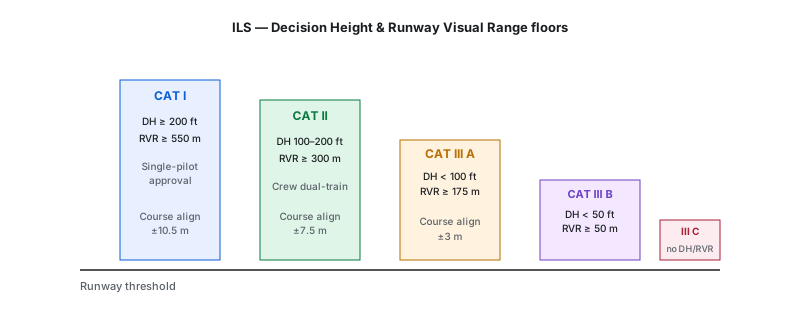
ILS Categories (CAT I/II/III)
Definition
The Instrument Landing System (ILS) is a ground-based precision approach aid providing lateral (localizer) and vertical (glide path) guidance, supplemented by markers or DME for range. "ILS Category" is layered: it describes both the integrity/performance of the ground facility (Annex 10) and the operational minima - decision height (DH) and runway visual range (RVR) - under which the approach may be flown (Annex 6, PANS-OPS). Aerodrome infrastructure (Annex 14) and operator/aircraft approval complete the picture.
Regulatory Basis
- Annex 10 Vol I, Ch 3.1 - facility performance Cat I/II/III; signal, monitoring, integrity, continuity.
- Annex 6 Part I, Ch 4 - operating minima, CAT I/II/III definitions, low-visibility operations (LVO).
- Annex 14 Vol I - precision approach runway categories; lighting, OFZ, LVP infrastructure.
- Doc 8168 (PANS-OPS) Vol II - obstacle clearance/OAS for CAT I/II/III.
- Doc 9328 - RVR observing/reporting; Doc 9365 - All-Weather Ops.
Facility Performance Categories (Annex 10)
Annex 10 Vol I, 3.1.1 (definitions, ~AN10_V1_cons.md:910-918) sets three ground-facility tiers:
- Facility Performance CAT I - guidance from coverage limit down to the point where the localizer course intersects the glide path at 30 m (100 ft) or less above threshold.
- Facility Performance CAT II - guidance down to 15 m (50 ft) or less above threshold; tighter course alignment, displacement-sensitivity, bend, monitoring and continuity standards.
- Facility Performance CAT III - guidance from coverage limit to and along the runway surface, with ancillary equipment as needed.
Key tightening from CAT I -> II -> III (AN10 V1 3.1.3 / 3.1.5):
- Course alignment at threshold: +/-10.5 m (CAT I), +/-7.5 m (CAT II), +/-3 m (CAT III).
- Localizer monitor reaction time: <=10 s (I), <=5 s (II), <=2 s (III).
- Modulation tolerance: +/-1.5 % (I/II) tightened to +/-1 % (III).
- Integrity/continuity: CAT II/III localizer and glide path require Level 3 (3.1.2.6.1; 3.1.3.12.4; 3.1.5.8.4).
- CAT II/III ATS units controlling final approach must receive ILS status with operationally acceptable delay (3.1.2.x).
- Critical and sensitive area protection becomes mandatory and progressively larger for CAT II/III (Attachment C).
Operational Categories and Minima (Annex 6 / PANS-OPS)
Annex 6 Part I, 4.2.8 (~AN06_P1_cons.md:2110-2120) classifies Type B (precision) instrument approach operations:
- CAT I - DH not lower than 60 m (200 ft); visibility >=800 m or RVR >=550 m.
- CAT II - DH lower than 60 m (200 ft) but not lower than 30 m (100 ft); RVR >=300 m.
- CAT III - DH lower than 30 m (100 ft) or no DH; RVR <300 m or no RVR limitation.
CAT III is sub-divided in operational practice (Doc 9365; widely reflected in State rules):
- CAT IIIA - DH <100 ft or no DH; RVR >=200 m (some States >=175 m). Typically flown fail-passive with autoland or HUD.
- CAT IIIB - DH <50 ft or no DH; RVR >=50 m and <200 m. Requires fail-operational guidance (continued automatic landing after a single failure).
- CAT IIIC - no DH, no RVR limitation. Not currently authorised operationally (surface movement guidance not assured in zero vis).
Low-Visibility Operations (LVO) are defined as approaches with RVR <550 m and/or DH <200 ft, or take-off with RVR <400 m (AN06_P1_cons.md:1580). The State of the Operator must issue specific approval (4.2.8.4) and RVR information must be provided.
CAT I / II / IIIA / IIIB / IIIC summary
| Cat | Decision Height | Min RVR / Visibility | Crew/System |
|---|---|---|---|
| I | >=200 ft (60 m) | RVR >=550 m or vis 800 m | Manual / FD |
| II | 100-200 ft (30-60 m) | RVR >=300 m | FD or autoland |
| IIIA | <100 ft or no DH | RVR >=175-200 m | Fail-passive AP/HUD |
| IIIB | <50 ft or no DH | RVR 50 m - <200 m | Fail-operational |
| IIIC | None | None | Not yet operational |
Fail-passive: on autopilot failure no significant out-of-trim or flight-path deviation occurs and the pilot takes over manually. Fail-operational: after a single failure the approach, flare and rollout can be completed automatically (typically triplex sensors and computers).
Aerodrome Lighting and Protection (Annex 14)
Annex 14 Vol I (~an14_v1_cons.md:780-786) defines precision approach runway categories I, II and III matching the operational minima above. Higher categories require:
- Full Cat II/III approach lighting system (centreline + crossbars + side rows) extending 900 m from threshold.
- Touchdown zone lights, runway centreline lights at 15 m spacing, high-intensity runway edge lights with reduced spacing in TDZ.
- Obstacle Free Zone (OFZ): inner approach, inner transitional and balked-landing surfaces protected (PANS-OPS Vol II 1.4 references).
- LVP: protection of ILS critical/sensitive areas, dual power feeds with stand-by within 1 s for Cat II/III (Annex 14 Chap 8).
- Cat II/III specifications apply to Code 3/4 runways only.
PANS-OPS Vol II (8168_v2_cons_en.md:9631+) ties OAS construction to Annex 10 categories: Cat I OAS limited to 300 m height, Cat II OAS to 150 m, with Cat III flown within Annex 14 inner approach, inner transitional and balked-landing surfaces.
External Sources
- ICAO Annex 10 Vol I - Radio Navigation Aids.
- ICAO Annex 6 Part I - Operation of Aircraft (Int'l Commercial).
- ICAO Annex 14 Vol I - Aerodrome Design and Operations.
- ICAO Doc 8168 PANS-OPS Vol II.
- ICAO Doc 9365 (All-Weather Ops); Doc 9328 (RVR).
- SKYbrary: ILS, Autoland, Precision Approach.
- FAA Notice N8200.97 - ILS Cat I/II/III Operator Approval.
References
Annex 10 (Aeronautical Telecommunications), Volume I, Chapter 3, §3.1.1 — Definitions of Facility Performance Categories I, II and III ILS (coverage limits down to 30 m / 15 m / runway surface).
Annex 10 (Aeronautical Telecommunications), Volume I, Chapter 3, §3.1.2.1.3 / §3.1.2.6.1 — Operational status indications for CAT I/II/III ILS and Level 3 integrity/continuity requirement for CAT II/III localizers and glide paths.
Annex 10 (Aeronautical Telecommunications), Volume I, Chapter 3, §3.1.3.6.1 — Localizer course alignment tolerances at threshold: ±10.5 m (CAT I), ±7.5 m (CAT II), ±3 m (CAT III).
Annex 10 (Aeronautical Telecommunications), Volume I, Chapter 3, §3.1.3.11.3.1 — Localizer monitor maximum out-of-tolerance radiation periods: 10 s (CAT I), 5 s (CAT II), 2 s (CAT III).
Annex 6 (Operation of Aircraft), Part I, Chapter 1, Definitions — Low-Visibility Operations (LVO): RVR <550 m and/or DH <60 m (200 ft), or take-off RVR <400 m.
Annex 6 (Operation of Aircraft), Part I, Chapter 4, §4.2.8.3 — Classification of Type B precision instrument approach operations into CAT I (DH ≥60 m, RVR ≥550 m), CAT II (DH 30–60 m, RVR ≥300 m), and CAT III (DH <30 m or no DH, RVR <300 m or none).
Annex 6 (Operation of Aircraft), Part I, Chapter 4, §4.2.8.4 — State of the Operator specific approval for low-visibility instrument approach operations and RVR provision.
Annex 14 (Aerodromes), Volume I, Chapter 1, §1.1 Definitions — Precision approach runways Category I, II and III matched to corresponding DH/RVR operating minima.
Doc 8168 (PANS-OPS), Volume II, Part II, Section 1, Chapter 1, §1.1.1 — ILS criteria related to ground/airborne equipment performance and integrity for Annex 10 Category I, II and III operational objectives.
Doc 8168 (PANS-OPS), Volume II, Part II, Section 1, Chapter 1, §1.1.3 h) — CAT II/III protection within Annex 14 inner approach, inner transitional and balked-landing surfaces (extension to CAT II OCA/H to accommodate CAT III).
Doc 8400 (PANS-ABC), Q-code list — NOTAM codes IS/IT/IU designating ILS Category I, II and III status (specify runway).
Related topics
Detailed working notes on the ICAO Instrument Landing System (ILS)
categorisation framework. This folder expands the summary in
topics/ils_categories.md into per-aspect files so each can be read on
its own.
Files in this folder
overview.md— what ILS is, where it sits in the regulatory stack (Annex 10 Vol I, Annex 6, Annex 14, PANS-OPS), and the purpose of categorisation (Facility Performance vs. Operational minima).components.md— the physical and functional components of an ILS: Localizer, Glide Path, Marker Beacons / DME, RVR sensors, approach and runway lighting, and monitor/standby equipment.blocks.md— the ILS categories themselves (CAT I, CAT II, CAT IIIA, CAT IIIB, CAT IIIC) — Decision Height (DH) and Runway Visual Range (RVR) thresholds for each, with the operational character of each category.threads.md— the three concurrent aspects of any ILS category: ground (facility), airborne (avionics and crew), and procedure (approach design, charting, LVP).modules.md— anatomy of a single category as a deliverable: the DH, the RVR minimum, integrity / continuity / alert limits, monitor reaction times, and the runway lighting requirement that applies.enablers.md— supporting elements: ground monitor and standby power, autoland avionics, PANS-OPS criteria, runway physical characteristics (LDA, TDZ, OFZ), and Annex 14 lighting standards.performance_objectives.md— KPAs touched by ILS categorisation (safety, capacity in low visibility, regularity, access) and the KPIs that planners use to monitor benefit.timeline.md— Annex 10 evolution of ILS provisions; CAT IIIB normalisation in line operations; the trajectory toward GLS (GBAS Landing System) and SBAS-supported approach operations.references.md— consolidated ICAO and external references for everything in this folder.
Reading order
Start with overview.md, then components.md, then blocks.md and
threads.md, then drill into modules.md, enablers.md, and
performance_objectives.md. Use timeline.md for date context and
references.md for citations.
Source basis
Content is grounded in:
- ICAO Annex 10 (Aeronautical Telecommunications), Volume I — Radio Navigation Aids, Chapter 3 (ILS facility performance categories).
- ICAO Annex 6 (Operation of Aircraft), Part I — operating minima and classification of Type B precision approach operations.
- ICAO Annex 14 (Aerodromes), Volume I — precision approach runway categories, lighting, OFZ and LVP infrastructure.
- ICAO Doc 8168 (PANS-OPS), Volume II — instrument procedure design, Obstacle Assessment Surfaces (OAS) for CAT I / II / III ILS.
- ICAO Doc 9365 — Manual of All-Weather Operations.
- ICAO Doc 9328 — Manual of Runway Visual Range Observing and Reporting Practices.
- ICAO Doc 8400 (PANS-ABC) — Q-codes for ILS NOTAM (IS / IT / IU).
Where a regulator beyond ICAO is the authoritative reference for an operational practice (FAA Order / Notice; EASA AWO / CAT.OP.MPA), it is cited in the relevant file and marked accordingly.
What ILS is
The Instrument Landing System (ILS) is a ground-based precision approach aid that provides an aircraft on final approach with two continuous radio guidance signals plus a range reference:
- a localizer giving lateral guidance along the extended runway centreline;
- a glide path giving vertical guidance along a fixed descent angle (typically 3.0°); and
- range information supplied historically by 75 MHz marker beacons (outer / middle / inner) and today almost universally by a co-located DME, with FAF / final approach fixes published on the approach chart.
When the airborne ILS receiver is coupled to the autopilot, flight director, or a head-up guidance system, the aircraft can be flown to very low decision heights and, in CAT III, to and along the runway surface.
Where ILS sits in the regulatory stack
ILS is layered across four ICAO instruments. Each layer has its own "Category I / II / III" view of the system, and they must agree before a low-visibility approach can be flown.
- Annex 10 (Aeronautical Telecommunications), Volume I — Chapter 3, §3.1. Defines the Facility Performance Categories I, II and III. Sets signal-in-space requirements: course alignment, structure, displacement sensitivity, monitoring reaction times, integrity and continuity of service.
- Annex 6 (Operation of Aircraft), Part I — Chapter 4, §4.2.8. Classifies Type B (precision) instrument approach operations into CAT I, CAT II and CAT III by Decision Height (DH) and Runway Visual Range (RVR). Imposes the State of the Operator's specific approval regime for low-visibility operations.
- Annex 14 (Aerodromes), Volume I — Chapter 1 (Definitions), Chapter 3 (physical characteristics), Chapter 5 (visual aids), Chapter 8 (electrical systems), Chapter 9 (LVP). Defines precision approach runway categories I, II and III: lighting, touchdown-zone marking, Obstacle Free Zone (OFZ), critical and sensitive area protection, and electrical resilience required at the airport for each category.
- Doc 8168 (PANS-OPS), Volume II. Defines the procedure-design criteria — Obstacle Assessment Surfaces (OAS) and Obstacle Clearance Altitude / Height (OCA/H) — used to construct an ILS approach procedure compatible with each category.
A category is therefore not a single number. It is a stack of agreement between the ground installation, the published procedure, the airport's lighting and electrical resilience, the avionics and crew approval on the aircraft, and the meteorological reports available at the time of the approach.
Purpose of categorisation
Categorisation answers a single question: how low may the aircraft be flown on this approach in low visibility before the pilot must see the runway environment to continue? The answer is expressed as a decision height and a minimum reported RVR.
Lowering DH and RVR delivers several benefits:
- Regularity / access in low visibility. The airport remains usable in fog, low cloud, heavy precipitation, and night operations rather than diverting traffic.
- Capacity preservation. With CAT II / III approvals the runway arrival rate degrades less in poor weather, since aircraft do not go around at relatively high minima.
- Safety. Tighter ground-facility tolerances, redundant monitoring, and certified airborne automation reduce the risk of undetected guidance error precisely in the conditions where the pilot has the least visual information.
The price is also explicit: progressively tighter monitor reaction times, course-alignment tolerances, integrity / continuity levels, critical / sensitive area protection on the ground, augmented runway lighting and electrical redundancy, and certified fail-passive or fail-operational airborne systems backed by recurrent crew training.
What categorisation is not
- It is not an aircraft-only authorisation. A CAT III-equipped aircraft cannot fly a CAT III approach to a CAT I runway facility, and vice versa.
- It is not a binary "the airport is CAT III today". The active category for an approach is the lowest category supported by (facility status) AND (LVP active on the airport) AND (operator approval) AND (aircraft and crew currency) AND (reported RVR).
- It is not static. NOTAM Q-codes IS / IT / IU (Doc 8400) downgrade an ILS facility's working category in real time when a monitor faults, a sensitive-area protection lapses, or LVP is not active. The crew flies the lowest category currently supported.
Relationship to other topics in this repo
- PBN / APTA modules — RNP APCH / LPV / GLS approaches now coexist with ILS. ILS remains the most widely deployed Type B precision approach and the operational benchmark for CAT II / III.
- GBAS / SBAS — long-term path away from ILS for CAT II / III at
some airports; covered briefly in
timeline.md. - Aerodrome design — Annex 14 Vol I provisions in this folder also feed into the runway design topic.
- A-SMGCS / surface ops — relevant to CAT IIIB and any future CAT IIIC because rollout and taxi guidance in zero visibility depend on surface surveillance and guidance, not on the ILS itself.
An ILS installation is more than a localizer and a glide path. The category that an installation supports depends on the full set of components below, on their integrity and continuity, and on the airport infrastructure that surrounds them.
Show data
| Category | Course alignment at THR (m) | LLZ shutdown reaction (s) | GP shutdown reaction (s) |
|---|---|---|---|
| CAT I | 10.5 | 10 | 6 |
| CAT II | 7.5 | 5 | 2 |
| CAT III | 3 | 2 | 2 |
1. Localizer (LLZ / LOC)
- Function. Lateral guidance along the extended runway centreline.
- Frequency. VHF, 108.10–111.95 MHz (odd 100 kHz channels paired with the glide path UHF channel per Annex 10 Vol I, §3.1.6).
- Modulation. 90 Hz / 150 Hz amplitude-modulated tones; the Difference in Depth of Modulation (DDM) drives the lateral deviation displayed in the cockpit.
- Coverage. Per Annex 10 Vol I, §3.1.3.3 — typically ±35° to 17 NM and ±10° to 25 NM from the localizer antenna.
- Course alignment at threshold (Annex 10 Vol I, §3.1.3.6).
- CAT I — within ±10.5 m.
- CAT II — within ±7.5 m.
- CAT III — within ±3 m.
- Monitor / shutdown reaction time (§3.1.3.11.3).
- CAT I — not greater than 10 s.
- CAT II — not greater than 5 s.
- CAT III — not greater than 2 s.
- Integrity / continuity (§3.1.3.12). CAT II / III localizers require Level 3 integrity and continuity of service.
2. Glide Path (GP)
- Function. Vertical guidance, typically a 3.0° descent.
- Frequency. UHF, 328.6–335.4 MHz, paired with the localizer channel (Annex 10 Vol I, §3.1.5).
- Modulation. 90 Hz above the path / 150 Hz below the path; DDM drives glideslope deviation.
- Coverage. Sectors specified in §3.1.5.3.
- Reference Datum Height (RDH). Nominal 15 m (50 ft) above threshold for CAT I; tighter tolerances for CAT II / III.
- Monitor / shutdown reaction time.
- CAT I — not greater than 6 s.
- CAT II — not greater than 2 s.
- CAT III — not greater than 2 s.
- Integrity / continuity (§3.1.5.8). Level 3 for CAT II / III.
3. Markers and DME
- Marker beacons (75 MHz). Outer Marker (OM, ~4 NM), Middle Marker (MM, ~0.5 NM) and Inner Marker (IM, near threshold, CAT II / III). In modern installations markers are increasingly replaced by:
- Co-located DME. A DME co-sited with the localizer or referenced from threshold provides continuous slant-range, removing the need for fixed marker overflights and supporting RNAV-style fixes on the approach chart. PANS-OPS Vol II permits substitution of DME for markers under defined conditions.
4. Power supply and standby
Annex 14 Vol I, Chapter 8 sets electrical resilience matched to the runway category:
- Dual feeders are required for CAT II / III.
- Maximum interruption to ILS, approach lighting, runway centreline and TDZ lighting is 1 s for CAT II / III, with stand-by power picking up automatically.
- For CAT I the comparable maxima are longer (typically 15 s for the ILS and 10 s for the approach lighting subsystem, per Annex 14 Vol I).
5. Critical and sensitive area protection
- Critical area. Volume around the localizer and glide-path antennas where movement of vehicles or aircraft will distort the signal-in-space outside tolerance. Always protected when the ILS is in use.
- Sensitive area. Larger volume protected only during CAT II / CAT III operations, because larger aircraft taxiing or holding beyond the critical area can introduce multipath that degrades the course at low altitude.
- ATC procedures (LVP) enforce protection by holding short of CAT II / III hold-points. Annex 10 Vol I, Attachment C, gives illustrative area dimensions.
6. Runway Visual Range (RVR) sensors
- RVR is the principal meteorological input that gates the minima applied to a given approach.
- Modern airports use forward-scatter transmissometers at:
- Touchdown zone (TDZ).
- Mid-point of the runway.
- Stop-end (rollout) — required for CAT IIIB.
- Reporting practices follow ICAO Doc 9328 (Manual of Runway Visual Range Observing and Reporting Practices) and Annex 3 (Meteorological Service for International Air Navigation).
7. Approach and runway lighting
Annex 14 Vol I, Chapter 5 requires progressively richer visual aids as the runway category rises:
- Approach Lighting System (ALS). Simple ALS for CAT I; full Precision Approach CAT I or, more usually, a Precision Approach CAT II / III ALS (centreline + crossbars + side rows) extending 900 m from threshold for CAT II / III runways.
- Runway threshold and end lighting. Threshold green, end red.
- Runway centreline lights. 15 m spacing for CAT II / III; colour- coded (white, alternating red/white in the last 900 m, red in the last 300 m).
- Touchdown zone lights (TDZL). Required for CAT II / III.
- Runway edge lights. High-intensity, with reduced spacing in the touchdown zone.
- Stop bars and lead-on lights. At LVP holding positions for CAT II / III runway-incursion prevention.
8. Cockpit / airborne components
- ILS receiver(s), with diversity / dual installation for CAT II / III.
- Flight director and / or coupled autopilot (autoland) certified to the appropriate category. CAT IIIA typically requires fail-passive automation; CAT IIIB requires fail-operational automation.
- Radio altimeter, used to arm and trigger flare / autoland modes and to define the DH for CAT II / III.
- Head-Up Display / Enhanced Flight Vision System (HUD / EFVS). In some operator approvals, a HUD certified to a CAT III standard substitutes for fail-operational autoland.
- Independent annunciation of localizer and glideslope deviation, excessive deviation alerts, and decision-height alerting.
9. Procedural / publication elements
- Published instrument approach chart with DA(H), category-specific minima, missed-approach segment, and notes on LVP.
- AIP entries declaring the runway's precision approach category (Annex 14 Vol I §1.1) and any restrictions.
- NOTAM coverage of facility downgrades using PANS-ABC (Doc 8400) Q-codes IS (CAT I), IT (CAT II) and IU (CAT III) so the operative category is unambiguous in real time.
What a category is
An ILS Category is the operating-minima envelope under which an ILS approach may be flown, expressed as a Decision Height (DH) and a minimum Runway Visual Range (RVR). It is the operational view (Annex 6, Part I, §4.2.8) of the approach. It must be matched by:
- a Facility Performance Category on the ground (Annex 10 Vol I);
- a Precision Approach Runway Category at the airport (Annex 14 Vol I); and
- a procedure designed to PANS-OPS Vol II criteria for that category.
Each category builds on the one below: a CAT II runway must already meet CAT I requirements; a CAT III installation must meet CAT II.
Summary table
| Cat | Decision Height | Min RVR / Visibility | Crew / system |
|---|---|---|---|
| I | not below 60 m / 200 ft | RVR ≥550 m or vis ≥800 m | Manual / flight director |
| II | 30–60 m / 100–200 ft | RVR ≥300 m | Flight director or autoland |
| IIIA | <100 ft or no DH | RVR ≥175–200 m (State-spec.) | Fail-passive autoland or HUD |
| IIIB | <50 ft or no DH | RVR 50 m to <200 m | Fail-operational autoland |
| IIIC | none | none | Not currently authorised |
DH and RVR thresholds are taken from Annex 6, Part I, §4.2.8. CAT III sub-divisions (IIIA / IIIB / IIIC) come from operational practice (Doc 9365 — Manual of All-Weather Operations) and are reflected in State operating rules (e.g. EASA AWO; FAA AC 120-28 / Notice N8200.97). Latest EASA-style notation also permits "DH 0 ft" and RVR ≥75 m for CAT IIIB with appropriate fail-operational equipage.
CAT I — "Standard precision approach"
- DH. Not lower than 60 m (200 ft).
- Visibility / RVR. Visibility ≥800 m or RVR ≥550 m.
- Operational character. Flown manually or with flight-director guidance. Autoland is not required. The pilot must acquire the visual reference at or before the DH and continue manually.
- Ground facility. Facility Performance CAT I — guidance from the coverage limit down to the point where the localizer course intersects the glide path at 30 m (100 ft) or less above threshold.
- Airport. Precision Approach Runway CAT I — simple or full CAT I approach lighting; runway centreline lights desirable, threshold and end lights, edge lights.
- Use. The vast majority of precision approaches flown worldwide are CAT I. It is the "default" precision capability at most international and regional airports.
CAT II — "Lower-than-standard with autoland or flight director"
- DH. Lower than 60 m (200 ft) but not lower than 30 m (100 ft).
- RVR. ≥300 m.
- Operational character. Flown using a coupled approach with autopilot or a certified flight director / HUD; minimum airborne equipment is more capable than for CAT I, dual ILS receivers recommended.
- Ground facility. Facility Performance CAT II — guidance down to 15 m (50 ft) or less above threshold; tighter alignment, monitor reaction times (5 s LLZ, 2 s GP), Level 3 integrity / continuity.
- Airport. Precision Approach Runway CAT II — full CAT II ALS, TDZ lights, centreline lights at 15 m, dual electrical feeds with ≤1 s switchover, sensitive area protection during operations.
- Approval. Requires State of the Operator specific approval under Annex 6 Part I §4.2.8.4 and matching crew training / currency.
CAT IIIA — "Below 100 ft, fail-passive"
- DH. Lower than 30 m (100 ft) or no DH.
- RVR. ≥175–200 m (State-specific; ICAO Annex 6 sets the bracket RVR <300 m, with sub-division per Doc 9365).
- Operational character. Coupled autopilot approach with fail-passive autoland: on a single failure, the autopilot disconnects without significant out-of-trim or flight-path deviation, and the pilot takes over manually. A CAT III-certified HUD with autoland-equivalent guidance is, in some States, an alternative.
- Ground facility. Facility Performance CAT III — guidance to and along the runway surface; tightest alignment (±3 m at threshold); 2 s monitor reaction times.
- Airport. Precision Approach Runway CAT III — full CAT II / III ALS, TDZ lights, centreline lights, runway end lights, stop bars at CAT III holding positions, LVP active.
CAT IIIB — "Below 50 ft, fail-operational"
- DH. Lower than 15 m (50 ft) or no DH.
- RVR. Not less than 50 m and less than 200 m. Modern operator approvals may extend to RVR 75 m with DH 0 ft.
- Operational character. Fail-operational autoland — after a single failure, the approach, flare and rollout can be completed automatically. Triplex or duplex monitored sensor / computer architecture is typical. Rollout guidance and autobrake required; third RVR sensor at the rollout end of the runway is normally required.
- Ground facility / airport. Same Facility Performance CAT III and Precision Approach Runway CAT III as IIIA, but the airport's taxi-route LVP, surface lighting (centreline / stop bars) and ATC procedures must be sufficient to recover the aircraft to the gate in the prevailing visibility.
CAT IIIC — "No DH, no RVR limitation"
- DH. None.
- RVR. None.
- Operational status. Defined in principle but not currently authorised for line operations. Surface movement guidance and rescue / firefighting access cannot be guaranteed in true zero visibility. CAT IIIC remains a definitional placeholder that may become reachable as A-SMGCS, follow-the-greens guidance, and surface surveillance mature.
Operative category in real time
The active category for any individual approach is the lowest of:
- the facility's currently radiating performance category (an unservicable monitor or sensitive-area incursion downgrades it; the status is broadcast and NOTAMed via Q-codes IS / IT / IU);
- the airport's lighting and electrical state (LVP active, all required lights operative);
- the operator's approval and the aircraft's serviceable equipment (e.g. a single ILS receiver fault may downgrade an aircraft from CAT III to CAT I); and
- the reported RVR.
If any of these is below CAT III, the approach is flown to the highest minima still supported.
A useful way to read the ILS framework is as three concurrent threads that all have to be satisfied simultaneously for an approach to a given category:
- Ground thread — the radiated signal-in-space and the surrounding airport (Annex 10 Vol I; Annex 14 Vol I).
- Airborne thread — what the aircraft must carry, and what the crew must be approved to do (Annex 6 Part I).
- Procedure thread — how the approach is designed, charted, protected against obstacles, and notified to users (PANS-OPS Vol II; PANS-AIM; PANS-ABC Q-codes).
If any thread is below the intended category, the operative category falls to the highest level all three threads can support. This is the single most important practical fact about ILS operations.
1. Ground thread
Signal-in-space (Annex 10 Vol I, §3.1)
- Localizer course alignment, displacement sensitivity, course bend, modulation balance and depth, frequency and channel pairing.
- Glide path angle, RDH, displacement sensitivity, course structure.
- Coverage volumes (azimuth and elevation).
- Monitor reaction times (10 / 5 / 2 s for CAT I / II / III LLZ; 6 / 2 / 2 s for GP).
- Integrity and continuity (Level 3 for CAT II / III LLZ and GP).
Airport (Annex 14 Vol I)
- Precision approach runway category (I / II / III) per Annex 14 Vol I, §1.1 (Definitions) and Chapter 3.
- Approach lighting system: simple / CAT I / CAT II-III (Chapter 5).
- Touchdown-zone lighting, runway centreline lights, edge lights, stop bars, taxiway centreline lights to / from the runway.
- Obstacle Free Zone (inner approach, inner transitional, balked- landing surfaces) for CAT II / III.
- Critical and sensitive area protection on the ground (LVP holding positions; ATC procedures).
- Electrical resilience (Chapter 8): dual feeders, ≤1 s switchover for CAT II / III lighting and ILS.
- Runway physical characteristics: length (LDA), width, longitudinal slope, transverse slope, surface friction (esp. for CAT III rollout).
- RVR sensor coverage at TDZ, mid-point and rollout (CAT IIIB).
Operational status broadcast
- ATS units and pilots must know in real time which facility category is currently being radiated. Annex 10 Vol I requires that ATS units controlling final approach receive ILS status with operationally acceptable delay. NOTAM downgrades use PANS-ABC Q-codes IS / IT / IU.
2. Airborne thread
Aircraft equipment (Annex 6 Part I; Annex 10 Vol I airborne
provisions; State avionics standards)
- ILS receiver(s), with diversity / dual installations for CAT II / III.
- Autopilot / flight director coupled to ILS, certified to the intended category.
- For CAT II — typically flight director or fail-passive autoland.
- For CAT IIIA — fail-passive autoland or CAT III HUD.
- For CAT IIIB — fail-operational autoland (continued automatic approach, flare and rollout after a single failure), autobrake, rollout guidance.
- Radio altimeter (DH determination; flare arming).
- Independent loss-of-guidance and excessive-deviation alerting.
- Reversion modes consistent with the certified failure model.
Crew approval and currency
- State of the Operator approval per Annex 6 Part I §4.2.8.4 for low-visibility operations (DH <60 m / 200 ft and / or RVR <550 m, or take-off RVR <400 m).
- Initial qualification and recurrent line-checks for the highest category claimed (typically every 6 or 12 months).
- Pilot Monitoring / Pilot Flying low-visibility callouts and go-around criteria.
Operational rules
- Stabilised approach gates; minimum equipment list (MEL) impacts on the maximum category an aircraft may fly that day.
- Use of HUD / EFVS as a substitute for or supplement to autoland per the State's specific approval.
- Go-around philosophy below the alert height (typically 100 ft for fail-operational systems): autopilot continues unless reversion is triggered.
3. Procedure thread
Procedure design (Doc 8168 PANS-OPS Vol II)
- ILS approach segments: initial, intermediate, final, missed.
- Obstacle Assessment Surfaces (OAS): horizontal and sloping surfaces derived from the ILS performance category; OAS boxes are smaller and lower for CAT II than CAT I; CAT III is flown within the Annex 14 inner approach, inner transitional and balked-landing surfaces.
- Obstacle Clearance Altitude / Height (OCA / OCH) per category.
- Missed approach gradient (typically 2.5%; up to 5% for ILS).
- Adjustments for non-standard temperature, glide-path angle other than 3.0°, and non-standard threshold crossing height.
Charting (Annex 4; PANS-AIM Doc 10066)
- Published DA(H) and minima per category on the same chart.
- Notes on LVP applicability, alternate-airport requirements, and any restrictions (e.g. CAT IIIB available "RVR ≥75 m" only when third RVR sensor serviceable).
- Coding for FMS / RNP overlay where the ILS supports an ILS / RNP-monitored approach.
Notification (PANS-AIM; PANS-ABC Doc 8400)
- AIP entry of the runway category and ILS facility category.
- NOTAM Q-codes:
- IS — ILS Category I (specify runway).
- IT — ILS Category II.
- IU — ILS Category III.
- ATIS broadcast of the active category, RVR values, and LVP status.
Why three threads, not one
Any temptation to label an entire airport "CAT III" hides the operational reality. A CAT IIIB-capable runway becomes a CAT I runway the moment LVP is not in force, just as a CAT IIIB-equipped aircraft becomes a CAT I aircraft when its second autopilot is on MEL release. The three-thread view makes that intuitive and enforces the discipline that low-visibility operations require all three threads to be healthy at once.
This file treats a single ILS category as the equivalent of an "ASBU
module": a well-defined deliverable described by a fixed set of
attributes. Read it alongside blocks.md (which lists the categories)
and enablers.md (which lists what each category needs to be in
place).
Anatomy
Each category, viewed as a deliverable, is described by ten attributes.
1. Identifier
Plain "CAT I", "CAT II", "CAT IIIA", "CAT IIIB", "CAT IIIC". The identifier carries through Annex 6 (operational), Annex 10 (facility), Annex 14 (runway), and PANS-OPS (procedure design).
2. Decision Height (DH)
Height above threshold at which a missed approach must be initiated if the required visual reference for landing has not been established. Determined by:
- The published DA(H) on the approach chart.
- The minimum DH for the category in Annex 6 Part I §4.2.8.
- The State of the Operator's approved minima for the operator and the aircraft.
- The radio altimeter reference (CAT II / III).
3. Minimum Runway Visual Range (RVR)
The reported RVR at or above which the approach may be commenced or continued past the approach ban point, expressed in metres. RVR is observed and reported per ICAO Doc 9328; sensors are typically at TDZ, mid-point, and (for CAT IIIB) the rollout end of the runway.
4. Integrity and continuity of service
Quantified for the ground signal-in-space:
- Integrity — probability that the system does not radiate hazardously misleading guidance.
- Continuity — probability that the radiated signal will not be interrupted while in use.
Annex 10 Vol I, §3.1.2.6 / §3.1.3.12 / §3.1.5.8 require Level 3 integrity and continuity for CAT II / III localizers and glide paths. CAT I uses Level 1 / 2 with corresponding numerical bounds.
5. Alert limits
The maximum permissible course / glide-path deviation from the true runway centreline / glide path before the radiated signal is considered hazardously misleading. For ILS these are not labelled "alert limits" identically to GBAS, but the tightened course- alignment and structure tolerances (±10.5 / ±7.5 / ±3 m at threshold) play the same role.
6. Monitoring and shutdown reaction time
The maximum time between an out-of-tolerance condition occurring and the facility ceasing to radiate that signal:
- Localizer (Annex 10 Vol I §3.1.3.11.3.1). 10 s (CAT I), 5 s (CAT II), 2 s (CAT III).
- Glide path (Annex 10 Vol I §3.1.5.7.3). 6 s (CAT I), 2 s (CAT II / III).
Dual transmitters with hot stand-by and automatic monitor takeover are the norm for CAT II / III.
7. Course alignment and structure
- Course alignment at threshold: ±10.5 m / ±7.5 m / ±3 m (CAT I / II / III), per Annex 10 Vol I §3.1.3.6.
- Course structure tolerances tighten progressively from the outer segments through ILS Point B, ILS Point C, ILS Point D, ILS Point T (threshold) and, for CAT III, ILS Point E (rollout).
8. Runway lighting requirement
Driven by Annex 14 Vol I, Chapter 5. The lighting set scales with category:
- CAT I. Simple or CAT I ALS; threshold and end lights; runway edge lights; centreline / TDZ lights desirable.
- CAT II. Full CAT II / III ALS (centreline + crossbars + side rows, 900 m); TDZ lights; runway centreline lights at 15 m; reduced-spacing edge lights in TDZ.
- CAT III. Same as CAT II plus full surface-movement guidance (taxiway centreline, stop bars, lead-on lights at LVP holding positions); runway centreline coded white / red-white / red over the last 900 m / 300 m to provide rollout cues.
9. Critical / sensitive area protection
Always enforced in CAT II / III; ATC procedures hold traffic clear of the published sensitive areas while the ILS is in use at low minima. Loss of protection downgrades the facility, broadcast via the IT / IU NOTAM Q-code.
10. Operational approval and currency
The category at which an operator may fly an aircraft is set by State of the Operator approval (Annex 6 Part I §4.2.8.4) tied to:
- Aircraft and avionics certification (e.g. autoland fail-passive vs. fail-operational; CAT III HUD).
- MEL state of the day (e.g. dual ILS receivers required).
- Crew qualification and recency for the category claimed.
Worked examples
CAT I
- DH 200 ft, RVR ≥550 m or vis ≥800 m.
- Level 1 / 2 integrity and continuity; LLZ monitor 10 s; GP 6 s.
- Course alignment ±10.5 m at threshold.
- Approach lighting: CAT I ALS; centreline / TDZ desirable.
- Aircraft: ILS receiver, flight director; autoland not required.
- Crew: standard instrument rating with ILS competence.
CAT II
- DH 100 ft, RVR ≥300 m.
- Level 3 integrity and continuity; LLZ monitor 5 s; GP 2 s.
- Course alignment ±7.5 m at threshold.
- Approach lighting: CAT II / III ALS, TDZ, centreline.
- Aircraft: dual ILS, certified flight director or fail-passive autoland; radio altimeter.
- Crew: CAT II training, semi-annual / annual currency.
CAT IIIB
- DH below 50 ft (or no DH); RVR not less than 50 m, less than 200 m.
- Level 3 integrity and continuity; LLZ and GP monitor 2 s.
- Course alignment ±3 m at threshold; rollout-end RVR sensor.
- Approach lighting: full CAT II / III ALS, TDZ, centreline (15 m), stop bars, lead-on / lead-off lights.
- Aircraft: fail-operational autoland with rollout guidance and autobrake.
- Crew: CAT III training including alert-height handling and reversion modes; recurrent currency.
Why this view is useful
Treating each category as a packaged deliverable (signal + monitor + runway + procedure + approval) clarifies what a State must put in place to declare a runway at that category. It also makes downgrade behaviour explicit: lose any one ingredient, and the deliverable reverts to the next category whose ingredients are still intact.
An Enabler is a supporting element without which the ILS category cannot deliver its operational benefit. Enablers are not the category itself; they are the prerequisites that an airport, an ANSP, an operator, and a regulator must put in place before low-visibility operations are authorised. They fall into seven categories.
1. Ground monitoring and electrical resilience
The signal-in-space cannot be trusted at low minima unless its monitoring is itself trustworthy.
- Dual / hot stand-by transmitters with automatic monitor takeover. Failure of the monitored parameter must remove the signal within the §3.1.3.11.3 / §3.1.5.7 time limits (10 / 5 / 2 s LLZ; 6 / 2 / 2 s GP).
- Field monitor antennas at the LLZ near-field and far-field positions; elevation monitor for the GP.
- Built-in test (executive monitor) detecting modulation balance, RF level, and identification.
- Dual feeders / standby power. Per Annex 14 Vol I Chapter 8, CAT II / III lighting and ILS must recover within 1 s on loss of primary supply. CAT I tolerances are longer (typically 15 s ILS, 10 s ALS).
- Sensitive area protection as a procedural enabler: ATC LVP that prevents aircraft and vehicles from entering the sensitive volume while CAT II / III is in use.
2. Airborne / autoland avionics
The aircraft side of every category. Without certified equipage and a serviceable MEL state, the operator cannot fly the category even if the airport supports it.
- Dual ILS receivers (CAT II / III).
- Coupled autopilot certified to the intended category:
- Fail-passive for CAT II and CAT IIIA — autopilot disconnect on first failure does not produce significant out-of-trim or flight-path deviation.
- Fail-operational for CAT IIIB — approach, flare and rollout can complete after a single failure (typically duplex monitored or triplex architecture).
- Radio altimeter(s) for DH determination and autoland mode arming.
- Flight director / HUD certified for low-visibility operations.
- Autobrake and rollout guidance for CAT IIIB.
- Reversion / alert-height logic suited to fail-operational systems.
- MEL provisions clearly mapping unserviceabilities to the highest category permitted that day.
3. PANS-OPS criteria (procedure design)
- Doc 8168 PANS-OPS Vol II, Part II, Section 1, Chapter 1 — procedure-design criteria for ILS approaches by Annex 10 category.
- Obstacle Assessment Surfaces (OAS). Constructed surfaces above which obstacles must clear. Tighter for CAT II than CAT I; CAT III is flown within the Annex 14 OFZ envelope (inner approach, inner transitional, balked-landing surfaces).
- OCA / OCH. Obstacle Clearance Altitude / Height per category; the published DA(H) is OCA(H) plus operator / State buffer.
- Missed approach gradient typically 2.5%, up to 5% on obstacle-rich profiles.
- Adjustments for non-standard temperature, glide-path angle, and threshold crossing height.
4. Runway physical characteristics (LDA)
- LDA — Landing Distance Available. Must be sufficient to land, decelerate, and stop with a wet / contaminated runway margin in the prevailing visibility. Critical for CAT III where the rollout may be conducted in less than 200 m visibility and braking performance cannot be confirmed by visual cues.
- Runway width consistent with the aerodrome reference code (Annex 14 Vol I §3.1).
- Longitudinal and transverse slopes within Annex 14 limits to preserve glide-path geometry and prevent water pooling.
- Surface friction characteristics monitored, especially for CAT III rollout in rain / contamination.
- Runway markings including TDZ markers, fixed-distance markers, and centreline.
- Stopway / RESA as required by Annex 14 Vol I.
5. Annex 14 lighting and surface-movement guidance
The lighting standard is the most visible enabler scaling step from CAT I to CAT III.
- Approach Lighting System (ALS). Simple ALS (CAT I) → Precision Approach CAT II / III ALS (centreline + crossbars + side rows, 900 m).
- Touchdown Zone Lights (TDZL). Required CAT II / III.
- Runway Centreline Lights (RCLL). 15 m spacing; colour-coded white / alternating red-white (last 900 m) / red (last 300 m) for CAT II / III rollout cueing.
- Runway edge lights with reduced spacing in the TDZ.
- Stop bars and lead-on lights at LVP holding positions.
- Taxiway centreline lights to / from the CAT II / III runway, enabling guidance to the gate after rollout.
6. Regulatory framework
- State approval — facility. Civil Aviation Authority approves the Facility Performance Category through commissioning flight checks (per Doc 8071) and periodic flight inspection.
- State approval — runway. Annex 14 inspection and certification of the precision approach runway category.
- State approval — operator. Annex 6 Part I §4.2.8.4 specific approval for low-visibility operations covering operator, fleet, crew training and currency, MEL, and dispatch procedures.
- AIP / NOTAM regime. PANS-AIM (Doc 10066) for AIP entries; PANS- ABC (Doc 8400) Q-codes IS / IT / IU for category status.
- Safety oversight. Annex 19 SMS at the ANSP, airport operator, and air operator.
- Spectrum management. Protection of 108–112 MHz (LLZ), 328–336 MHz (GP), 1030 / 1090 MHz (DME), and surrounding bands from harmful interference.
WEB FALLBACK references for operator-side practice — beyond ICAO, the authoritative regulator-level texts are:
- EASA — Regulation (EU) No 965/2012, Annex V (Part-SPA), Subpart E (LVO); CAT.OP.MPA.110 / .115 (LVO); AMC1 to CAT.OP.MPA.110. https://www.easa.europa.eu/en/document-library/regulations
- FAA — AC 120-28D (Criteria for Approval of CAT III Weather Minima); FAA Order 8400.13 / N8200.97 series. https://www.faa.gov/
- EUROCONTROL — Specification for the use of military VOR/DME and the European LVP best-practice notes. https://www.eurocontrol.int/
These are useful where the local ICAO library does not carry the implementing regulation directly.
7. Human resources and training
- Controllers. LVP procedural training; sensitive-area protection; category-status broadcast; IS / IT / IU NOTAM coordination.
- Pilots. Initial CAT II / III qualification; fail-passive vs. fail-operational handling; alert-height response; reversion modes; recurrent currency (typically 6 / 12 months).
- Engineering / maintenance. ILS flight-inspection liaison; monitor calibration; sensitive-area survey; lighting maintenance with serviceability levels matched to the category claimed.
- Aerodrome operations / RFFS. LVP activation criteria; surface movement supervision; rescue access in low visibility.
How enablers are managed in practice
- An airport that wishes to declare a runway CAT II / III runs through a coordinated commissioning campaign: facility flight inspection, Annex 14 lighting and electrical sign-off, sensitive-area survey, PANS-OPS procedure design and validation, AIP publication, ATC LVP procedure rehearsal, and CAA approval.
- Day-to-day, a single missing enabler downgrades the operative category for that day until restored.
ILS categorisation is justified, like any other ATM capability, by the measurable benefit it delivers. The ICAO performance language — Key Performance Areas (KPAs), Performance Objectives, Key Performance Indicators (KPIs) — comes from Doc 9854 and Doc 9883 and is consistent with how the GANP / ASBU framework expresses benefit.
The chain is:
KPA  --(measured by)-->  KPI  <--(targeted by)--  Performance Objective
                                                  --(achieved by)-->  ILS Category capability
KPAs principally improved by ILS categorisation
Of the eleven KPAs, ILS categorisation primarily moves the following:
- Safety. Tighter signal-in-space tolerances, faster monitor reaction, and certified airborne automation reduce the risk of an undetected guidance error precisely in conditions where the pilot has the least visual information.
- Capacity (preserved in low visibility). With CAT II / III approvals the runway arrival rate degrades less in fog or low cloud, since the approach ban moves down with RVR.
- Predictability and access (regularity). The airport remains usable when CAT I-only airports would have to reject or hold traffic, reducing diversions and ground delay.
- Flight efficiency. Avoided diversions and avoided low-visibility holding cut fuel burn and crew duty hours.
- Cost-effectiveness. Fewer disruption events; lower compensation, lodging, and re-rotation costs for airlines; lower stand congestion at diversion airports.
- Environmental impact. Reduced fuel burn from avoided holding and diversions; quieter community impact from steady, on-profile ILS approaches versus repeated go-arounds.
ILS categorisation is largely neutral on flexibility, participation, and access and equity at the airspace level — it is a runway-end capability rather than an airspace concept.
Performance objectives
Stated, measurable improvements that an ILS upgrade programme typically targets.
- PO — Maintain runway accessibility in low-visibility weather. Measured by the proportion of scheduled arrivals that complete an approach versus diverting / holding when RVR < 800 m. Delivered by CAT II and CAT III capability with LVP.
- PO — Reduce diversion and cancellation rate due to low visibility. Measured by diversions per 1 000 scheduled flights during fog season. Delivered by CAT IIIA / IIIB capability and third-RVR-sensor coverage.
- PO — Preserve runway throughput under LVP. Measured by the ratio of LVP arrival rate to fair-weather arrival rate. Delivered by CAT II / III plus arrival-management coordination with longer in-trail spacing.
- PO — Reduce go-around rate in marginal weather. Measured by go-arounds per 1 000 approaches at RVR ≤ 1 200 m. Delivered by CAT II minima where the previous ceiling was CAT I.
- PO — Reduce risk of CFIT and undershoot in IMC. Measured by loss-of-separation / undershoot precursor events per movement. Delivered by tighter facility tolerances and certified airborne automation; reinforced by EGPWS and SBAS-augmented approaches.
Key Performance Indicators
KPIs that operators, ANSPs, and CAAs typically use to evidence performance of ILS-category investment.
Safety KPIs
- Approach and landing accident / serious incident rate per million movements.
- Loss-of-localizer / loss-of-glideslope events per 10 000 approaches.
- Sensitive-area incursion rate per LVP hour.
- Reportable autoland fault rate per 1 000 autolands (operator level).
Capacity / regularity KPIs
- LVP arrival rate vs. CAT I arrival rate.
- Hours per year of LVP activation.
- Diversions per 1 000 scheduled flights when RVR ≤ 600 m.
- Cancellations attributable to fog or low cloud.
Flight efficiency / environmental KPIs
- Fuel burn attributable to weather-induced holding and diversion.
- Block-time variance during fog seasons.
- CO2 attributable to weather-induced reroutes.
Cost-effectiveness KPIs
- Direct cost of weather disruption per scheduled flight (airline- side).
- Capex / opex amortisation of CAT II / III upgrade vs. avoided disruption cost (airport / ANSP-side).
Predictability KPIs
- Schedule punctuality (D0 / D15) during fog season pre- and post-upgrade.
- Time to recover normal operations after an LVP episode.
How performance is reported
- Globally. Through ICAO regional implementation monitoring (APAC Seamless ATM Plan, MID Air Navigation Strategy, EUR ATM Master Plan reporting cycles), where ILS / approach capability sits within Performance Improvement Areas covering airport operations and efficient flight path.
- Regionally. EUROCONTROL Performance Review Body publishes regularity / punctuality data by airport that capture the effect of CAT II / III availability. APAC reports analogously through APANPIRG.
- Nationally. State Action Plans on Aviation Safety reference approach and landing accident KPIs; CAA annual reports record category status of declared runways and any downgrades.
- Operator level. Autoland / approach performance is monitored by FDM (Flight Data Monitoring) programmes per Annex 6 §3.3 SMS provisions and Annex 19.
Why this matters for planning
A CAT II or CAT III upgrade is capital-intensive on three sides at once (airport lighting and electrical, ground monitoring and sensitive-area protection, and operator avionics / training). Tying the upgrade to a stated PO and a quantified KPI is how the business case is justified to the regulator and to the funding entity, and is how the post-implementation review confirms that the predicted benefit was actually delivered.
Two timelines to keep distinct
When discussing ILS dates it helps to separate:
- Annex 10 / standards timeline — when ICAO codified each layer of the ILS framework.
- Operational adoption timeline — when CAT II and CAT III became normal line operations, and when the path toward post-ILS approach modes (GLS, SBAS-LPV) became visible.
A given airport's history is a third timeline, expressed against the two above.
Annex 10 / standards timeline
| Year (approx.) | Milestone |
|---|---|
| 1949 | First ILS Standards adopted by ICAO; CAT I-equivalent only. |
| 1968–72 | Annex 10 introduces Facility Performance CAT II in response to growing CAT II line operations on widebody fleets. |
| 1972–78 | CAT III definitions added; subdivision into IIIA / IIIB / IIIC reflected in operational practice (Doc 9365). |
| 1980s | Annex 14 adds precision approach runway categories I, II, III; required lighting and electrical resilience. |
| 1990s | Annex 10 Vol I integrity / continuity Levels (1 / 2 / 3); Level 3 mandated for CAT II / III LLZ and GP. |
| 2000s | Doc 8168 (PANS-OPS) Vol II OAS construction by Annex 10 category formalised; CAT III flown within Annex 14 OFZ. |
| 2007 | GBAS approach service type GAST-C introduced (CAT I equivalent) in Annex 10 Vol I. |
| 2010s | GAST-D in development for CAT II / III equivalent via GBAS; SBAS LPV approaches mature alongside ILS for CAT I-equivalent minima. |
| 2018+ | Continued amendments to ILS provisions in Annex 10 Vol I; co-located DME standardised as preferred substitute for marker beacons. |
| 2020s | Active ICAO work programme on GBAS GAST-D / GAST-F and on SBAS-supported approach beyond CAT I. |
Dates are indicative; exact amendment numbers vary by Annex.
Operational adoption timeline
CAT I — universal baseline (1950s onward)
Operational from the earliest jet age. Today the default precision approach capability at virtually every international and regional airport with an ILS. Increasingly supplemented or replaced at smaller airports by RNP APCH with vertical guidance (Baro-VNAV / LPV) under the PBN APTA thread.
CAT II — line operations on widebodies (late 1960s–1970s)
Driven by the introduction of Boeing 707, 747 and L-1011 / DC-10 families with capable autopilots and dual ILS. Major fog-prone hubs in northern Europe (LHR, AMS, FRA, CDG) were among the first to declare CAT II runways. State-level pilot CAT II approval regimes matured in the same period.
CAT IIIA — fail-passive autoland (1970s–1980s)
Adopted progressively at the same hubs as autoland systems matured on the L-1011, DC-10, A300 and 747-200 / -400. Trident and Caravelle families pioneered earlier.
CAT IIIB — fail-operational autoland; "normalised" (1990s–2000s)
The shift from CAT IIIA to CAT IIIB at major fog-prone hubs is the most significant 20-year operational change in the ILS story. Triplex and duplex-monitored fail-operational architectures on A320 / A330 / A340, 757 / 767, 777, A380 and 787 made CAT IIIB approaches a routine feature of the line operation rather than a flight-test rarity. RVR thresholds for CAT IIIB were progressively reduced in operator specific approvals from 200 m toward 75 m, accompanied by stop-bar / lead-on lighting, third RVR sensor at the rollout end, and refined LVP at airports.
CAT IIIC — definitional, not operational (2020s)
Surface movement, RFFS access and self-separation in true zero visibility cannot yet be guaranteed. CAT IIIC remains a definitional placeholder. Progress toward it depends on:
- A-SMGCS Level 3 / 4 with surface guidance (follow-the-greens).
- Surface surveillance (SMR / multilateration / vehicle ADS-B).
- Vehicle / aircraft autonomy on the ground.
These are tracked under the SURF / RATS threads of the ASBU framework rather than under ILS itself.
Toward post-ILS approach (GLS / SBAS / mixed-mode)
GLS — GBAS Landing System
- GBAS broadcasts differential GPS corrections from a ground reference station on a VDB link in the 108–117.975 MHz band.
- GAST-C is the first GBAS approach service type, equivalent to CAT I minima. Operational at a number of airports since the late 2000s.
- GAST-D is the standardised CAT II / III equivalent. Annex 10 SARPs work and field trials at major European, North American, and Asian airports continue.
- GAST-F under study extends GBAS to dual-frequency / dual- constellation operations.
GBAS is attractive because a single ground station serves all runway ends at an airport, has no critical / sensitive area protection problem, and is intrinsically curved-approach-capable.
SBAS — Satellite Based Augmentation Systems
- WAAS (US), EGNOS (Europe), MSAS (Japan), GAGAN (India), SDCM (Russia) deliver vertical guidance at LPV minima (typically DA 200 ft or 250 ft). LPV is the dominant CAT I-equivalent vertical guidance service for new instrument runways without an ILS.
- SBAS does not currently support CAT II / III minima at the category threshold; ILS and GBAS GAST-D remain the route to those minima.
Mixed-mode — ILS as the operational anchor
For the foreseeable future, CAT II and CAT III operations remain ILS- centric at most airports. GBAS GAST-D adoption is gradual and tends to coexist with ILS rather than replace it. SBAS LPV expands the "all-airport" approach inventory but does not eliminate ILS at hubs.
Where Pakistan / APAC sit on the timeline
Indicative regional context (verify against current APAC Seamless ATM Plan documents):
- CAT I — universal at international and major regional airports.
- CAT II — established at major hubs (e.g. major Indian and South-East Asian gateways); selective at fog-prone airports such as northern Indian and Pakistani hubs in winter.
- CAT IIIA / IIIB — present at some major fog-prone hubs in the region (notably DEL / IGI, with mature CAT IIIB operations since the late 2000s); under consideration / declared at others as monsoon and winter-fog disruption justifies the business case.
- GLS / GAST-D — early trials and pilots; selective deployment.
A typical national CAT III upgrade campaign sequences as: facility upgrade with dual transmitters and tightened monitors, runway lighting and electrical resilience to Annex 14 CAT II / III, sensitive area survey and ATC LVP procedures, third RVR sensor at the rollout end, PANS-OPS Vol II procedure design, AIP / NOTAM regime, and operator fleet approvals tracked in parallel.
Primary ICAO Annexes
- Annex 10 (Aeronautical Telecommunications), Volume I — Radio
Navigation Aids, Chapter 3, §3.1 — Instrument Landing System.
- §3.1.1 — Definitions of Facility Performance Categories I, II and III ILS (coverage limits down to 30 m / 15 m / runway surface).
- §3.1.2.1.3 — Operational status indications for CAT I / II / III ILS to ATS units controlling final approach.
- §3.1.2.6.1 — Level 3 integrity / continuity of service for CAT II / III localizers and glide paths.
- §3.1.3.6 — Localizer course alignment tolerances at threshold: ±10.5 m (CAT I), ±7.5 m (CAT II), ±3 m (CAT III).
- §3.1.3.11.3 — Localizer monitor maximum out-of-tolerance periods: 10 s (CAT I), 5 s (CAT II), 2 s (CAT III).
- §3.1.3.12 — Localizer integrity and continuity (Level 3 for CAT II / III).
- §3.1.5.7 — Glide path monitor (6 / 2 / 2 s) and §3.1.5.8 — glide path integrity / continuity.
- Attachment C — illustrative critical and sensitive area dimensions.
- Annex 6 (Operation of Aircraft), Part I — International
Commercial Air Transport Aeroplanes.
- Chapter 1 — Definition of Low-Visibility Operations (LVO): RVR < 550 m and / or DH < 60 m (200 ft); take-off RVR < 400 m.
- Chapter 4, §4.2.8 — Classification of Type B precision instrument approach operations (CAT I, CAT II, CAT III).
- Chapter 4, §4.2.8.4 — State of the Operator specific approval for low-visibility operations and RVR provision.
- Annex 14 (Aerodromes), Volume I — Aerodrome Design and
Operations.
- Chapter 1, §1.1 Definitions — precision approach runways Category I, II and III.
- Chapter 3 — physical characteristics (LDA, OFZ, slopes).
- Chapter 5 — Visual Aids for Navigation (approach lighting, TDZ, centreline, edge lights, stop bars).
- Chapter 8 — Electrical systems (dual feeders, ≤1 s switchover for CAT II / III).
- Chapter 9 — LVP (operational procedures).
ICAO PANS and supporting documents
- Doc 8168 — PANS-OPS, Volume II — Construction of Visual and
Instrument Flight Procedures.
- Part II, Section 1, Chapter 1 — ILS criteria related to ground / airborne equipment performance and integrity for the Annex 10 Category I, II and III operational objectives.
- Part II, Section 1, Chapter 1, §1.1.3 h) — CAT II / III protected within Annex 14 inner approach, inner transitional and balked- landing surfaces.
- Doc 8168 — PANS-OPS, Volume I. Operational procedures associated with instrument approach.
- Doc 9365 — Manual of All-Weather Operations. Operational doctrine for CAT II / III, including the IIIA / IIIB / IIIC sub-division, fail-passive vs. fail-operational definitions, and LVP guidance.
- Doc 9328 — Manual of Runway Visual Range Observing and Reporting Practices. RVR sensor siting, reporting cadence, third sensor at rollout end for CAT IIIB.
- Doc 8071 — Manual on Testing of Radio Navigation Aids, Volume I (Testing of Ground-based Radio Navigation Systems). Flight- inspection tolerances for ILS commissioning and periodic checks by category.
- Doc 8400 — PANS-ABC. NOTAM Q-codes IS / IT / IU designating ILS Category I / II / III status (specify runway).
- Doc 10066 — PANS-AIM. AIP entries for runway category and ILS facility category; data quality requirements for instrument procedures.
Related ICAO documents
- Doc 9613 — PBN Manual. PBN approach context, including RNP APCH and APV-Baro-VNAV / LPV that coexist with ILS.
- Doc 9750 — Global Air Navigation Plan (GANP). ASBU framework in which CAT II / III readiness sits within APTA, A-CDM, A-SMGCS threads.
- Doc 9854 — Global ATM Operational Concept. Source of KPAs
used in
performance_objectives.md. - Doc 9883 — Manual on Global Performance of the Air Navigation System. KPI methodology.
Authoritative external sources
(Where the ICAO Annex / PANS describes the international standard but the operational implementing rule is regulator-specific, the sources below are authoritative. Marked WEB FALLBACK where they sit outside the local ICAO library.)
- EASA — All-Weather Operations. Regulation (EU) No 965/2012 (Air Operations), Annex V (Part-SPA), Subpart E — Low-Visibility Operations; CAT.OP.MPA.110 / .115 and AMC / GM. (WEB FALLBACK.) https://www.easa.europa.eu/en/document-library/regulations
- EASA — Acceptable Means of Compliance (AMC) and Guidance Material (GM) on All-Weather Operations. (WEB FALLBACK.) https://www.easa.europa.eu/
- FAA — Advisory Circular AC 120-28D, Criteria for Approval of Category III Weather Minima for Takeoff, Landing, and Rollout. (WEB FALLBACK.) https://www.faa.gov/regulations_policies/advisory_circulars/
- FAA — Notice N8200.97, ILS Cat I / II / III Operator Approval guidance. (WEB FALLBACK.) https://www.faa.gov/
- EUROCONTROL — All-Weather Operations / LVP best-practice documents. (WEB FALLBACK.) https://www.eurocontrol.int/
- SKYbrary — Articles on ILS, Autoland, Precision Approach, LVP, Decision Height, RVR. (WEB FALLBACK.) https://www.skybrary.aero/
- RTCA / EUROCAE MOPS for airborne ILS receivers and autoland systems (referenced from Annex 10 Vol I and from State avionics rules).
Industry training / supporting material
- IATA / regional civil aviation training organisations — recurrent CAT II / III crew qualification courses (operator-specific).
- ICAO regional offices' workshops on All-Weather Operations (APAC / MID / EUR-NAT) — periodic.
Pointer to topic-page citations
The clean citable summary, with formal Annex / Doc / Chapter /
paragraph references for use by the public web app, is in
topics/ils_categories.md. This file is the consolidated reference
for the working notes in this folder.