Latest separation minima
Current ATC separation minima under PANS-ATM (Doc 4444) 16th edition Amdt 12 and Doc 7030 regional supplements — the floor below which spacing must not decrease
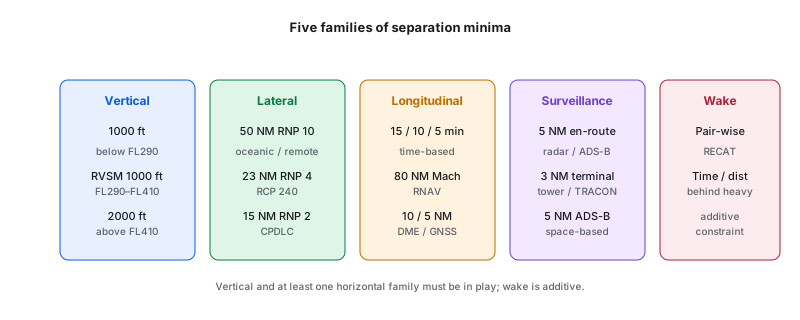
Latest Separation Minima
Definition
Separation minima are the prescribed minimum spacing values, expressed in time, distance, or vertical units, that an air traffic control (ATC) unit must keep between two controlled flights to prevent collision and to mitigate wake turbulence. They are not the targets controllers aim for; they are the floor below which the spacing must not decrease. "Latest" minima refers to the values currently in force under the sixteenth edition of PANS-ATM (Doc 4444) as amended through Amendment 12 (applicable 28 November 2024) and the regional supplements in Doc 7030.
Regulatory Basis
Annex 11, 3.4.1, requires separation minima to be selected from PANS-ATM (Doc 4444) and the Regional Supplementary Procedures (Doc 7030). Where neither covers the case, the appropriate ATS authority shall establish other minima after consultation with neighbours. Annex 2 prescribes the cruising-level tables. Doc 4444 Chapter 5 is the operational core; Chapter 6 handles aerodrome vicinity, Chapter 8 governs ATS surveillance separation.
Vertical Separation
Standard vertical separation is 300 m (1 000 ft) below FL 290 and 600 m (2 000 ft) above FL 290 in non-RVSM airspace. Within RVSM airspace, 300 m (1 000 ft) is applied between FL 290 and FL 410 inclusive between RVSM-approved aircraft. RVSM is implemented globally (NAT, EUR/SAM, AFI, MID, APAC, CAR/SAM, NAM, RUS). Non-RVSM aircraft require 600 m (2 000 ft) from other traffic; State aircraft without RVSM approval are admitted on a workload-permitting basis. Above FL 410, 600 m (2 000 ft) applies unless a regionally agreed modified table is prescribed (Annex 2, Appendix 3). Annex 11, 3.3.5.1 mandates regional height-monitoring programmes (RMA) supported by Doc 9574 to preserve the RVSM target level of safety of 5 x 10E-9 fatal accidents per flight hour.
Lateral Separation
Lateral separation may be established by geographic position reporting, by track divergence, or by area navigation (RNAV/RNP). Doc 4444, 5.4.1, lists VOR (15 deg divergence with one aircraft at or beyond 28 km / 15 NM), NDB (30 deg divergence) and dead-reckoning methods. PBN-based lateral minima introduced through Amendment 7 and refined since are 93 km (50 NM) for RNP 10 or RNP 4 oceanic/remote operations, 42.6 km (23 NM) for RNP 4 with RCP 240 / RSP 180, and 27.8 km (15 NM) for RNP 2 (or GNSS) with direct controller-pilot communications (CPDLC). In terminal airspace, 9.3 km (5 NM) lateral separation between RNP 1, RNP APCH or RNP AR APCH tracks is authorised under 5.4.1.2.
Longitudinal Separation
Procedural longitudinal separation is expressed in time (Mach number technique) or distance (distance-measuring equipment, GNSS, RNAV). Doc 4444, 5.4.2, prescribes 15 minutes between aircraft on the same track, reducible to 10 minutes when navigation aids permit frequent position fixes, and 5 minutes when both aircraft maintain a Mach number prescribed by ATC. Distance-based longitudinal minima include 150 km (80 NM) RNAV with Mach number, 93 km (50 NM) for qualifying RNP 10 routes, 19 km (10 NM) and 9.3 km (5 NM) DME/GNSS-based minima between aircraft on the same track at the same level. ADS-C ITP (in-trail procedure) climbs/descents use 28 km (15 NM) at low closing speeds. ADS-C climb-descent procedures use 27.8 km (15 NM) or 46.3 km (25 NM) depending on relative speed.
ATS Surveillance Separation
Doc 4444 Chapter 8 sets the standard ATS surveillance separation at 9.3 km (5 NM). It may be reduced to 5.6 km (3 NM) when surveillance system capability allows, and to 4.6 km (2.5 NM) on final approach between successive aircraft on the same approach track when authorised by the appropriate ATS authority and runway occupancy times permit. Within 22 km (12 NM) of antenna of certain SSR/MSSR systems, 5.6 km (3 NM) is routinely applied in approach control. Independent and dependent parallel approaches use 300 m (1 000 ft) vertical or 5.6 km (3 NM) horizontal until aircraft are established on the final approach course; closely spaced parallel runways use 2.8 km (1.5 NM) diagonal minima with NTZ monitoring. Amendment 12 (2024) clarified time-based separation (TBS) versus distance-based wake minima and updated surveillance-based provisions.
Wake Turbulence Separation
ICAO recognises four wake categories: Super (J, currently the A380), Heavy (H, MTOW >= 136 000 kg), Medium (M, 7 000 - 136 000 kg) and Light (L, <= 7 000 kg). Doc 4444 specifies distance-based minima on approach (e.g. 7.4 km / 4 NM Heavy behind Super, 9.3 km / 5 NM Heavy behind Heavy, 11.1 km / 6 NM Medium behind Heavy, 13 km / 7 NM Light behind Heavy) and time-based minima on departure (typically 2 to 3 minutes). Amendment 9 (2020) introduced an enhanced wake scheme based on seven groups (A-G), aligned with EUROCONTROL RECAT-EU. RECAT-EU splits Heavy and Medium into Upper/Lower pairs and adds Super Heavy for the A380, increasing runway throughput by roughly 5-8 per cent. RECAT-EU-PWS (pair-wise separation) further reduces selected pair minima by 0.5-1 NM. RECAT-PBN remains a developmental concept.
Regional Supplementary Procedures (Doc 7030)
Doc 7030 adapts the global minima to regional traffic and equipage. EUR/SAM applies 93 km (50 NM) lateral and longitudinal RNP 10 minima in the Canarias southern sector, Dakar Oceanic, Recife and Sal Oceanic FIRs, and 10 minutes Mach-number longitudinal over continental Africa. CAR/SAM uses 93 km (50 NM) RNP 10/RNP 4 in WATRS, with 167 km (90 NM) for non-RNP traffic between the United States/Canada/Bermuda and the CAR Region, and 20-minute longitudinal in the San Juan/Piarco/Paramaribo/Rochambeau areas. AFI mandates RVSM 300 m (1 000 ft) FL 290-FL 410 and 185 km (100 NM) lateral by default. NAT applies 23 NM, 19 NM, and 15 NM ADS-B/RNP-based longitudinal minima in NAT HLA. APAC uses 93 km (50 NM) and 50 NM/50 NM RNP 4 in designated oceanic FIRs.
External Sources
- ICAO Doc 4444, PANS-ATM, 16th Edition, Amendment 12 (28 Nov 2024).
- ICAO Doc 7030, Regional Supplementary Procedures.
- ICAO Annex 2 and Annex 11.
- ICAO Doc 9574 (RVSM) and Doc 9613 (PBN Manual).
- ICAO Circular 349 (Lateral Separation Minima).
- EUROCONTROL RECAT-EU and RECAT-EU-PWS publications.
- EASA, Assignment of ICAO Aircraft Types to RECAT-EU.
References
Annex 2, Appendix 3 — Tables of Cruising Levels (RVSM feet table, FL 290-FL 410, 1 000 ft increments).
Annex 11, §3.3.5.1 — Regional height-monitoring programmes for the 300 m (1 000 ft) RVSM minimum between FL 290 and FL 410.
Annex 11, §3.4.1 — Selection of separation minima from PANS-ATM (Doc 4444) and Regional Supplementary Procedures (Doc 7030).
Doc 4444 (PANS-ATM), Chapter 4, §4.9.1 — Wake turbulence categories (SUPER, HEAVY, MEDIUM, LIGHT) and groups A-G.
Doc 4444 (PANS-ATM), Chapter 5, §5.1 — Separation methods and minima, scope of Chapters 5, 6, 7 and 8.
Doc 4444 (PANS-ATM), Chapter 5, §5.4.1.2 — Lateral separation criteria and minima (VOR 15 deg, NDB 30 deg, GNSS, RNP-based 93/42.6/27.8 km).
Doc 4444 (PANS-ATM), Chapter 5, §5.4.2 — Longitudinal separation (time-based, DME/GNSS distance, Mach number technique, RNP, ADS-B ITP, ADS-C CDP).
Doc 4444 (PANS-ATM), Chapter 5, §5.8 — Time-based wake turbulence longitudinal separation minima for arriving and departing aircraft.
Doc 4444 (PANS-ATM), Chapter 6, §6.7.3.2.5 — 300 m (1 000 ft) vertical or 5.6 km (3.0 NM) horizontal separation on parallel/converging final approach.
Doc 4444 (PANS-ATM), Chapter 8, §8.7.3.1 — Standard 9.3 km (5.0 NM) ATS surveillance horizontal separation minimum.
Doc 4444 (PANS-ATM), Chapter 8, §8.7.3.2 — Reductions to 5.6 km (3.0 NM) and 4.6 km (2.5 NM) on final approach subject to authority approval.
Doc 4444 (PANS-ATM), Chapter 8, §8.7.3.5 — Distance-based wake turbulence surveillance minima (SUPER/HEAVY/MEDIUM/LIGHT pairs).
Doc 7030 (Regional Supplementary Procedures), AFI §4.2.1 — RVSM 300 m (1 000 ft) FL 290-FL 410 in listed AFI FIRs.
Doc 7030 (Regional Supplementary Procedures), CAR/SAM §4.2.1 — RVSM applicability in CAR/SAM FIRs (Barranquilla, Havana, Miami Oceanic, San Juan, etc.).
Doc 7030 (Regional Supplementary Procedures), CAR/SAM §6.2.1.1 — Lateral minima 93/110/167/185/223 km in WATRS, San Juan, Piarco and New York Oceanic FIRs.
Circular 349 — Guidelines for the Implementation of Lateral Separation Minima (93/42.6/27.8 km RNP-based).
Related topics
Detailed working notes on the separation minima currently in force under
ICAO PANS-ATM (Doc 4444), Annex 11, Annex 2 cruising-level tables, and
the Regional Supplementary Procedures (Doc 7030). This folder expands
the summary in topics/latest_separation_minima.md into per-aspect files
so each can be read on its own.
Files in this folder
overview.md— what separation minima are, where they live in PANS-ATM and Annex 11, and the vertical / horizontal / wake families.components.md— the full set: vertical (RVSM and non-RVSM), longitudinal (time and distance), lateral, ATS surveillance, wake turbulence (legacy four-category and RECAT).blocks.md— adapted view: the family of minima grouped as vertical, lateral, longitudinal, surveillance-based, and wake.threads.md— adapted view: cuts the same minima by surveillance medium (procedural, radar/MSSR, ADS-B, MLAT) and by wake category scheme (legacy ICAO four-category, RECAT-EU, RECAT-2, pair-wise).modules.md— anatomy of a single minimum: definition, applicability, conditions, monitoring requirements.enablers.md— surveillance, ATC tools, controller training, safety case, post-implementation monitoring.performance_objectives.md— KPAs (capacity, safety, environment), KPIs and how each minimum maps to them.timeline.md— Doc 4444 amendment history, RVSM rollout, RECAT-EU introduction, ADS-B 5 / 3 NM minima.references.md— consolidated ICAO and external references for everything in this folder.
Reading order
Start with overview.md, then components.md for the full list, then
blocks.md and threads.md for the two organising lenses. Drill into
modules.md for the anatomy of any one minimum, then enablers.md for
what must be in place to apply it. Use performance_objectives.md to
see why each minimum exists, timeline.md for amendment context, and
references.md for citations.
Source basis
Content is grounded in:
- ICAO Annex 11 (Air Traffic Services), §3.3.5 and §3.4.1.
- ICAO Annex 2 (Rules of the Air), Appendix 3 — Tables of Cruising Levels.
- ICAO Doc 4444 (PANS-ATM), 16th edition, Amendment 12 (28 Nov 2024) — Chapters 5, 6, 8.
- ICAO Doc 7030 (Regional Supplementary Procedures), AFI / EUR/SAM / CAR/SAM / NAT / APAC / MID parts.
- ICAO Doc 9574 (Manual on a 300 m / 1 000 ft Vertical Separation Minimum between FL 290 and FL 410 inclusive — RVSM Manual).
- ICAO Doc 9613 (PBN Manual).
- ICAO Doc 9426 (Air Traffic Services Planning Manual).
- ICAO Doc 9863 (Airborne Collision Avoidance System Manual — ACAS).
- ICAO Circular 349 — Guidelines for the Implementation of Lateral Separation Minima.
- EUROCONTROL RECAT-EU and RECAT-EU-PWS publications (regional fallback where local library does not carry the text).
What separation minima are
A separation minimum is the prescribed minimum spacing — expressed in time, distance, or vertical units — that an air traffic control unit must keep between two controlled flights to prevent collision and to mitigate wake turbulence. Minima are not target values; they are the floor below which spacing must not decrease. Controllers normally plan with a buffer above the minimum to absorb tactical variability.
"Latest" minima refers to the values currently in force under the 16th edition of PANS-ATM (Doc 4444) as amended through Amendment 12 (applicable 28 November 2024), supplemented by the regional values in Doc 7030 (Regional Supplementary Procedures).
Where minima live in the ICAO framework
Separation minima are distributed across a small set of documents:
- Annex 11 (Air Traffic Services), §3.4.1. Mandates that separation minima be selected from PANS-ATM and the Regional Supplementary Procedures. Where neither covers the case, the appropriate ATS authority establishes other minima after consultation with neighbours.
- Annex 2 (Rules of the Air), Appendix 3. Prescribes the cruising- level tables, including the RVSM 1 000 ft table for FL 290–FL 410.
- Doc 4444 (PANS-ATM). The operational core.
- Chapter 5 — Separation methods and minima (vertical, lateral, longitudinal, wake).
- Chapter 6 — Aerodrome vicinity separation (parallel approaches, dependent / independent / closely spaced parallel runways).
- Chapter 8 — ATS surveillance services and minima (radar / MSSR / ADS-B / MLAT-based).
- Doc 7030. Regional adaptations (oceanic / remote / continental variants).
- Doc 9574. RVSM target level of safety and height-monitoring.
- Circular 349. Guidelines for RNP-based lateral minima (93 / 42.6 / 27.8 km).
The three families
Separation minima fall into three operational families that must each be satisfied at all times:
- Vertical separation. 300 m (1 000 ft) below FL 290 and inside RVSM airspace FL 290–FL 410 between approved aircraft; 600 m (2 000 ft) otherwise above FL 290 and above FL 410.
- Horizontal separation. Lateral or longitudinal — established by procedural means, by track geometry, by RNAV/RNP performance, or by ATS surveillance.
- Wake turbulence separation. A distance- or time-based add-on applied behind heavier aircraft on approach, on departure, and in some cruise / crossing geometries.
A pair of aircraft is "separated" only when at least one family is satisfied. The controller normally chooses the most efficient applicable combination given equipage, surveillance, and the airspace.
What "latest" introduced
The most recent rounds of amendments delivered:
- Amendment 7 (2016) — first PBN-based lateral and longitudinal minima (RNP 10, RNP 4, RNP 2) generalised into Doc 4444.
- Amendment 9 (2020) — enhanced wake scheme based on seven groups (A–G) aligned with EUROCONTROL RECAT-EU.
- Amendment 12 (28 Nov 2024) — clarified time-based separation (TBS) versus distance-based wake minima, refined surveillance-based provisions, harmonised ADS-B 3 NM / 5 NM applicability, and tightened monitoring expectations.
What planners use this for
For a State, ANSP, or unit, the separation framework answers four questions per pair of flights:
- What vertical, lateral, longitudinal, surveillance, and wake minima are applicable given the route, level, equipage, and surveillance medium?
- Which is the binding minimum — i.e. which value can be reduced no further without losing separation status?
- What conditions must remain satisfied to keep that minimum (CPDLC link, ADS-B coverage, RNP monitoring and alerting, RVSM approval, wake scheme applicability)?
- What monitoring is required after implementation (RVSM RMA, ADS-B data quality, runway-throughput evidence for TBS / RECAT)?
The separation framework is not a single value; it is a structured set of interlocking components that together describe what spacing is applicable, when, why, and how it is monitored. The components, paralleling the asbu/components view, are:
1. Vertical separation
The "z-axis" floor between two flights at different levels.
- Below FL 290. 300 m (1 000 ft) globally.
- FL 290 – FL 410 (RVSM). 300 m (1 000 ft) between RVSM-approved aircraft. RVSM is now applied in all major regions (NAT, EUR/SAM, AFI, MID, APAC, CAR/SAM, NAM, RUS).
- Non-RVSM aircraft inside RVSM airspace. 600 m (2 000 ft) from other traffic; State aircraft without RVSM approval admitted on a workload-permitting basis.
- Above FL 410. 600 m (2 000 ft) unless a regionally agreed modified table is prescribed (Annex 2, Appendix 3).
- Monitoring. Annex 11 §3.3.5.1 requires regional height-monitoring programmes (RMAs); Doc 9574 sets the target level of safety at 5 x 10E-9 fatal accidents per flight hour (vertical only).
2. Lateral separation
Spacing across the cross-track axis. Doc 4444 §5.4.1 lists:
- VOR. 15 deg track divergence with one aircraft at or beyond 28 km (15 NM) from the VOR.
- NDB. 30 deg track divergence with comparable distance criteria.
- Dead-reckoning with specified angles and reporting points.
- PBN-based (RNAV/RNP). Three principal values — 93 km (50 NM) for RNP 10 / RNP 4 oceanic and remote; 42.6 km (23 NM) for RNP 4 with RCP 240 / RSP 180; 27.8 km (15 NM) for RNP 2 (or GNSS) with direct CPDLC.
- Terminal RNP. 9.3 km (5 NM) lateral between RNP 1, RNP APCH, or RNP AR APCH tracks under §5.4.1.2.
3. Longitudinal separation
Spacing along-track. Two sub-families.
Time-based
- 15 minutes between aircraft on the same track.
- 10 minutes with frequent navigation aid fixes.
- 5 minutes with assigned Mach number technique on the same track at the same level.
Distance-based
- 150 km (80 NM) RNAV with Mach number technique.
- 93 km (50 NM) for qualifying RNP 10 routes.
- 19 km (10 NM) and 9.3 km (5 NM) DME / GNSS-based on the same track at the same level.
- ADS-C ITP climbs / descents — 28 km (15 NM) at low closing speeds.
- ADS-C climb-descent procedures — 27.8 km (15 NM) or 46.3 km (25 NM) by relative speed.
4. ATS surveillance separation
Doc 4444 Chapter 8.
- Standard — 9.3 km (5 NM).
- Reduced (system-capability-permitting) — 5.6 km (3 NM).
- Final approach — 4.6 km (2.5 NM) between successive aircraft on the same approach track when authorised and runway occupancy permits.
- SSR/MSSR within 22 km (12 NM) of antenna — 5.6 km (3 NM) routinely applied in approach control.
- Parallel approaches — 300 m (1 000 ft) vertical or 5.6 km (3 NM) horizontal until aircraft are established on final.
- Closely spaced parallel runways — 2.8 km (1.5 NM) diagonal with NTZ monitoring.
- Time-based separation (TBS). Headwind-compensated arrival spacing on final, clarified by Amendment 12 (2024).
5. Wake turbulence separation
Two parallel schemes are recognised.
Legacy ICAO four-category
- Super (J) — currently the A380.
- Heavy (H) — MTOW >= 136 000 kg.
- Medium (M) — 7 000 – 136 000 kg.
- Light (L) — <= 7 000 kg.
Distance-based examples on approach: 7.4 km (4 NM) Heavy behind Super, 9.3 km (5 NM) Heavy behind Heavy, 11.1 km (6 NM) Medium behind Heavy, 13 km (7 NM) Light behind Heavy. Departure values typically 2 to 3 minutes.
RECAT family (seven groups A–G)
Introduced into Doc 4444 by Amendment 9 (2020), aligned with EUROCONTROL RECAT-EU. Splits Heavy and Medium into Upper/Lower pairs and adds a Super Heavy band for the A380. Yields ~5–8 % runway throughput uplift. RECAT-EU-PWS (pair-wise) further trims selected pair minima by 0.5–1 NM. RECAT-PBN is developmental.
6. Regional supplements
Doc 7030 layers regional values on top.
- EUR/SAM — 93 km (50 NM) lateral and longitudinal RNP 10 in named oceanic FIRs; 10-minute Mach over continental Africa.
- CAR/SAM — 93 km (50 NM) RNP 10/RNP 4 in WATRS; 167 km (90 NM) for non-RNP traffic between US/Canada/Bermuda and the CAR Region; 20-minute longitudinal in San Juan / Piarco / Paramaribo / Rochambeau.
- AFI — RVSM FL 290–FL 410; 185 km (100 NM) lateral default.
- NAT — 23 / 19 / 15 NM ADS-B / RNP-based longitudinal in NAT HLA.
- APAC — 93 km (50 NM) and 50 NM/50 NM RNP 4 in designated oceanic FIRs.
7. Conditions and equipage
Each minimum carries explicit applicability conditions: aircraft approval (RVSM, RNP 10, RNP 4, RNP 2, ADS-B, ADS-C), communication performance (RCP 240, direct controller-pilot communications, CPDLC, voice direct), surveillance performance (RSP 180), and ATC system capability (alerting, conformance monitoring, MTCD).
8. Monitoring and safety case
Every reduced minimum requires a documented safety case under Annex 19 SMS, plus post-implementation monitoring: height-keeping (RVSM RMA), horizontal navigation accuracy and integrity (RNP monitoring), surveillance data quality (ADS-B DO-260B), and runway throughput / wake encounter evidence (RECAT, TBS).
This file adapts the "blocks" lens used in the ASBU detailed reference to separation minima. Here, a block is one of the five families of minima that must each be considered for any pair of flights. At least one family must be satisfied at all times.
The five families
Show data
| Spec | Minimum lateral (NM) |
|---|---|
| RNP 10 oceanic | 50 |
| RNP 4 + RCP240 | 23 |
| RNP 2 + CPDLC | 15 |
| Terminal RNP 1/APCH | 5 |
| Family | Axis / Means | Source |
|---|---|---|
| Vertical | Altitude / flight level | Doc 4444 §5.3, Annex 2 App. 3 |
| Lateral | Cross-track distance / angle | Doc 4444 §5.4.1, Circular 349 |
| Longitudinal | Along-track time or distance | Doc 4444 §5.4.2 |
| Surveillance-based | Radar / MSSR / ADS-B / MLAT range | Doc 4444 Chapter 8 |
| Wake turbulence | Category-pair-specific spacing | Doc 4444 §4.9 / §5.8 / Chapter 8 |
Each family has its own conditions, equipage requirements, and monitoring obligations. They are not alternatives in the procurement sense: vertical and at least one horizontal family must always be in play, and wake is an additive constraint where applicable.
Family 1 — Vertical
Theme. Use of altitude separation; the cheapest and most universal form. Floor values:
- 300 m (1 000 ft) below FL 290.
- 300 m (1 000 ft) FL 290 – FL 410 inside RVSM between RVSM-approved aircraft.
- 600 m (2 000 ft) FL 290 – FL 410 if either aircraft is non-RVSM, and generally above FL 410 (Annex 2 App. 3, regional variants).
Representative provisions. Annex 11 §3.3.5.1 (RMA and the RVSM target level of safety); Annex 2 App. 3 (level tables); Doc 9574 (the RVSM Manual).
Family 2 — Lateral
Theme. Geographic offset across track. Two sub-families.
- Conventional / procedural. VOR 15 deg with one aircraft >= 28 km (15 NM); NDB 30 deg; dead-reckoning angles.
- PBN-based. 93 km (50 NM) RNP 10 or RNP 4; 42.6 km (23 NM) RNP 4 with RCP 240 / RSP 180; 27.8 km (15 NM) RNP 2 with direct CPDLC.
- Terminal RNP. 9.3 km (5 NM) between RNP 1 / RNP APCH / RNP AR tracks (§5.4.1.2).
Lateral minima are the principal lever for oceanic and remote airspace where surveillance is unavailable or expensive.
Family 3 — Longitudinal
Theme. Spacing along the same track or converging tracks.
- Time-based. 15 / 10 / 5 minutes (Mach number technique).
- Distance-based RNAV. 150 km (80 NM) with Mach number technique.
- Distance-based RNP. 93 km (50 NM) RNP 10.
- DME / GNSS. 19 km (10 NM) and 9.3 km (5 NM) on same track at same level.
- ADS-C ITP and CDP. 28 km (15 NM) ITP, 27.8 km (15 NM) or 46.3 km (25 NM) CDP depending on closing speed.
The "latest" longitudinal step is the migration of oceanic 80 NM / 10 minutes to 50 NM / 23 NM / 19 NM / 15 NM as performance (RNP, ADS-B / ADS-C, CPDLC) is provisioned.
Family 4 — Surveillance-based
Theme. Use of cooperative surveillance to bring spacing well below procedural values.
- Standard. 9.3 km (5 NM).
- Reduced (system-permitting). 5.6 km (3 NM).
- Final approach. 4.6 km (2.5 NM) on a single runway when authorised.
- Parallel approaches. 300 m (1 000 ft) vertical or 5.6 km (3 NM) horizontal until established on final.
- Closely spaced parallels. 2.8 km (1.5 NM) diagonal with NTZ monitoring.
- TBS. Time-based final-approach spacing under headwind, harmonised by Amendment 12.
Source: Doc 4444 Chapter 8 (and Chapter 6 for the parallel-runway and final-approach geometries).
Family 5 — Wake turbulence
Theme. Additive spacing behind heavier aircraft on approach, on departure, and in selected en-route geometries.
- Legacy ICAO four-category (Super / Heavy / Medium / Light) — distance-based on approach (4 / 5 / 6 / 7 NM behind Heavy or Super pairs) and time-based on departure (typically 2 / 3 minutes).
- RECAT seven-group (A–G) — Amendment 9 (2020), aligned with EUROCONTROL RECAT-EU; splits Heavy/Medium into Upper/Lower; ~5–8 % runway uplift.
- RECAT-EU-PWS — pair-wise refinement, 0.5–1 NM trim on selected pairs.
- RECAT-PBN — developmental concept linking RNP guidance to pair-wise wake minima.
Combination principle
For any pair of flights, the controller asserts separation when one of the following holds, and the wake constraint (where applicable) is also satisfied:
- Vertical met (cheapest, always preferred where geometry permits).
- Lateral met (oceanic / remote default).
- Longitudinal met (same track / converging tracks).
- Surveillance-based horizontal met (continental / TMA default).
Loss of any condition (e.g. RVSM approval lapses, ADS-B coverage gap, controller assigning a non-RNP route) immediately voids the associated minimum, and the controller must establish another family or revert to the next-larger minimum that still applies.
This file adapts the "threads" lens to separation minima. Two orthogonal cuts are useful: by surveillance medium (which fixes the horizontal minimum that is admissible) and by wake category scheme (which fixes the additive wake constraint behind heavier aircraft).
Thread family A — by surveillance medium
The surveillance medium determines what horizontal minimum can be applied at all and how much it can be reduced.
A1 — Procedural (no ATS surveillance)
Used in oceanic and remote airspace where radar / ADS-B is absent. Spacing is asserted from pilot position reports, time / distance calculations, and (more recently) RNP / ADS-C / CPDLC performance.
- Lateral: 93 km (50 NM) RNP 10 / RNP 4; 42.6 km (23 NM) RNP 4 with RCP 240 / RSP 180; 27.8 km (15 NM) RNP 2 with direct CPDLC.
- Longitudinal: 15 / 10 / 5 minutes; 80 / 50 NM with Mach; 27.8 / 46.3 km ADS-C CDP; 28 km ADS-C ITP.
A2 — Primary / Secondary radar (PSR / SSR / MSSR)
Doc 4444 Chapter 8.
- Standard 9.3 km (5 NM).
- Reduced 5.6 km (3 NM) where the surveillance system performance and controller workload permit (e.g. within 22 km / 12 NM of a qualified SSR/MSSR antenna in approach control).
- 4.6 km (2.5 NM) final-approach reduction subject to authority approval and runway-occupancy evidence.
A3 — ADS-B (1090 ES)
Cooperative surveillance derived from on-board GNSS. Once the data quality (NUC/NIC/NACp/SIL/SDA per DO-260B) and ground processing meet the criteria, ADS-B supports the same 5 NM and 3 NM minima as radar under Doc 4444 Chapter 8.
- Continental: 9.3 km (5 NM) and 5.6 km (3 NM) where authorised.
- Remote / oceanic ADS-B (e.g. NAT, Australian Indian Ocean): reduced longitudinal minima down to 23 / 19 / 15 NM in NAT HLA, combined with RNP 4 and CPDLC.
A4 — Multilateration (MLAT / WAM)
Wide-area multilateration replicates SSR/MSSR-type performance and admits the same minima where its performance is certified, including 3 NM in approach control and aerodrome-vicinity minima at airports served by surface MLAT.
A5 — Space-based ADS-B
Constellation-derived ADS-B (Aireon and similar). Treated as ADS-B for minima purposes when latency and integrity are validated; supports minima reductions in oceanic regions previously limited to procedural values (notably NAT track structure rationalisation).
Thread family B — by wake category scheme
The wake constraint stacks on top of whichever horizontal family is in play. Four schemes coexist.
B1 — Legacy ICAO four-category (Super / Heavy / Medium / Light)
- Super (J). A380.
- Heavy (H). MTOW >= 136 000 kg.
- Medium (M). 7 000 – 136 000 kg.
- Light (L). <= 7 000 kg.
Distance-based on approach: 7.4 km (4 NM) Heavy behind Super, 9.3 km (5 NM) Heavy behind Heavy, 11.1 km (6 NM) Medium behind Heavy, 13 km (7 NM) Light behind Heavy. Departure: 2 / 3 minutes.
Default scheme worldwide. Several States and many smaller airports continue to use it where RECAT is not yet implemented.
B2 — RECAT-EU (six categories Super Heavy / Upper Heavy / Lower
Heavy / Upper Medium / Lower Medium / Light)
EUROCONTROL scheme deployed in Europe and adapted by the US FAA as "RECAT-1.5". Splits the legacy Heavy and Medium bands by mass and span to give finer-grained, evidence-based pairs. Typical runway-throughput uplift 5–8 %.
B3 — RECAT-2 / Doc 4444 seven-group (A–G)
Amendment 9 (2020) introduced the seven-group scheme A–G into Doc 4444, aligned with the European RECAT-2 work. Categories are:
- A — Super Heavy.
- B — Upper Heavy.
- C — Lower Heavy.
- D — Upper Medium.
- E — Lower Medium.
- F — Light upper.
- G — Light lower.
Pair-specific minima are tabulated in Doc 4444 §5.8 (time, departure) and Chapter 8 (distance, approach, surveillance-based).
B4 — RECAT-EU-PWS (Pair-Wise Separation)
Each ICAO type pair carries its own wake minimum derived from type-specific wake characterisation. Operationally implemented at major European hubs (e.g. Paris CDG, London Heathrow). Trims 0.5–1 NM beyond RECAT-EU on selected pairs without a runway throughput trade-off.
B5 — RECAT-PBN (developmental)
Concept tying RNP guidance accuracy to pair-wise minima — particularly for crossing and converging operations and for offset / curved approaches. Not yet generalised in Doc 4444.
Cross-thread dependencies
- 3 NM and 2.5 NM minima depend on certified surveillance performance plus runway-occupancy evidence. They cannot be applied on ADS-B alone in marginal coverage.
- RNP 2 / 15 NM longitudinal depends on direct CPDLC or equivalent voice connectivity plus RNP 2 approval and monitoring.
- RECAT and PWS depend on a wake-encounter monitoring programme, controller training, fleet mix data feeds, and an updated SMS safety case.
- TBS depends on a high-integrity wind-data feed to the arrival manager and a tool that resolves wake minima to time on final.
What a "module" is here
In ASBU usage a module is the smallest plannable unit of capability. Adapted to separation minima, a module is a single named minimum value — for example, "5 NM ATS surveillance separation", "50 NM RNP 10 lateral", or "RECAT pair Heavy-behind-Super at 4 NM". Each such minimum is an operationally distinct deliverable: a State or unit can decide to apply it, write a procedure for it, train for it, safety-case it, and monitor it.
Anatomy of a separation minimum
Every minimum in Doc 4444 carries a regular structure. Documenting it in this form makes implementation and oversight tractable.
1. Identifier
A short label that the local procedures and training material will use:
e.g. LAT-RNP10-50NM, LON-RNP4-23NM, SURV-3NM, WAKE-RECAT-B-A.
The identifier is a local convention; the authoritative reference is
the paragraph number in Doc 4444 (or Doc 7030 for the regional version).
2. Definition
The plain-language statement: which axis (vertical / lateral / longitudinal / surveillance / wake), what value, what unit. For example, "50 NM lateral separation between two aircraft on parallel RNP 4 tracks at the same level".
3. Applicability
Where and when the minimum is allowed:
- Airspace volume (FIR, sector, oceanic / continental, terminal / en route).
- Flight phase (cruise, descent, approach, departure, missed approach).
- Aircraft pair eligibility (RVSM-approved, RNP 10/4/2 approved, ADS-B Out / DO-260B compliant, RECAT category).
- Time-of-day or runway configuration (for parallel-approach and closely spaced runway minima).
4. Conditions
Continuous prerequisites that must remain true:
- Surveillance medium and performance (e.g. SSR/MSSR within 22 km / 12 NM, ADS-B with stated NIC/NAC/SIL).
- Communication performance (e.g. CPDLC RCP 240 with surveillance performance RSP 180 for 23 NM lateral).
- Track geometry (e.g. one aircraft >= 28 km / 15 NM from VOR for the 15-degree procedural lateral).
- Wind / runway occupancy (for 2.5 NM final-approach reduction and TBS).
5. Reference
The authoritative paragraph:
- Vertical baseline — Doc 4444 §5.3 and Annex 2 App. 3.
- Lateral procedural — Doc 4444 §5.4.1.
- Lateral PBN — Doc 4444 §5.4.1.2 and Circular 349.
- Longitudinal — Doc 4444 §5.4.2.
- ATS surveillance — Doc 4444 Chapter 8 (§8.7.3).
- Aerodrome vicinity — Doc 4444 Chapter 6 (§6.7.3).
- Wake — Doc 4444 §4.9 (categories) and §5.8 (time-based minima).
- Regional — Doc 7030 part for the FIR concerned.
6. Equipage / approval
What the operator has to bring:
- RVSM approval (Doc 9574).
- RNP approval per Doc 9613 (RNP 10, RNP 4, RNP 2, RNP 1, RNP APCH, RNP AR APCH).
- ADS-B Out (DO-260B) and / or ADS-C contracts.
- CPDLC FANS-1/A or ATN B1/B2 with required RCP/RSP performance.
- Wake category certification per the published RECAT mapping.
7. Controller training and tools
- Procedure-specific syllabi (oceanic transition through CPDLC, RNP separation, TBS / RECAT, parallel approaches with NTZ).
- ATC system functions (MTCD, conformance monitoring, RNP/CPDLC status, ADS-B quality flags, NTZ alerts, wake separation indicator).
8. Safety case
Annex 19 SMS deliverable. Demonstrates the target level of safety is preserved when the new minimum is introduced. Cites assumptions (surveillance update rate, RNP containment, fleet mix, controller workload).
9. Monitoring
Post-implementation evidence that conditions and assumptions hold:
- Vertical — RMA height-monitoring (Doc 9574), TLS 5 x 10E-9.
- RNP — navigation accuracy and integrity sampling.
- ADS-B — DO-260B quality indicators, latency, drop-out rate.
- Wake — wake-encounter reports, RECAT and PWS validation evidence.
- Runway throughput — for TBS and pair-wise schemes.
10. Coordination
Bilateral letters of agreement with neighbouring FIRs, regional endorsement (APANPIRG, MIDANPIRG, EANPG, NAT SPG), AIP publication of any State-specific provisions.
Worked examples
Example 1 — SURV-3NM (3 NM ATS surveillance separation)
- Definition: 5.6 km (3 NM) horizontal separation under ATS surveillance.
- Applicability: terminal / approach airspace where the surveillance medium and ATC system are certified for 3 NM; outside the wake- turbulence "behind heavier" cases that demand a larger value.
- Conditions: SSR/MSSR / ADS-B / MLAT performance; controller training; display update rate.
- Reference: Doc 4444 §8.7.3.2 and the local AIP ENR section.
Example 2 — LAT-RNP4-23NM
- Definition: 23 NM lateral between RNP 4 tracks.
- Applicability: oceanic / remote with RCP 240 / RSP 180.
- Conditions: both aircraft RNP 4 approved; CPDLC operating; ADS-C contract active.
- Reference: Doc 4444 §5.4.1.2; Circular 349.
Example 3 — WAKE-RECAT-Cat-pair-B-behind-A
- Definition: distance / time pair from the seven-group RECAT table.
- Applicability: aerodromes that have implemented Doc 4444 Amendment 9 wake scheme.
- Conditions: published RECAT category for both types; ATC tool that resolves the pair on final / departure.
- Reference: Doc 4444 §4.9 (categories) and §5.8 (table).
What an enabler is
An enabler is a supporting element without which a separation minimum cannot be safely applied. Enablers are not minima themselves; they are prerequisites. Annex 11 §3.4.1 lets a State select minima from PANS-ATM and Doc 7030, but the State remains responsible for ensuring that the underlying enablers are in place and remain so. The categories below mirror the asbu/enablers structure.
1. Surveillance infrastructure
The horizontal minimum that may be applied is bounded by the surveillance available.
- Primary radar (PSR). Coverage for non-cooperative tracking.
- Secondary radar (SSR / Mode S / MSSR). Cooperative surveillance, altitude reporting, Mode S enhanced surveillance downlinked aircraft parameters (DAPs).
- ADS-B (1090 ES) Out. Cooperative surveillance based on on-board GNSS; DO-260B quality indicators (NIC / NACp / SIL / SDA).
- ADS-C. Periodic / event contracts in oceanic / remote regions; feeds 23 NM, 19 NM, 15 NM longitudinal/lateral minima with CPDLC.
- Multilateration (MLAT / WAM). Surface and en-route multilateration for airports and remote regions.
- Space-based ADS-B. Constellation-based feed for oceanic / polar.
- Update rate, latency, integrity. The minimum applicable is a function of these parameters, not just of the medium label.
2. Communications
- VHF voice direct controller-pilot communications (DCPC). Required baseline for terminal and continental.
- HF voice. Backbone of legacy oceanic; degraded performance drives larger minima.
- CPDLC FANS-1/A and ATN B1 / B2. Enables RCP 240 and 23 / 19 / 15 NM oceanic minima when paired with RNP 4 / RNP 2 and ADS-C.
- Satcom voice and data. Required where HF / VHF do not reach.
- RCP / RSP performance. Doc 9869 RCP and RSP specifications fix the communication and surveillance performance against which a minimum is justified.
3. Navigation performance and approval
- RVSM approval (Doc 9574). Aircraft and operator approval to use 300 m (1 000 ft) FL 290–FL 410.
- PBN approvals (Doc 9613). RNP 10 (oceanic), RNP 4 (oceanic / remote), RNP 2 (oceanic / remote and continental), RNP 1 (terminal), RNP APCH, RNP AR APCH.
- GNSS receiver capability. Multi-constellation, multi-frequency where the lateral / longitudinal minima depend on it.
- Conventional aids retained. VOR / DME backbone where procedural lateral minima still apply.
4. ATC tools
The controller cannot keep the minimum without supporting tools.
- Conformance monitoring against assigned route, level, speed, Mach.
- Medium-Term Conflict Detection (MTCD). Predictive separation alerting based on the planned trajectory.
- STCA / MSAW / APW. Reactive ground-based safety nets (Doc 4444 §15 and SNET specifications).
- Wake separation indicator. Resolves the applicable wake pair (legacy or RECAT) on the controller's display.
- TBS tool. Headwind-compensated arrival spacing on final.
- NTZ alert. For closely spaced parallel approaches.
- CPDLC operational system. Including uplink response monitoring.
5. Procedures and standards
- Annex 11 (Air Traffic Services). §3.3.5 (vertical), §3.4.1 (selection of minima).
- Annex 2 (Rules of the Air). Appendix 3 cruising-level tables.
- Annex 10 (CNS). Vols I–V for the underlying CNS standards.
- Annex 19 (SMS). Required SMS for service providers and States introducing reduced minima.
- Doc 4444 (PANS-ATM). Operational procedures.
- Doc 7030 (Regional Supplementary Procedures). Regional adaptations.
- Doc 9426 (ATS Planning Manual). Capacity and airspace planning basis for choosing the right minimum for the traffic.
- Doc 9574, Doc 9613, Doc 9869, Doc 9863 (ACAS). Underlying performance manuals.
6. Controller training and licensing
- Endorsements: oceanic (CPDLC, ADS-C, RNP-based minima), continental (3 NM and 5 NM, TBS, RECAT, parallel approaches), aerodrome-vicinity (NTZ, dependent and independent parallels, closely spaced parallels).
- Conversion training when migrating from legacy four-category wake to RECAT seven-group.
- Refresher cycle linked to procedure changes (e.g. Amendment 12 of Doc 4444).
- Human-factors design — controller workload assessment for any reduction.
7. Safety case and post-implementation monitoring
- Safety case (Annex 19). Pre-implementation argument that the introduction of a reduced minimum preserves the target level of safety, with traceable assumptions.
- Height-keeping monitoring. RMAs (e.g. EUR RMA, APAC AAMA, AFI ARMA, MID MIDRMA) measure RVSM TVE.
- RNP monitoring. Lateral deviation and containment statistics for PBN-based lateral / longitudinal minima.
- ADS-B data quality monitoring. DO-260B compliance, message rate, integrity flags.
- Wake encounter reporting. Standing system to capture and assess wake encounters following RECAT / PWS introduction.
- Runway throughput evidence. Validates the predicted capacity uplift from RECAT, PWS, TBS.
8. Institutional and inter-State
- Bilateral letters of agreement between adjacent ATS units fixing applicable minima at FIR boundaries and the conditions under which they apply.
- Regional planning fora (APANPIRG, MIDANPIRG, EANPG, GREPECAS, NAT SPG) endorsing harmonised regional values into Doc 7030.
- Memoranda of understanding for ADS-B / ADS-C / CPDLC service exchange (e.g. NAT data link mandate; APAC ADS-B sharing).
- Notification through AIP and AIC of the local minima actually applied, including any State-specific tighter values.
The performance lens
Separation minima exist to balance two objectives that pull in opposite directions. They must be small enough to deliver capacity and flight efficiency, and large enough to preserve the target level of safety. Every reduction in a minimum is a performance trade. The same KPA / KPI machinery that ASBU uses for modules applies here, anchored in Doc 9854 (Global ATM Operational Concept) and Doc 9883 (Manual on Global Performance of the Air Navigation System).
The chain:
KPA --(measured by)--> KPI <--(targeted by)-- Performance Objective --(achieved by)--> separation minimum
Primary KPAs touched by separation minima
- Safety. Target level of safety for vertical (RVSM TLS at 5 x 10E-9 fatal accidents per flight hour); collision risk envelope for horizontal; wake-encounter risk for wake minima.
- Capacity. Runway, sector, and route throughput. The largest single lever for runway capacity at busy airports is the wake minimum; for sector capacity it is the horizontal en-route minimum.
- Flight efficiency. Smaller minima permit more direct routings, tighter level changes, and faster descent profiles.
- Environmental impact. Fuel and CO2 per flight track changes in minima via routing, level optimisation, and CDO conformance.
- Predictability. Variance between planned and actual times of arrival shrinks when sector and runway throughput become more stable.
- Cost-effectiveness. Lower unit costs of ANS service follow from higher throughput per controller and per sector.
- Interoperability. Common minima across FIR boundaries reduce coordination cost and enable seamless flow.
Performance objectives
Illustrative, in the GANP Portal style:
- PO — Increase runway throughput at high-density airports. Delivered by RECAT, RECAT-EU-PWS, TBS, and 2.5 NM final-approach reduction. Measured by movements per hour, mean / 95th-percentile in-trail spacing on final, runway occupancy time.
- PO — Increase sector capacity in continental en-route. Delivered by 5 NM and 3 NM ATS surveillance separation, free route airspace using the same minima, MTCD-based conflict resolution. Measured by sustained sector throughput, instantaneous traffic count, peak-rate adherence.
- PO — Increase oceanic capacity and flight efficiency. Delivered by 50 / 23 / 19 / 15 NM RNP/ADS-C/CPDLC minima, RVSM, ITP / CDP. Measured by track-mile efficiency (KEA), level adherence to optimum, fuel burn per flight.
- PO — Reduce wake-encounter rate per movement. Delivered by sound RECAT category assignment, wake-encounter monitoring, controller tooling. Measured by encounters per million movements, severity-weighted encounter rate.
- PO — Preserve the RVSM target level of safety. Delivered by RVSM approval, RMA monitoring (Doc 9574), height-keeping performance reporting. Measured by total vertical error (TVE) distribution, large height deviation (LHD) rate.
KPIs by family
Safety KPIs
- RVSM total vertical error (TVE) distribution; LHD rate per flight hour.
- Loss-of-separation events per flight hour (continental, oceanic).
- Wake-encounter rate per movement; severity classification.
- Runway-incursion severity-weighted rate (intersects with surface separation).
Capacity KPIs
- Runway movements per hour, declared capacity vs. peak achieved.
- Sustained sector throughput; instantaneous traffic count limits.
- ATFM regulation rate / minutes of ATFM delay per flight (improves when minima allow more capacity to be declared).
Flight efficiency KPIs
- KEP / KEA flight-efficiency indicators (planned and actual vs. great-circle).
- Vertical efficiency — cruise altitude vs. optimum; level-change count under reduced longitudinal minima.
- Track-mile efficiency on oceanic structured tracks vs. user-preferred.
Predictability KPIs
- Variance / standard deviation of actual vs. planned landing time; off-block punctuality.
- TBS / RECAT in-trail spacing variance on final.
Environmental KPIs
- Fuel burn / CO2 per flight (segment and total).
- CDO conformance rate, excess fuel per arrival.
- Noise contour exposure at airports (PWS / RECAT change marginally).
Interoperability KPIs
- Number of FIR boundaries with harmonised minima.
- Bilateral LoAs in force for cross-FIR ADS-B / CPDLC / RNP / RVSM.
How performance is reported
- Globally. ICAO ASBU implementation monitoring; Doc 9883 KPI catalogue; State letters and audits (USOAP).
- Regionally.
- APAC — APANPIRG; APAC Seamless ATM Plan KPI annex.
- MID — MIDANPIRG.
- EUR — EUROCONTROL Performance Review Body, LSSIP cycle.
- NAT — NAT SPG; NAT Operations Bulletins.
- CAR/SAM — GREPECAS.
- Nationally. State Action Plans (environment), State Safety Programme reports, ANSP performance plans.
Why this matters for planning
Tying every minimum to a Performance Objective and a KPI keeps the trade explicit. A 0.5 NM reduction in a wake pair is justified only when the encounter-rate KPI stays inside its target and the throughput KPI improves measurably. A 1 000 ft RVSM is justified only while the TVE distribution and LHD rate remain within Doc 9574 limits. This is also why business cases for new tooling (TBS, RECAT, RNP-based minima) must come with a monitoring plan, not just a procurement specification.
Three timelines to keep distinct
When discussing separation minima dates, separate three threads:
- Doc 4444 amendment timeline — when the global PANS-ATM text actually changed.
- Implementation timeline — when each minimum was rolled out region-by-region (RVSM, ADS-B 5 / 3 NM, RECAT-EU, oceanic 23 NM).
- State applicability timeline — when a State / FIR adopted the minimum locally via Doc 7030 and AIP.
Mixing them up leads to false claims that an airspace is "behind" or "ahead". The only meaningful measure is the State's published AIP against the global text in force.
Doc 4444 amendment timeline (selected)
| Edition / Amendment | Year applicable | What it did for minima |
|---|---|---|
| Doc 4444, 14th ed. | 2001 | Consolidated PANS-ATM after Doc 4444-RAC and Doc 4444-OPS merger. |
| 15th ed., Amdt 1–3 | 2007–2012 | Introduced ADS-B-based 5 NM minima; refined RVSM provisions. |
| 15th ed., Amdt 4–6 | 2014–2016 | Tightened CPDLC procedures; first PBN-based oceanic minima. |
| 16th ed. | 2016 | Major restructure of separation chapters; Chapter 5 (separation methods and minima), Chapter 6 (aerodrome vicinity), Chapter 8 (ATS surveillance) take their current form. |
| 16th ed., Amdt 7 | 2016 | Generalised RNP-based lateral and longitudinal minima (50 / 23 / 15 NM). |
| 16th ed., Amdt 8 | 2018 | Refinements to surveillance-based minima; CPDLC consolidation. |
| 16th ed., Amdt 9 | 2020 | Seven-group wake scheme A–G introduced, aligned with EUROCONTROL RECAT-EU. |
| 16th ed., Amdt 10–11 | 2020–2022 | Updated ADS-C, ITP, CDP minima; refined parallel-approach provisions. |
| 16th ed., Amdt 12 | 28 Nov 2024 | Clarified time-based separation (TBS) versus distance-based wake; updated surveillance-based provisions; tightened monitoring expectations. |
Key inflection points: 2016 (16th edition / Amdt 7 — PBN minima generalised), 2020 (Amdt 9 — RECAT seven-group), and 2024 (Amdt 12 — TBS / wake clarification).
RVSM rollout timeline
The 1 000 ft vertical minimum FL 290–FL 410 was introduced by region.
1997  NAT MNPS — first RVSM application (NAT FL 330–FL 370 trial, then full).
2001  NAT full RVSM FL 290–FL 410.
2002  WATRS (CAR/SAM oceanic).
2002  EUR — January 2002.
2003  Australia, NZ, Tasman Sea.
2003  Pacific (PAC) — February 2003.
2005  US / Canada / Mexico (DRVSM) — January 2005.
2005  South America (SAM).
2008  AFI — September 2008.
2011  MID — November 2011.
2011  Russia / CIS — November 2011.
Today RVSM is applied globally, with the residual category being non-RVSM (notably some State and military aircraft) absorbed via 2 000 ft buffers and specific procedures.
RECAT-EU and Doc 4444 wake timeline
2006  ICAO accepts the A380 "Super" category, additional 2 NM behind for Heavy / Medium / Light.
2012  EUROCONTROL RECAT-EU concept published.
2015  Paris CDG operational RECAT-EU implementation.
2016  London Heathrow operational RECAT-EU.
2018  US FAA RECAT-1.5 phase-1 deployments.
2020  ICAO Doc 4444 Amendment 9 — seven-group A–G scheme.
2020+ EUR airports rolling RECAT-EU and PWS into operations.
2022+ RECAT-EU-PWS — pair-wise schemes operational at major hubs.
RECAT-PBN, the concept of tying wake minima to RNP guidance for crossing / converging operations, remains research-stage as of 2026.
ADS-B and 5 / 3 NM minima timeline
2009  Australia ADS-B 5 NM en-route (continental).
2010+ ADS-B 5 NM continental in selected EUR / NAM States.
2014  Doc 4444 generalises ADS-B as an admissible surveillance medium for 5 / 3 NM.
2016  Doc 4444 16th ed. — surveillance Chapter 8 in current form.
2019  Iridium NEXT space-based ADS-B operational over NAT (Aireon).
2019+ NAT 14 / 15 / 17 NM trials transitioning to 23 / 19 NM RNP-based minima.
2020+ Continental 3 NM ADS-B applications expand in TMA.
Other relevant ICAO documents and dates
- Doc 9574 (RVSM Manual). 1st edition 1995; 3rd edition 2002 with the global TLS framework. Periodically updated.
- Doc 9613 (PBN Manual). 4th edition 2013; subsequent revisions carry the RNP specifications used for 50 / 23 / 15 NM minima.
- Circular 349 — Lateral Separation Minima. First issued 2017, consolidating 50 / 23 / 15 NM rationale.
- Doc 9426 (ATS Planning Manual). Older publication, reissued, the reference for matching minima to airspace and traffic profile.
- Doc 9863 (ACAS Manual). ACAS / ACAS X evolution interacts with reduced minima through nuisance-alert rates.
How to read a date in a separation document
- "Amendment 12 (28 November 2024)" — the global text changed on that date; applicability per State follows.
- "RVSM in MID from November 2011" — implementation date for that region.
- "RECAT-EU at CDG in 2015" — local introduction at one airport.
- "Doc 9574 third edition" — supporting manual edition.
- "Circular 349" — non-mandatory guidance, but the explanatory backbone for the 50 / 23 / 15 NM lateral suite.
Primary ICAO documents
- Annex 11 — Air Traffic Services. §3.3.5 (regional height-monitoring programme for 300 m / 1 000 ft RVSM) and §3.4.1 (selection of separation minima from PANS-ATM and Regional Supplementary Procedures).
- Annex 2 — Rules of the Air. Appendix 3 — Tables of Cruising Levels (RVSM table FL 290–FL 410 in 1 000 ft increments, and the conventional table elsewhere).
- Doc 4444 — PANS-ATM, 16th edition, Amendment 12 (28 Nov 2024).
- Chapter 4, §4.9 — wake turbulence categories (Super / Heavy / Medium / Light) and the seven-group A–G scheme.
- Chapter 5, §5.1 — scope; §5.3 — vertical separation; §5.4.1 — lateral; §5.4.2 — longitudinal; §5.8 — time-based wake longitudinal minima.
- Chapter 6, §6.7.3 — aerodrome-vicinity separation, including parallel-approach provisions.
- Chapter 8, §8.7.3 — ATS surveillance separation (5 NM standard, 3 NM reduced, 2.5 NM on final approach).
- Doc 7030 — Regional Supplementary Procedures. AFI, EUR/SAM, CAR/SAM, NAT, APAC, MID parts. Carries the regional 50 / 23 / 19 / 15 NM values, RVSM applicability statements, and AFI 100 NM lateral default.
- Doc 9574 — Manual on a 300 m / 1 000 ft Vertical Separation Minimum between FL 290 and FL 410 inclusive (RVSM Manual). Target level of safety, RMA framework, height-keeping monitoring requirements.
- Doc 9613 — Performance-Based Navigation (PBN) Manual. Specifications for RNP 10, RNP 4, RNP 2, RNP 1, RNP APCH, RNP AR APCH, that underpin the PBN-based lateral and longitudinal minima.
- Doc 9426 — Air Traffic Services Planning Manual. Capacity, airspace and route-structure planning context for selecting separation minima against forecast traffic.
- Doc 9863 — Airborne Collision Avoidance System (ACAS) Manual. TCAS / ACAS X integration with reduced minima, especially RVSM and closely spaced parallel approaches.
- Doc 9869 — Performance-Based Communication and Surveillance (PBCS) Manual. RCP / RSP specifications used to justify 23 / 19 / 15 NM oceanic / remote minima.
- Doc 9854 — Global ATM Operational Concept and Doc 9883 — Manual on Global Performance of the Air Navigation System. KPA / KPI catalogue used for the performance lens.
ICAO Circulars
- Circular 349 — Guidelines for the Implementation of Lateral Separation Minima. Rationale and conditions for 93 km (50 NM), 42.6 km (23 NM), 27.8 km (15 NM) RNP-based lateral minima.
Formal citations used in this folder
- Annex 2, Appendix 3 — Tables of Cruising Levels (RVSM feet table).
- Annex 11, §3.3.5.1 — Regional height-monitoring programmes for the 300 m (1 000 ft) RVSM minimum between FL 290 and FL 410.
- Annex 11, §3.4.1 — Selection of separation minima from PANS-ATM and Doc 7030.
- Doc 4444 (PANS-ATM), Chapter 4, §4.9 — Wake turbulence categories and groups A–G.
- Doc 4444 (PANS-ATM), Chapter 5, §5.1 — Separation methods and minima.
- Doc 4444 (PANS-ATM), Chapter 5, §5.4.1.2 — Lateral separation criteria and PBN-based 93 / 42.6 / 27.8 km minima.
- Doc 4444 (PANS-ATM), Chapter 5, §5.4.2 — Longitudinal separation.
- Doc 4444 (PANS-ATM), Chapter 5, §5.8 — Time-based wake turbulence longitudinal separation for arriving and departing aircraft.
- Doc 4444 (PANS-ATM), Chapter 6, §6.7.3 — Aerodrome-vicinity separation (parallel-approach provisions).
- Doc 4444 (PANS-ATM), Chapter 8, §8.7.3.1 — Standard 9.3 km (5 NM) ATS surveillance separation.
- Doc 4444 (PANS-ATM), Chapter 8, §8.7.3.2 — Reductions to 5.6 km (3 NM) and 4.6 km (2.5 NM) on final approach.
- Doc 4444 (PANS-ATM), Chapter 8, §8.7.3.5 — Distance-based wake surveillance minima for SUPER / HEAVY / MEDIUM / LIGHT pairs.
- Doc 7030 (Regional Supplementary Procedures), AFI §4.2.1 — RVSM 300 m (1 000 ft) FL 290–FL 410 in listed AFI FIRs.
- Doc 7030 (Regional Supplementary Procedures), CAR/SAM §4.2.1 — RVSM applicability in CAR/SAM FIRs.
- Doc 7030 (Regional Supplementary Procedures), CAR/SAM §6.2.1.1 — Lateral minima 93 / 110 / 167 / 185 / 223 km in WATRS, San Juan, Piarco and New York Oceanic FIRs.
Authoritative external sources (web fallback where local library
does not carry the text)
- ICAO RVSM resources — https://www.icao.int/safety/airnavigation/Pages/RVSM.aspx
- ICAO PBN portal — https://www.icao.int/airnavigation/pbn
- EUROCONTROL RECAT-EU — https://www.eurocontrol.int/concept/wake-turbulence-recategorisation
- EUROCONTROL RECAT-EU-PWS — https://www.eurocontrol.int/concept/pair-wise-separation-minima
- EUROCONTROL Time-Based Separation — https://www.eurocontrol.int/concept/time-based-separation
- EASA — Assignment of ICAO Aircraft Types to RECAT-EU Wake Turbulence Categories.
- FAA RECAT (Wake Turbulence Recategorization) — https://www.faa.gov/air_traffic/separation_standards/wake_turbulence
- NAT Operations and Airspace Manual (NAT Doc 007) — https://www.icao.int/EURNAT/
Regional implementation references
- APAC Seamless ATM Plan (ICAO Asia/Pacific Regional Office) — APAC applicability of RVSM, ADS-B, RNP-based oceanic minima; APANPIRG monitoring.
- MID Air Navigation Strategy (ICAO MID Regional Office) — monitored by MIDANPIRG.
- EUR / EUROCONTROL — LSSIP cycle reporting against ICAO global minima and the European ATM Master Plan.
- NAT SPG — NAT track structure rationalisation under reduced longitudinal minima.
Cross-references inside this folder
overview.md— definition, regulatory location, three families.components.md— full list of minima.blocks.md— grouping by family (vertical / lateral / longitudinal / surveillance / wake).threads.md— by surveillance medium and wake scheme.modules.md— anatomy of one minimum.enablers.md— surveillance, comms, navigation, tools, training, safety case, monitoring.performance_objectives.md— KPAs and KPIs.timeline.md— Doc 4444 amendment, RVSM, RECAT, ADS-B history.