SWIM (System Wide Information Management)
System-Wide Information Management — ICAO service-oriented architecture replacing one-to-one AFTN/AMHS bulletins with many-to-many machine-to-machine information services over IP
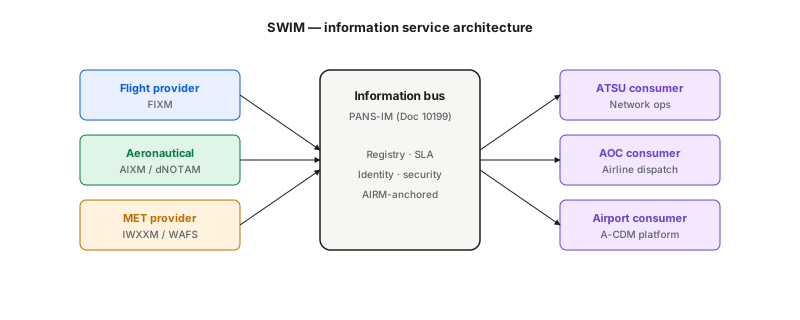
SWIM
System-Wide Information Management (SWIM) is the ICAO framework for machine-to-machine exchange of ATM-related information between qualified parties via interoperable information services. It replaces the legacy one-to-one, message-based, point-to-point paradigm (AFTN/AMHS bulletins, NOTAM, OPMET broadcasts) with a many-to-many, service-oriented architecture (SOA) running over an IP-based network.
Definition
PANS-IM (Doc 10199) and Annex 10 Volume II adopt the same definition: "SWIM consists of standards, infrastructure and governance enabling the management of ATM-related information and its exchange between qualified parties via interoperable information services." Annex 15 (§5.4.3.1, Note 1) clarifies that, in a SWIM context, the notion of an information service addresses machine-to-machine interaction in a service-oriented architecture.
Regulatory Basis
- Annex 10 Vol II - the SWIM definition sits in the Chapter 1 definitions; the Introduction establishes that information-services provisions are found in PANS-IM and complement the Annex for network access and the ATN/IPS internet and transport layers.
- Annex 15 - §5.4.3 "Data set information services" requires that, when digital data sets in §5.3 are provided, they are made available through information services; Notes reference Doc 10199 and Doc 10203 for procedures and guidance.
- PANS-IM (Doc 10199) - first edition, approved by Council 18 March 2024, applicable 28 November 2024; no amendments issued as at this review. Contains the generic SWIM procedures for governance, service design, registries, information security and interface bindings; developed by the Information Management Panel (IMP), established by the Air Navigation Commission in 2013 following the 38th ICAO Assembly call for globally harmonized SWIM.
- PANS-AIM (Doc 10066) and PANS-MET (Doc 10157) - domain procedures that consume SWIM (digital NOTAM, AIXM data sets, IWXXM products).
- Doc 10039 - Manual on the SWIM Concept (concept, principles, components, global interoperability framework).
- Doc 10203 - Manual on SWIM Implementation (SOA guidance, service lifecycle, AIRM alignment, interface bindings).
- Doc 8126 - Aeronautical Information Services Manual (operational guidance for AIS/AIM contributing to SWIM).
- GANP (Doc 9750) - SWIM is a thread under Performance Improvement Area 2 ("Globally interoperable systems and data"), realized through ASBU Block 1 and Block 2 SWIM elements (B1-SWIM, B2-SWIM).
Concept and Architecture
Doc 10039 organizes SWIM around four components:
- Information - the payload, semantically anchored to the ATM Information Reference Model (AIRM) so providers and consumers share meaning across domains.
- Information services - functional capabilities published with an information service overview (a registry entry) that declares interface, payload model, QoS, security and lifecycle.
- Technical infrastructure - the IPS network (per Annex 10 Vol II and the ATN/IPS Manual), middleware, message brokers, identity and PKI.
- Governance - the bodies, standards, policies and processes that ensure interoperable information is provided by reliable and trusted services, manage the registry, and operate a SWIM region (a geographical area with common governance, per Doc 10199).
PANS-IM §5.3 requires the URL where information service overviews are publicized to be included in the AIP; where a SWIM registry is used, the published URL is that of the registry. The registry holds the metadata necessary to discover and access information services.
PANS-IM §4.2 requires information service providers to use domain-specific information exchange models aligned with the AIRM for their payloads; where they do not, they must align the payload definition with a global reference model and use a standardized exchange schema.
EUROCONTROL Specification EUROCONTROL-SPEC-170 (the "SWIM TI Yellow Profile") is cited in Doc 10199 §6.2.4, Note 2 as an example specification on interface bindings. Edition 2.0 of the Yellow Profile specification was released by EUROCONTROL in July 2025.
Information Exchange Models
SWIM payloads are carried in standardized, UML/XML-based exchange models, all aligned to the AIRM:
- AIXM - Aeronautical Information Exchange Model. Co-developed by EUROCONTROL and the FAA under a joint Change Control Board. Version 5.2 was issued in January 2025, adding support for PBN, GNSS elements, runway condition reporting and updates to instrument flight procedures; version 5.1.1 remains in widespread operational use. AIXM encodes features required by Annex 15 / PANS-AIM (airspace, routes, navaids, obstacles, aerodrome data, digital NOTAM via the AIXM Event/Temporality model).
- IWXXM - ICAO Meteorological Information Exchange Model. Mandated by PANS-MET (Doc 10157) in addition to traditional alphanumeric (TAC) form for METAR, SPECI, TAF, trend forecasts, SIGMET, AIRMET, VAA, VONA, tropical cyclone advisories, space weather advisories and WAFS SIGWX. Technical specifications are in WMO-No. 306 Vol I.3 Part D; ICAO guidance is in Doc 10003. The model is maintained by the WMO through dated releases (the 2023-1 release being current at this review), with a further version under development for Annex 3 Amendment 81.
- FIXM - Flight Information Exchange Model. Captures flight data and is the data backbone for FF-ICE/R1 (Flight and Flow Information for a Collaborative Environment). FIXM Core 4.3.0 is the current release, accompanied by the FF-ICE Message and Basic Message application libraries; the model is governed by a Change Control Board led by the FAA and EUROCONTROL with partner States.
Implementation Status
- Europe (SESAR 3 / EUROCONTROL): SWIM is a baseline of the Digital European Sky programme delivered by the SESAR 3 Joint Undertaking. EUROCONTROL operates the Network Manager B2B services and the European SWIM registry, and maintains the SWIM TI Yellow Profile specification (Edition 2.0, July 2025). The SWIM TI Blue Profile, targeting very-high-availability real-time flight-object exchange between ATC centres, remains in a research phase and is not yet ready for implementation.
- United States (FAA / NextGen): the FAA SWIM program is the data-sharing backbone of NextGen; the NAS Enterprise Messaging Service (NEMS) distributes SWIM services such as STDDS, TFMS, ITWS, TBFM and SFDPS to industry consumers.
- Asia-Pacific, Middle East, AFI: ICAO regional SWIM roadmaps are active, coordinated through bodies such as the APAC SWIM Task Force and the AFI SWIM implementation initiative; FIXM v4.3 regional extensions are under development for Asia-Pacific. The GCAA (UAE) operates a regional SWIM gateway in the MID region.
- ASBU monitoring: EUROCONTROL/ICAO ASBU implementation reporting tracks B1-SWIM and B2-SWIM elements per State.
External Sources
- ICAO Store - Doc 10039 Manual on the SWIM Concept: https://store.icao.int/en/manual-on-the-system-wide-information-management-concept-doc-10039
- EUROCONTROL - SWIM concept page: https://www.eurocontrol.int/concept/system-wide-information-management
- EUROCONTROL - EUROCONTROL-SPEC-170 SWIM TI Yellow Profile: https://www.eurocontrol.int/publication/eurocontrol-spec-170-eurocontrol-specification-swim-technical-infrastructure-ti-yellow
- EUROCONTROL - AIXM, FIXM, AIRM model pages: https://www.eurocontrol.int/model/aeronautical-information-exchange-model https://www.eurocontrol.int/model/flight-information-exchange-model https://www.eurocontrol.int/model/airm
- AIXM - official model site (versions, including AIXM 5.2): https://aixm.aero/
- FIXM - official model site: https://www.fixm.aero/
- IWXXM - WMO community page: https://community.wmo.int/iwxxm
- FAA - SWIM Program Overview: https://www.faa.gov/air_traffic/technology/swim/overview
- FAA - AIXM: https://www.faa.gov/about/office_org/headquarters_offices/ato/service_units/mission_support/aixm
- SESAR Joint Undertaking - SWIM Blue Profile: https://www.sesarju.eu/sesar-solutions/swim-blue-profile
- SKYbrary - SWIM article: https://skybrary.aero/articles/system-wide-information-management-swim
References
Annex 10 Vol II, Chapter 1, §1.1 — defines SWIM as standards,
Annex 10 Vol II, Introduction — establishes that information-services
Annex 15, Chapter 5, §5.4.3 — "Data set information services":
Annex 15, Chapter 5, §5.4.2.7 — selective distribution lists should
PANS-IM (Doc 10199), Foreword §1 — historical background: 38th
PANS-IM (Doc 10199), Foreword §2 — scope: SWIM as enabler of the GANP
PANS-IM (Doc 10199), Chapter 1, Definitions — SWIM, SWIM region and
PANS-IM (Doc 10199), Chapter 2, §2.1 — provisions apply to
PANS-IM (Doc 10199), Chapter 4, §4.2 — information service providers
PANS-IM (Doc 10199), Chapter 5, §5.3.2 — the URL where information
PANS-IM (Doc 10199), Chapter 6, §6.2.4 — interface bindings; Note 2
PANS-MET (Doc 10157), Foreword, Historical background — positions the
PANS-MET (Doc 10157), Chapter 2, §2.1.1.3 — mandates METAR and SPECI
Doc 8126 (Aeronautical Information Services Manual), Part I, §1.4-§1.5
Doc 10039 (Manual on the SWIM Concept), full document — concept,
Doc 9750 (GANP), SWIM thread under PIA-2 — ASBU B1-SWIM and B2-SWIM
Related topics
Detailed working notes on System-Wide Information Management (SWIM), the
ICAO framework for machine-to-machine exchange of ATM-related information
between qualified parties via interoperable information services. This
folder expands the summary in topics/swim.md into per-aspect files so
each can be read on its own.
Files in this folder
overview.md— what SWIM is, its role in the GANP and ASBU, and the governance bodies (ICAO, FAA, EUROCONTROL, the legacy JPDO that seeded NextGen SWIM).components.md— the four SWIM components per Doc 10039, the ICAO Information Service Reference Model, and the canonical information- service categories (flight, aerodrome, weather, surveillance, airspace structure).blocks.md— SWIM maturity steps expressed both as ASBU SWIM-B0/B1/B2/B3 modules and as the EUROCONTROL technical-infrastructure profiles (SWIM-TI Yellow Profile, Blue Profile) plus the emerging SWIM-IPS line.threads.md— the four SWIM working domains: information-services governance, technical infrastructure, data exchange models (AIXM / FIXM / IWXXM / AIRM), and identity / security.modules.md— anatomy of a SWIM information service: objective, interface binding, data model, enablers, KPIs, lifecycle.enablers.md— IPS networking, service registries, governance, certification, the AIRM-aligned exchange models, and security.performance_objectives.md— SWIM-relevant KPAs (interoperability, predictability, efficiency, cost-effectiveness) and KPIs.timeline.md— Doc 10039 / Doc 10199 / Doc 10203 edition history and regional SWIM programmes (FAA NextGen SWIM, EUROCONTROL B2B and SWIM-TI, APAC and MID roadmaps).references.md— consolidated ICAO and external references used across this folder.
Reading order
Start with overview.md, then components.md, then blocks.md and
threads.md, then drill into modules.md, enablers.md, and
performance_objectives.md. Use timeline.md for date context and
references.md for citations.
Source basis
Content is grounded in:
- ICAO Doc 10039 (Manual on the SWIM Concept).
- ICAO Doc 10199 (PANS-IM, Procedures for Air Navigation Services — Information Management), 1st edition, applicable 28 November 2024.
- ICAO Doc 10203 (Manual on SWIM Implementation).
- ICAO Doc 9750 (GANP), SWIM thread under PIA-2.
- ICAO Annex 10 Volume II (SWIM and ATN/IPS provisions).
- ICAO Annex 15 §5.4.3 (Data set information services) and PANS-AIM (Doc 10066).
- ICAO Annex 3 / PANS-MET (Doc 10157) and Doc 10003 for IWXXM.
- ICAO Doc 8126 (Aeronautical Information Services Manual).
- EUROCONTROL SWIM concept and SWIM-TI specifications.
- AIXM, FIXM, IWXXM model sites: https://aixm.aero/ , https://fixm.aero/ , https://www.wmo.int/ .
- ICAO GANP Portal: https://ganpportal.icao.int/
What SWIM is
SWIM stands for System-Wide Information Management. It is the ICAO framework that allows ATM-related information — flight, flow, aeronautical, meteorological, surveillance, and airspace data — to be exchanged machine-to-machine between qualified parties through interoperable information services running over a common, IP-based network.
The canonical definition, adopted in identical wording by Annex 10 Volume II and by PANS-IM (Doc 10199), is:
"SWIM consists of standards, infrastructure and governance enabling the management of ATM-related information and its exchange between qualified parties via interoperable information services."
SWIM replaces the legacy one-to-one, message-based, point-to-point paradigm (AFTN / AMHS bulletins, NOTAM, OPMET broadcasts) with a many-to-many, service-oriented architecture (SOA). Producers publish information services; consumers discover them through a registry and subscribe to or request the data they need, with known semantics, quality of service, security, and lifecycle.
Role in the GANP and ASBU
SWIM sits at the technical level of the ICAO Global Air Navigation Plan (Doc 9750-AN/963), as one of the information threads of the Aviation System Block Upgrade (ASBU) framework. It is the backbone of Performance Improvement Area 2 — Globally Interoperable Systems and Data.
SWIM is delivered cumulatively across ASBU Blocks:
- Block 0 — initial regional information services and bilateral exchange (AIXM, FIXM seeds).
- Block 1 — operational SWIM services for flight, flow, aeronautical and meteorological domains; service registry; quality of service.
- Block 2 — full SWIM with policy-based access, semantic interoperability, and trajectory-based information flows.
- Block 3 — fully federated, semantically interoperable information environment.
PANS-IM Chapter 2 §2.1–§2.2 explicitly positions SWIM as an enabler of the GANP and of the Doc 9854 Global ATM Operational Concept.
Governance — who maintains SWIM
SWIM is maintained by a layered set of bodies. ICAO sets the global framework; regions and States deliver it; the data-model communities maintain the exchange formats.
ICAO
- Information Management Panel (IMP). Created after the 38th ICAO Assembly (2013) called for a globally harmonised SWIM. IMP authored PANS-IM (Doc 10199) and supports Doc 10039 (Manual on the SWIM Concept) and Doc 10203 (Manual on SWIM Implementation).
- Air Navigation Commission (ANC). Approves the SARPs and PANS that carry SWIM provisions (Annex 10 Vol II, Annex 15 §5.4.3, PANS-AIM, PANS-MET, PANS-IM).
- ICAO Regional Offices (APAC, MID, EUR/NAT, AFI, NACC, SAM). Drive regional SWIM roadmaps and operate regional planning groups (APANPIRG, MIDANPIRG, EANPG, etc.).
Europe — EUROCONTROL and SESAR
- EUROCONTROL. Operates the Network Manager B2B services (the largest production SWIM service set in Europe), the EUROCONTROL SWIM Registry, and publishes the SWIM-TI Yellow Profile (EUROCONTROL-SPEC-170) and SWIM-TI Blue Profile technical- infrastructure specifications cited in PANS-IM as reference examples.
- SESAR JU and SESAR Deployment Manager. SWIM is a SESAR Solution baseline; SESAR Deployment Programme funds Pilot Common Project (PCP) SWIM deliveries via the European ATM Master Plan.
United States — FAA and the legacy JPDO
- FAA SWIM Program (Air Traffic Organization). Operates the data-sharing backbone of NextGen. NEMS (NAS Enterprise Messaging Service) distributes SWIM services such as STDDS, TFMS, ITWS, TBFM and SFDPS to industry consumers.
- Joint Planning and Development Office (JPDO). Created by Vision 100 (2003) and disbanded in 2014. Set the original NextGen architecture, including SWIM, before responsibility transferred fully to the FAA NextGen Office.
Data-model communities
- AIXM Change Control Board. Joint EUROCONTROL / FAA stewardship of the Aeronautical Information Exchange Model. Site: https://aixm.aero/ .
- FIXM Change Control Board. FAA / EUROCONTROL / partner stewardship of the Flight Information Exchange Model. Site: https://fixm.aero/ .
- WMO and ICAO MET Panel. Co-maintain IWXXM (WMO-No. 306 Vol I.3 Part D; ICAO Doc 10003).
Other regional and national programmes
- ICAO APAC SWIM roadmap and the AFI SWIM Project.
- GCAA (UAE) SWIM Gateway for the MID region.
- National SWIM programmes in Singapore, Thailand, Japan, Australia, Brazil (DECEA), and others.
SWIM is not a single system. It is a structured set of interlocking components that together describe what information is exchanged, how it is exchanged, who is allowed to exchange it, and with what semantics. Doc 10039 (Manual on the SWIM Concept) defines four top-level components; PANS-IM (Doc 10199) refines them with the Information Service Reference Model and a working catalogue of information-service categories.
1. Information
The payload. SWIM information is semantically anchored to the ATM Information Reference Model (AIRM), a UML conceptual model of ATM-domain concepts that gives providers and consumers a shared meaning across domains. The AIRM is maintained by EUROCONTROL with FAA participation; PANS-IM Chapter 4 requires that information services be described against the AIRM (or a documented mapping to it) so that semantic interoperability is preserved.
Information categories typically exposed through SWIM:
- Flight information — flight plans, flight objects, trajectory data, FF-ICE planning and execution information.
- Flow information — ATFM measures, regulations, slot allocation, airport demand and capacity profiles, NOPS data.
- Aeronautical information — AIXM features (airspace, routes, navaids, procedures, obstacles, aerodromes), digital NOTAM via the AIXM Event/Temporality model, eAIP data sets.
- Meteorological information — IWXXM products (METAR, SPECI, TAF, SIGMET, AIRMET, VAA, VONA, TCA, WAFS SIGWX) plus gridded MET data.
- Surveillance information — cooperative surveillance tracks, ADS-B / ADS-C data, where shared between authorised parties.
- Airspace structure — sector configurations, FUA bookings, free route airspace definitions, RAD restrictions.
2. Information services
A SWIM information service is a published functional capability with a formal description (a "service overview" in PANS-IM terms, or a registry entry) that declares:
- service identifier and version;
- interface binding (e.g. WS-* / REST request-response, AMQP / JMS publish-subscribe, file-based bulk delivery);
- payload model and AIRM mapping;
- quality of service (availability, latency, throughput);
- access policy and security requirements;
- lifecycle status (provisional, operational, deprecated, retired).
PANS-IM §5.3.2 requires AIPs to publish the URL where service overviews or the SWIM registry are advertised, so that consumers can discover services authoritatively.
3. Technical infrastructure
The systems and network that carry SWIM exchanges. Per Annex 10 Vol II and the ATN/IPS Manual, the network layer is IP-based (the ATN/IPS profile, evolving towards SWIM-IPS). Above that:
- Middleware and message brokers — for publish-subscribe and request-response patterns.
- Identity and access management — PKI, OAuth-style tokens, mutual TLS for service authentication.
- Registry — the SWIM registry holds metadata for service discovery, access, lifecycle, and information category.
- Monitoring and reporting — for service-level agreement (SLA) evidence and ASBU implementation reporting.
EUROCONTROL Specification EUROCONTROL-SPEC-170 (SWIM-TI Yellow Profile) is cited in PANS-IM Chapter 6 §6.2.4 Note 2 as a reference example of interface bindings (WS-* / REST + AMQP).
4. Governance
The rules and bodies that approve services, manage the registry, and operate a SWIM region (a geographical area with common governance, per PANS-IM Chapter 3 Definitions). Governance covers:
- service approval and lifecycle management;
- AIRM and exchange-model version control;
- conformance testing and certification;
- SLA management and dispute resolution;
- security accreditation.
ICAO Information Service Reference Model
PANS-IM introduces an Information Service Reference Model that expresses an information service as three layered concerns:
- Information layer — the AIRM-aligned conceptual model and the logical data model (e.g. AIXM, FIXM, IWXXM).
- Service layer — the functional behaviour, operations exposed, and the service overview document.
- Technical layer — the binding to a specific transport, payload encoding, and security profile (the SWIM-TI profile).
This three-layer separation lets the same logical service be re-bound to different technical profiles (e.g. the same flight-information service exposed once on a Yellow-Profile WS-* binding and once on a SWIM-IPS binding) without re-specifying its semantics.
Information-service categories
The working catalogue of SWIM service categories used by ICAO and the regions:
- Flight services — flight-object provision, FF-ICE filing / agreement / planning / execution exchanges.
- Flow services — ATFM measures, demand-capacity balancing data, network performance monitoring, ATFM slot management.
- Aerodrome services — A-CDM milestones, aerodrome mapping data, surface movement information, stand and gate planning.
- Weather services — IWXXM products, gridded MET, SIGMET / AIRMET alerts, volcanic-ash and tropical-cyclone advisories.
- Surveillance services — cooperative surveillance data feeds where governance permits.
- Airspace structure services — current and planned airspace configuration, sector and free-route definitions.
These categories map directly into the ASBU SWIM modules across Blocks 0–3 and into the FAA NEMS service portfolio (STDDS, TFMS, ITWS, TBFM, SFDPS) and the EUROCONTROL B2B service portfolio.
SWIM matures along two parallel axes that planners must keep distinct:
- ASBU SWIM modules. The ICAO global timeline — SWIM-B0, SWIM-B1, SWIM-B2, SWIM-B3 — exposed through the GANP Portal as part of the Aviation System Block Upgrade framework.
- EUROCONTROL SWIM-TI profiles. The European technical- infrastructure profiles — Yellow Profile (WS-* / REST + AMQP), Blue Profile (information-classified, secured air-ground / cross- border bindings), and the emerging SWIM-IPS line that aligns SWIM transport with the ATN/IPS network of Annex 10 Vol II.
Both axes describe the same underlying capability moving from initial pilots to a fully federated, secure, high-quality information environment. A national SWIM plan should express milestones against both axes plus the chosen exchange-model versions.
ASBU SWIM modules
SWIM-B0 — Initial Information Sharing (from 2013)
Theme. First operational exposure of digital ATM data using the common exchange models. Bilateral, often file- or WS-* based, frequently between adjacent ANSPs.
Representative content:
- AIXM 5 data exchange between AIS and consumers (eAIP).
- FIXM seed exchanges of flight data between adjacent FIRs.
- IWXXM TAC-equivalent meteorological products.
- Initial registry of regional information services.
- First versions of the AIRM published.
State milestone: at least one production information service available to authorised consumers, declared in the AIP per PANS-IM §5.3.2.
SWIM-B1 — Operational SWIM Services (from 2019)
Theme. Move from pilot to production. Service registries become authoritative; quality of service is measured; the four core domains (flight, flow, AIM, MET) are simultaneously available.
Representative content:
- Service registry operational; service overviews published.
- Flight and flow services on Yellow-Profile bindings.
- Digital NOTAM via AIXM Event/Temporality.
- IWXXM as the operational MET form (per PANS-MET §2.1.1.3).
- FF-ICE Release 1 (planning information) services on FIXM.
- Policy-based access control in production.
This is the headline SWIM block for most national plans today.
SWIM-B2 — Full SWIM (from 2025)
Theme. Trajectory-aware SWIM. Information services become trusted enough to drive automated decisions. SWIM transport migrates onto ATN/IPS / SWIM-IPS for cross-border and air-ground exchanges.
Representative content:
- Trajectory and 4D MET services supporting initial TBO (TBO-B2).
- FF-ICE Release 2 (execution information) on FIXM.
- AIXM 5.2 features in production.
- SWIM-IPS bindings for selected services.
- Cross-region SWIM federation agreements.
SWIM-B3 — Federated, Semantically Interoperable SWIM (from 2031)
Theme. End-state vision. Globally federated information environment; semantic interoperability based on the AIRM; full TBO information flow; network-centric, performance-based ATM.
EUROCONTROL SWIM-TI profiles
EUROCONTROL specifications give a concrete, testable target for the technical infrastructure layer of SWIM. PANS-IM Chapter 6 §6.2.4 cites them as reference examples; many APAC and MID States adopt them verbatim.
SWIM-TI Yellow Profile (EUROCONTROL-SPEC-170)
- Scope. Ground-ground exchange of non-classified, non-safety-of-life ATM information.
- Bindings. WS-* (SOAP) and REST request-response over HTTPS; AMQP publish-subscribe.
- Security. Mutual TLS, X.509 certificates, message-level signature optional.
- Adoption. Used by EUROCONTROL Network Manager B2B services and by most European ANSPs' SWIM nodes.
SWIM-TI Blue Profile
- Scope. Information classified or operationally sensitive, and exchanges that need higher assurance — typically air-ground or cross-region.
- Bindings. Stronger security profile, formal accreditation, potential use of dedicated networks.
- Adoption. Selected services where the Yellow Profile assurance is insufficient.
SWIM-IPS (emerging)
- Scope. Aligns SWIM transport with the ATN/IPS network defined in Annex 10 Vol II. Targets cross-border and air-ground SWIM where end-to-end IP from cockpit to ground is required.
- Status. In active specification by EUROCONTROL and ICAO; selected as the long-term substrate for trajectory and FF-ICE Release 2 services.
How the two axes line up
| ASBU SWIM | Typical SWIM-TI profile | Exchange models |
|---|---|---|
| SWIM-B0 | Pre-profile or Yellow-equivalent | AIXM 5.1, FIXM 3.x seed, TAC + early IWXXM |
| SWIM-B1 | Yellow Profile in production | AIXM 5.1.1, FIXM 4.x, IWXXM operational |
| SWIM-B2 | Yellow + Blue + initial SWIM-IPS | AIXM 5.2, FIXM (FF-ICE R2), IWXXM 4D MET |
| SWIM-B3 | SWIM-IPS dominant, federated | AIRM-aligned, fully versioned |
A pragmatic national roadmap therefore looks like: complete SWIM-B0 exposure on a Yellow-equivalent binding; reach SWIM-B1 by adopting the Yellow Profile and publishing a registry; plan SWIM-B2 by trialling SWIM-IPS for selected flight or trajectory services; treat SWIM-B3 as horizon planning aligned with regional federation timetables.
SWIM is delivered as four parallel working domains. Each is a distinct discipline with its own standards, communities, and implementation artefacts, and each must reach a comparable level of maturity before the SWIM environment as a whole can support an ASBU module that depends on it.
The four domains map directly onto the four components in components.md
but are framed here as working programmes — the activities a State
or ANSP must run.
1. Information-services governance
The non-technical backbone. Without governance the other three domains produce point capabilities that do not federate.
What this domain covers
- Service approval. A formal lifecycle from "candidate" through "provisional" and "operational" to "deprecated" and "retired", with an authority that signs off each transition.
- Registry operation. A SWIM registry as defined in PANS-IM Chapter 3 — discoverable metadata for every published service: identifier, version, owner, AIRM mapping, interface binding, lifecycle state, access policy, point of contact.
- AIP publication. Per PANS-IM §5.3.2, AIPs publish the URL of the service overview or the SWIM registry. This is the only authoritative discovery channel for foreign consumers.
- SLA management. Service-level agreements with measurable targets (availability, latency, throughput, integrity), monitoring, and reporting.
- SWIM region governance. A SWIM region is a geographical area with a common governance framework. Cross-region exchange requires bilateral or multilateral agreements between region authorities.
- Change control. Coordinated version management for AIRM, AIXM, FIXM, IWXXM, and the technical-profile specifications.
Reference standards
- PANS-IM (Doc 10199) Chapter 5 (registry and AIP publication) and Chapter 7 (governance procedures).
- Doc 10039 (Manual on the SWIM Concept).
- Doc 10203 (Manual on SWIM Implementation).
2. Technical infrastructure
The networks, brokers, and runtimes that carry SWIM exchanges.
What this domain covers
- Network layer. Migration of ground-ground transport onto IP (NewPENS in Europe, FAA NEMS backbone in the US, regional IP backbones elsewhere) and, longer term, ATN/IPS / SWIM-IPS for air-ground SWIM.
- Messaging middleware. Brokers supporting publish-subscribe (AMQP, JMS) for telemetry-style streams (positions, MET updates) and request-response (WS-* / REST) for state-snapshot retrieval.
- Identity and access management. PKI, certificate management, service-to-service authentication (mTLS), authorisation policies.
- Quality of service. Availability targets, latency budgets, throughput sizing, redundancy.
- Profile compliance. Conformance to a SWIM-TI profile (Yellow, Blue, or SWIM-IPS) and certification testing.
- Operations. Monitoring, incident management, change windows, capacity planning.
Reference standards
- Annex 10 Volume II (ATN/IPS network layer).
- ICAO ATN/IPS Manual (Doc 9896-equivalent successor material).
- EUROCONTROL-SPEC-170 (SWIM-TI Yellow Profile) and Blue Profile specifications.
- PANS-IM Chapter 6 (interface bindings and technical-profile use).
3. Data exchange models
The semantic glue. SWIM information is only useful if every consumer can parse and reason about it the same way.
Models in scope
- AIRM — ATM Information Reference Model. UML conceptual model of ATM information; the semantic anchor for all SWIM exchanges. Maintained by EUROCONTROL with FAA participation.
- AIXM — Aeronautical Information Exchange Model. Encodes Annex 15 / PANS-AIM features (airspace, routes, navaids, obstacles, aerodrome data, digital NOTAM through the AIXM Event/Temporality model). Production version 5.1.1; 5.2 in extension. Site: https://aixm.aero/ .
- FIXM — Flight Information Exchange Model. Flight-data backbone for FF-ICE/R1 and onwards. Governed by a Change Control Board of FAA, EUROCONTROL, and partners. Site: https://fixm.aero/ .
- IWXXM — ICAO Meteorological Information Exchange Model. Mandated by PANS-MET (Doc 10157 §2.1.1.3) for METAR, SPECI, TAF, SIGMET, AIRMET, VAA, VONA, TCA, and WAFS SIGWX. Specifications in WMO-No. 306 Vol I.3 Part D; ICAO guidance in Doc 10003.
What this domain covers
- Choosing and locking AIRM / AIXM / FIXM / IWXXM versions per service.
- Maintaining mappings from each logical service to AIRM.
- Conformance testing of payloads (schema validation plus business rules).
- Data quality regime aligned with PANS-AIM (Doc 10066) and Annex 15.
- Coordinated migration paths between exchange-model versions.
4. Identity and security
A horizontal domain that touches all of the above but warrants its own working programme.
What this domain covers
- Trust anchors. Region-level Certificate Authorities; mutual recognition between SWIM regions.
- Service authentication. Mutual TLS at the transport layer, plus message-level signing where required.
- Authorisation. Policy-based access control, attribute-based authorisation, integration with State or organisation identity systems.
- Information classification. Differentiating non-sensitive ground-ground exchange (Yellow Profile) from classified or air-ground SWIM (Blue Profile, SWIM-IPS).
- Cyber resilience. Annex 17-driven security oversight of SWIM-connected systems; State Aviation Cybersecurity Strategy alignment.
- Audit and forensics. Tamper-evident logging; SLA evidence.
Reference standards
- Annex 17 (Security) for the policy framing.
- Annex 10 Vol II for ATN/IPS security mechanisms.
- PANS-IM Chapter 8 (security provisions).
- ICAO Aviation Cybersecurity Strategy and Action Plan.
How the four domains interlock
A SWIM service is operational only when all four domains are satisfied for it: governance has approved it, technical infrastructure exposes it on a compliant profile, the data model is locked and AIRM-mapped, and the security and identity controls are in place. ASBU SWIM-B1 modules are scored against this four-way readiness, not against any single domain.
What an "information service" is in SWIM
A SWIM information service is the smallest deliverable unit of SWIM planning — the analogue, at SWIM scale, of an ASBU module. PANS-IM (Doc 10199) defines it as a published functional capability that lets a qualified consumer obtain or subscribe to ATM-related information from a qualified provider, with declared semantics, quality of service, and access policy.
A service is deliverable: a State, ANSP, airport operator, or airline can plan, fund, build, certify, expose, and operate it as a coherent capability, and a consumer can plan, fund, integrate, and rely on it on a known SLA.
Anatomy of a SWIM service
PANS-IM and Doc 10203 expect each information service to be described by a service overview carrying the following structured information.
1. Service identifier and version
For example: eAIP-DataSet-v1.2, FlightObject-Provision-FF-ICE-R1,
AIXM-Digital-NOTAM-v5.1.1, IWXXM-METAR-v3.
Versioning policy must distinguish backward-compatible from breaking-change increments.
2. Service objective
A plain-language statement of what operational purpose the service serves. Example: "Provide subscribers with the up-to-date AIXM 5.1.1 representation of airspace and route structures within the FIR, with event-based change notification."
3. Information category and AIRM mapping
The information category (flight, flow, AIM, MET, surveillance, airspace structure) and the AIRM concepts that the payload realises. Where the payload uses AIXM / FIXM / IWXXM, the mapping is mostly inherited from the model.
4. Interface binding
The technical interface(s) on which the service is exposed:
- transport (HTTPS, AMQP, JMS, file transfer);
- interaction style (request-response, publish-subscribe, batch);
- payload encoding (XML/GML, JSON, GeoJSON, where standardised);
- security profile (Yellow Profile, Blue Profile, SWIM-IPS).
A single logical service may be exposed on multiple bindings.
5. Data model
The exchange-model schema(s) and version(s) carried in the payload — e.g. AIXM 5.1.1 with the Digital NOTAM extension, FIXM 4.2 with FF-ICE R1 profile, IWXXM 3.0. Reference to the schema location and any business-rule overlay.
6. Quality of service
Quantified targets: availability (e.g. 99.5% measured monthly), latency (e.g. 95th percentile request latency under 2 seconds), throughput (messages or megabytes per minute), retention, ordering guarantees.
7. Access policy
Who can consume the service, under what conditions, with what authentication. Policy-based access control with attributes (region, role, organisation, certificate trust anchor).
8. Lifecycle status
provisional, operational, deprecated, retired, with effective
dates and migration guidance for consumers when status changes.
9. Enablers
Infrastructure, regulation, and institutional prerequisites — see
enablers.md.
10. Dependencies
Other SWIM services or ASBU modules that must be in place. Examples:
- A FIXM flight-object service depends on a service registry and on identity infrastructure.
- A digital-NOTAM service depends on AIXM 5 deployment and the Aeronautical Data Catalogue (PANS-AIM Doc 10066).
11. KPIs
Quantitative indicators on which the service's effectiveness can be measured: subscription count, message rate, semantic-conformance rate, SLA breach count, consumer adoption across regions.
12. Service overview document URL
Per PANS-IM §5.3.2 the URL is published in the AIP, or a SWIM registry URL is published from which the service overview can be retrieved.
Worked examples
Example 1 — AIXM-eAIP-DataSet
- Objective. Provide subscribers with the AIXM 5.1.1 representation of the State's eAIP, refreshed each AIRAC cycle.
- Information category. Aeronautical (DAIM thread).
- Binding. WS-* (Yellow Profile) request-response and AMQP topic for AIRAC publication notifications.
- Data model. AIXM 5.1.1.
- QoS. 99.5% availability; AIRAC publication within one hour of effective date.
- Enablers. PANS-AIM data quality regime; AIRAC procedures; State AIM organisation; service registry entry.
- KPIs. AIRAC adherence rate, consumer count, semantic-conformance rate.
Example 2 — FFICE-R1-FlightFiling
- Objective. Accept FF-ICE Release 1 flight planning information from operators and provide it to authorised ATM consumers.
- Information category. Flight.
- Binding. WS-* (Yellow Profile or evolving SWIM-IPS).
- Data model. FIXM with the FF-ICE R1 profile.
- QoS. Request latency under 2 seconds 95th percentile; 99.9% availability during operational hours.
- Enablers. Identity infrastructure; FF-ICE bilateral readiness with neighbour ANSPs; controller training.
- KPIs. FF-ICE filing share of total flight plans; rejection rate; cross-FIR FF-ICE handover success rate.
Example 3 — IWXXM-METAR
- Objective. Disseminate METAR / SPECI for State aerodromes in IWXXM.
- Information category. Meteorological.
- Binding. AMQP publish-subscribe (Yellow Profile).
- Data model. IWXXM 3.0 (per PANS-MET §2.1.1.3 Note referencing Doc 10003).
- QoS. Publication within minutes of issue; 99.9% availability.
- Enablers. State MET authority; OPMET pipeline integration; IWXXM encoder validation.
- KPIs. Publication latency; semantic-conformance rate; consumer count.
How services become a national SWIM portfolio
A national SWIM portfolio is built by:
- Selecting the information services relevant to each ASBU module the State plans to implement (SWIM-B0, SWIM-B1, etc.).
- Sequencing them per the ASBU dependency graph and the exchange-model version plan.
- Mapping each service to a responsible organisation, funding source, regulatory action, and milestone date.
- Publishing service overviews in the AIP (or registry URL in the AIP) per PANS-IM §5.3.2.
- Reporting implementation status into the regional SWIM monitoring programme (APANPIRG, MIDANPIRG, EUROCONTROL LSSIP, etc.).
What an Enabler is
An enabler is a supporting element without which a SWIM information service cannot deliver its intended benefit. Enablers are not themselves SWIM services; they are prerequisites. PANS-IM (Doc 10199) and Doc 10203 make enablers explicit so that planners do not deploy a service whose foundation is missing.
Enablers fall into seven categories.
1. IPS networking
The network substrate. SWIM is, by definition, IP-based.
- Ground-ground IP backbone. Regional networks such as NewPENS in Europe and the FAA NEMS backbone in the US, plus equivalent national backbones in other regions. IPv6 capability and adequate capacity are core requirements.
- ATN/IPS. The IPS network defined in Annex 10 Volume II that provides the air-ground IP layer for SWIM exchanges with aircraft.
- SWIM-IPS. The emerging SWIM technical-infrastructure profile aligned to ATN/IPS for cross-border and air-ground SWIM.
- Connectivity to external partners. Operators, airports, MET providers, and neighbouring ANSPs must reach the State's SWIM nodes with appropriate redundancy and security.
2. Information-service registries
Registries make SWIM discoverable. Without them, services exist but cannot be found authoritatively.
- National or regional SWIM registry. Hosts service overviews, metadata, lifecycle status. Per PANS-IM §5.3.2, the registry URL (or the service-overview URL) is advertised in the AIP.
- Federation between registries. Cross-region discovery requires metadata exchange between registries (for example between EUROCONTROL SWIM Registry, FAA SWIM service catalogues, and APAC / MID national registries).
3. Governance
Governance is itself an enabler — without it, services cannot be approved, certified, or retired in a controlled way.
- SWIM region authority. Defined per PANS-IM Chapter 3.
- Service approval body. Typically inside the State's CAA or the ANSP, with terms of reference covering lifecycle, AIRM mapping, exchange-model versioning, security accreditation.
- Change control boards. For AIRM, AIXM, FIXM, IWXXM, and the technical profiles.
- SLA governance. Authority to declare and enforce service-level agreements.
4. Certification and conformance
- Conformance testing. Schema and business-rule validation of payloads against AIXM / FIXM / IWXXM versions; profile-conformance testing against EUROCONTROL-SPEC-170 (Yellow) or Blue.
- Security accreditation. Per Annex 17 and the ICAO Aviation Cybersecurity Strategy, SWIM-connected systems require security accreditation under the State's safety and security oversight regime.
- SMS integration. Annex 19 SMS requirements extended to SWIM-driven changes in operational risk profile.
- Operational authorisations. State approvals where SWIM-delivered data is used as the basis for separation, ATFM, or trajectory management.
5. Exchange models — AIRM, AIXM, FIXM, IWXXM
The semantic enablers. A service cannot be globally interoperable without a locked, AIRM-aligned exchange model.
- AIRM — UML conceptual model; the semantic anchor. https://www.eurocontrol.int/model/airm
- AIXM — Aeronautical Information Exchange Model; production version 5.1.1 with 5.2 in extension. https://aixm.aero/
- FIXM — Flight Information Exchange Model; FF-ICE/R1 backbone. https://fixm.aero/
- IWXXM — ICAO MET Information Exchange Model; per PANS-MET §2.1.1.3 Note, references Doc 10003.
Adoption of a specific version of each model — and a documented migration plan to the next — is part of every SWIM service overview.
6. Security and identity
- PKI and certificate management. Region-level Certificate Authorities; cross-region trust anchors; certificate lifecycle.
- Identity and access management. Service-to-service authentication (mutual TLS) and policy-based access control.
- Information classification. Distinguishing Yellow-Profile-eligible exchanges from those needing Blue Profile / SWIM-IPS.
- Cyber resilience. Network segmentation, intrusion detection, incident response, evidence retention.
- Audit. Tamper-evident logs supporting SLA evidence and Annex 17 oversight.
7. Human resources, regulation, and institutional
- AIM, MET, ATM staff training for the new data-centric workflows (PANS-AIM data-quality regime; IWXXM authoring; FIXM-aware flight-data operations).
- Engineering and operations training for the SWIM platform (broker administration, certificate operations, registry curation).
- Regulatory framework. State approval framework for SWIM service exposure; cybersecurity regulation; data-protection regime where applicable.
- Institutional agreements. Bilateral and multilateral letters of agreement for cross-FIR SWIM exchange; FF-ICE bilateral readiness; MET data-sharing agreements; A-CDM / NOPS data-sharing agreements.
How enablers are managed in practice
Each information service in a SWIM registry should list its enablers with a status indicator. A service is considered fully implemented only when all of its declared enablers are also in place — not only the service endpoint and schema. ASBU SWIM-B1 readiness is judged against this full enabler set, not against the existence of a single endpoint.
This is why SWIM, like the wider ASBU framework, is much more than software procurement: a State that stands up a SWIM broker without publishing a service overview, accrediting security, or training AIM / MET staff will not see the predicted interoperability or efficiency benefits.
The performance lens of SWIM
SWIM is delivered under the same performance-based discipline as the rest of the ASBU framework. Every SWIM information service is justified by the performance benefit it enables, and progress is measured against defined Key Performance Indicators (KPIs). The KPA / PO / KPI terminology comes from the Global ATM Operational Concept (Doc 9854) and the Manual on Global Performance of the Air Navigation System (Doc 9883).
The chain is the same as for ASBU at large:
KPA --(measured by)--> KPI <--(targeted by)-- Performance Objective --(achieved by)--> SWIM service
The difference for SWIM is that SWIM services are usually second-order contributors: they enable other ASBU modules (TBO, A-CDM, NOPS, FF-ICE, AMET) to deliver flight-efficiency, capacity, or predictability gains. SWIM's own first-order KPAs are interoperability, predictability, efficiency, and cost-effectiveness.
KPA contribution by SWIM service category
Editorial scoring of SWIM service categories against the four KPAs they most directly affect (1 = some benefit, 2 = clear benefit, 3 = primary driver). Empty cells score zero by convention.
| KPA | Flight | Flow | Aeronautical | MET | Surveillance |
|---|---|---|---|---|---|
| Interoperability | 3 | 3 | 3 | 3 | 2 |
| Predictability | 3 | 3 | 1 | 2 | 1 |
| Flight efficiency | 3 | 2 | 2 | 3 | 1 |
| Cost-effectiveness | 2 | 2 | 3 | 1 | 1 |
Key Performance Areas most affected by SWIM
The four KPAs that SWIM most directly improves:
- Interoperability — common procedures, data formats, and systems enabling seamless cross-border exchange. SWIM is, definitionally, an interoperability programme.
- Predictability — variance between planned and actual times. Sharing flight-, flow-, MET-, and AIM-data in near real-time tightens variance across the gate-to-gate journey.
- Flight efficiency — track-mile and vertical-profile efficiency. Better information flow lets operators plan, file, and adjust closer to optimum trajectories.
- Cost-effectiveness — unit cost of ANS service. SWIM replaces bespoke bilateral exchanges with reusable services, reducing total integration cost across the network.
SWIM also touches safety (better-quality digital AIM and MET reduce human-error risk in the data chain), environmental impact (through TBO / CDO / CCO enablement), and capacity (through A-CDM, NOPS, and trajectory enablement).
SWIM-specific Performance Objectives
Performance Objectives drawn from the GANP Portal style and tailored to SWIM:
- PO — Achieve global SWIM service interoperability. Measured by the share of SWIM services using AIRM-aligned models (AIXM, FIXM, IWXXM) with declared technical profiles. Delivered by SWIM-B0 / B1.
- PO — Reduce information latency across the ATM network. Measured by 95th-percentile end-to-end latency from data event to consumer receipt. Delivered by SWIM-B1 (publish-subscribe operationalisation).
- PO — Increase predictability of arrival times. Measured by the variance between planned and actual landing times. Delivered jointly by SWIM-B1, FF-ICE Release 1 (FICE-B1), A-CDM-B1, and AMET-B1.
- PO — Reduce duplicated data integration cost. Measured by the count of bilateral, non-SWIM data integrations decommissioned. SWIM governance KPI; supports cost-effectiveness.
- PO — Increase digital NOTAM coverage. Measured by the share of NOTAM issued in AIXM 5 Event/Temporality form. Delivered by SWIM-B1 and DAIM-B1.
KPI families relevant to SWIM
Interoperability KPIs
- SWIM service availability (% of declared service hours).
- 95th-percentile message latency.
- Semantic-conformance rate (payloads passing schema and business-rule validation).
- Number of cross-region consumers per service.
- Number of bilateral data-sharing arrangements consolidated onto SWIM.
Predictability KPIs (SWIM-enabled)
- Standard deviation of actual vs. planned off-block, airborne, and landing times — improved when SWIM-fed A-CDM and FF-ICE are in use.
- ATFM slot adherence — improved when NOPS consumes SWIM-distributed data.
Flight-efficiency KPIs (SWIM-enabled)
- KEP / KEA (filed and actual flight-plan efficiency vs. great-circle).
- Share of flights filed under FF-ICE Release 1 / Release 2.
- Direct-routing percentage in free-route airspace fed by SWIM.
Environmental KPIs (SWIM-enabled)
- Fuel burn / CO2 per flight (improved by SWIM-enabled TBO, CDO).
- Excess fuel per arrival (CDO conformance).
Cost-effectiveness KPIs
- Unit cost of ANS service (Doc 9082 charging principles).
- Number of legacy bilateral integrations retired per year.
Safety KPIs (data-quality slice)
- Defect rate in published AIM data (Annex 15 / PANS-AIM data-quality regime).
- IWXXM publication-error rate.
How SWIM performance is reported
- Globally. ICAO ASBU implementation monitoring reports under the GANP review cycle (3-yearly, aligned with the ICAO Assembly).
- Regionally.
- APAC — APANPIRG performance reporting under the Seamless ATM Plan and the APAC SWIM roadmap.
- MID — MIDANPIRG and the MID Air Navigation Strategy; GCAA SWIM Gateway reporting.
- EUR — EUROCONTROL Performance Review Body; the LSSIP cycle explicitly tracks SWIM-related deliverables.
- AFI / NAT / CAR / SAM — through the respective ICAO regional offices.
- Nationally. State Action Plans express SWIM milestones in terms of services published, registry maturity, profile conformance, and exchange-model versions adopted.
Why this matters for planning
Tying every SWIM service to a Performance Objective and a KPI keeps SWIM honest. Without that linkage, SWIM risks being a technology programme with no measurable operational benefit. Doc 9587 (Policy and Guidance Material on the Economic Regulation of International Air Transport) reinforces the same discipline by requiring business-case justification for ASBU funding — including SWIM funding — anchored to a Performance Objective and a KPI.
Three timelines to keep distinct
When discussing SWIM "dates", separate three things:
- ICAO documentation timeline — when ICAO published or amended the manuals and PANS that specify SWIM (Doc 10039, Doc 10199 PANS-IM, Doc 10203, Annex 10 Vol II, Annex 15, PANS-AIM, PANS-MET).
- GANP / ASBU SWIM availability timeline — the notional ASBU dates from which SWIM-B0, B1, B2, B3 modules become globally implementable.
- Regional SWIM programme timeline — when the FAA SWIM (NextGen), SESAR / EUROCONTROL SWIM, APAC SWIM, MID, and AFI SWIM programmes reached operational milestones.
A national SWIM roadmap is a fourth timeline; it must be expressed in terms of all three of the above.
ICAO documentation timeline
| Item | Date | What it did for SWIM |
|---|---|---|
| 38th ICAO Assembly | 2013 | Resolved to develop a globally harmonised SWIM, leading to the Information Management Panel (IMP). |
| Doc 10039 (Manual on the SWIM Concept) — Interim Advance Edition | mid-2010s | First ICAO articulation of the four SWIM components and global interoperability framework. |
| AIXM 5 / 5.1 / 5.1.1 | 2010s | Production aeronautical exchange model adopted by EUROCONTROL / FAA and consumed by ICAO PANS-AIM. |
| Doc 10066 — PANS-AIM 1st edition | 2018 | Aeronautical Information Management procedures and the Aeronautical Data Catalogue; data-centric AIS-to-AIM transition. |
| Doc 10157 — PANS-MET 1st edition | 2019 | Mandates IWXXM dissemination of METAR / SPECI / TAF / SIGMET etc. (§2.1.1.3); positions PANS-MET in the SWIM environment. |
| Annex 10 Volume II — SWIM and ATN/IPS provisions | 2010s onwards | Introduces SWIM and the supporting ATN/IPS network layer. |
| Annex 15 §5.4.3 — Data set information services | 2010s onwards | Requires that, when digital data sets in §5.3 are provided, they be made available through information services. |
| Doc 10203 (Manual on SWIM Implementation) | early 2020s | SOA guidance, service lifecycle, AIRM alignment, interface bindings. |
| Doc 10199 — PANS-IM 1st edition, applicable | 28 November 2024 | First PANS dedicated to information management; generic SWIM procedures for governance, service design, registries, interface bindings. |
The key inflection points are 2013 (Assembly call), the late-2010s adoption of PANS-AIM and PANS-MET, and 2024 with PANS-IM — which is the first PANS that elevates SWIM from manual-level guidance to formal Procedures for Air Navigation Services.
GANP / ASBU SWIM availability timeline
SWIM-B0 ........ from 2013
SWIM-B1 ........ from 2019
SWIM-B2 ........ from 2025
SWIM-B3 ........ from 2031
Visualised:
2013 ----- 2019 ----- 2025 ----- 2031 ----- 2037
  |          |          |          |
  SWIM-B0    SWIM-B1    SWIM-B2    SWIM-B3
  Initial    Operational Trajectory Federated,
  exchange   services    -aware,    semantically
                         SWIM-IPS   interoperable
These dates are not deadlines for States. They are the dates by which the SARPs, PANS, exchange-model versions, and technical-profile specifications are mature enough that any State can implement modules in that Block.
Regional SWIM programme timeline
United States — FAA SWIM and the JPDO
- 2003. Vision 100 act creates the Joint Planning and Development Office (JPDO) to define NextGen. SWIM is one of the NextGen cornerstones from inception.
- Late 2000s — early 2010s. FAA SWIM Segment 1 deploys initial services (TFMS, ITWS, STDDS, SFDPS) onto NEMS (NAS Enterprise Messaging Service).
- 2014. JPDO disbanded; full responsibility transfers to the FAA NextGen Office.
- 2010s — 2020s. Successive SWIM Segments (2A, 2B) add services including TBFM data, expanded ITWS, expanded SFDPS; industry-facing SWIM Cloud Distribution Service (SCDS) launched.
- Reference: https://www.faa.gov/air_traffic/technology/swim/overview .
Europe — EUROCONTROL B2B and SESAR SWIM
- Late 2000s. EUROCONTROL Network Manager (then CFMU) begins exposing B2B Web Services for flow-management data.
- 2014–2015. SWIM-TI Yellow Profile (EUROCONTROL-SPEC-170) published; first reference profile cited as an example by ICAO PANS-IM.
- SESAR 1 → SESAR 2020 → SESAR 3. SWIM is a core SESAR Solution; the European ATM Master Plan and the Pilot Common Project (PCP) embed SWIM deliveries in the SESAR Deployment Programme.
- EUROCONTROL SWIM Registry in production, federated with the Network Manager service catalogue.
- 2020s. Iris (satcom data link), SWIM-IPS work, and Blue Profile work proceed in parallel.
Asia-Pacific, Middle East, AFI
- APAC SWIM roadmap under APANPIRG; national SWIM programmes in Singapore, Thailand, Japan, Australia, Republic of Korea.
- MID region. GCAA (UAE) operates a regional SWIM Gateway servicing MID States; MID Air Navigation Strategy aligns SWIM deliveries to MIDANPIRG cycles.
- AFI SWIM Project under the ICAO AFI Regional Office addresses AFI-region SWIM enablement.
South America
- DECEA (Brazil) operates a national SWIM portal and mirrors Doc 10039 publicly: https://portalswim.decea.mil.br/static/docs/doc_10039_SWIM_Manual.pdf .
Implementation monitoring cadence
- Global. ICAO publishes ASBU implementation status — including SWIM-B0 / B1 / B2 — as input to the GANP review cycle.
- APAC. APANPIRG monitors annually against the Seamless ATM Plan and APAC SWIM roadmap.
- EUR. EUROCONTROL LSSIP cycle reports annually; the EUROCONTROL / ICAO ASBU Implementation Monitoring Report is published periodically (the 2022 edition is publicly mirrored at https://www.icao.int/sites/default/files/EURNAT/Documents/eurocontrol-icao-asbu-implementation-monitoring-report-2022.pdf ).
- MID, AFI, NACC, SAM. Monitored through the respective ICAO regional offices and PIRGs.
How to read a date in a SWIM document
- "SWIM-B1 from 2019" — ASBU notional availability, global.
- "PANS-IM applicable 28 November 2024" — ICAO formal applicability date.
- "Service operational from Q3 2026" — national or regional commitment.
- "GANP 7th edition (2022)" — ICAO publication date.
- "EUROCONTROL-SPEC-170 v1.0" — technical-profile specification version.
Mixing these up leads to false claims that a State is "behind" or "ahead" of SWIM, when the only meaningful measure is the State's own SWIM roadmap against its declared milestones.
Primary ICAO documents
- Doc 10039 — Manual on the System Wide Information Management (SWIM) Concept. The conceptual foundation: four components (information, services, technical infrastructure, governance) and the global interoperability framework. Authoritative source — not in the local library. ICAO Store: https://store.icao.int/en/manual-on-the-system-wide-information-management-concept-doc-10039
- Doc 10199 — PANS-IM (Procedures for Air Navigation Services —
Information Management), 1st edition, applicable 28 November 2024.
The first ICAO PANS dedicated to SWIM; carries the generic procedures
for service governance, service design, registries, and interface
bindings.
- Doc 10199, Chapter 1, §1.1 — historical background; 38th Assembly call leading to the IMP and a globally harmonised SWIM.
- Doc 10199, Chapter 2, §2.1–§2.2 — scope: SWIM as enabler of the GANP (Doc 9750) and Doc 9854 ATM Operational Concept; IPS-based infrastructure; cross-reference to Doc 10203.
- Doc 10199, Chapter 3, Definitions — SWIM, SWIM region, and SWIM registry.
- Doc 10199, Chapter 5, §5.3.2 — service overview URL (or SWIM registry URL) must be published in the AIP.
- Doc 10199, Chapter 6, §6.2.4 — interface bindings; Note 2 cites EUROCONTROL-SPEC-170 (SWIM-TI Yellow Profile).
- Doc 10203 — Manual on SWIM Implementation. SOA guidance, service lifecycle, AIRM alignment, interface bindings (authoritative source — not in the local library).
- Doc 9750-AN/963 — Global Air Navigation Plan (GANP). SWIM is a thread under PIA-2 (Globally Interoperable Systems and Data) and is delivered through ASBU SWIM-B0 / B1 / B2 / B3 modules (authoritative source — not in the local library).
- Doc 9854 — Global Air Traffic Management Operational Concept. Source of the eleven KPAs that SWIM Performance Objectives target.
- Doc 9883 — Manual on Global Performance of the Air Navigation System. Performance management methodology.
- Doc 10066 — PANS-AIM. Aeronautical Information Management procedures and the Aeronautical Data Catalogue; the Annex 15 / SWIM AIM partner.
- Doc 10157 — PANS-MET.
- Foreword — positions PANS-MET in the SWIM environment alongside PANS-AIM, supporting the data-centric One-Sky transition.
- Chapter 2, §2.1.1.3 — mandates METAR and SPECI dissemination in IWXXM form; Note refers to Doc 10003 (ICAO MET Information Exchange Model).
- Doc 10003 — ICAO Meteorological Information Exchange Model (IWXXM) guidance. The ICAO companion to WMO-No. 306 Vol I.3 Part D (authoritative source — not in the local library).
- Doc 8126 — Aeronautical Information Services Manual. Operational guidance for AIS / AIM contributing to SWIM; cited by Annex 15 §5.4.2.7 Note for selective distribution lists.
- Doc 9587 — Policy and Guidance Material on the Economic Regulation of International Air Transport. Business-case justification basis for ASBU funding, including SWIM.
ICAO Annexes most touched by SWIM
- Annex 10 (Aeronautical Telecommunications), Volume II.
- Foreword — establishes that information-services provisions sit in PANS-IM and complement the ATN/IPS network for SWIM.
- Chapter 1, §1.1 — defines SWIM as standards, infrastructure and governance for ATM-related information exchange between qualified parties via interoperable services.
- Annex 15 (Aeronautical Information Services), Chapter 5, §5.4.3 — Data set information services. Digital data sets in §5.3 are to be made available through information services; Notes 1–3 reference Doc 10199 and Doc 10203.
- Annex 3 (Meteorological Service for International Air Navigation). IWXXM-borne meteorological exchange.
- Annex 17 (Security). Security framing for SWIM-connected systems.
- Annex 19 (Safety Management). SMS integration of SWIM-related changes.
Live / authoritative sources
- ICAO GANP Portal — live home of the ASBU framework, including SWIM modules: https://ganpportal.icao.int/
- ICAO ASBU Threads catalogue — https://ganpportal.icao.int/asbu/thread
- ICAO global air navigation plan (GANP) overview — https://www.icao.int/global-air-navigation-plan-ganp
- ICAO Doc 10039 mirror (DECEA, Brazil) — https://portalswim.decea.mil.br/static/docs/doc_10039_SWIM_Manual.pdf
Exchange-model authoritative sites
- AIRM (ATM Information Reference Model) — https://www.eurocontrol.int/model/airm
- AIXM (Aeronautical Information Exchange Model) — https://aixm.aero/ https://www.eurocontrol.int/model/aeronautical-information-exchange-model https://www.faa.gov/about/office_org/headquarters_offices/ato/service_units/mission_support/aixm
- FIXM (Flight Information Exchange Model) — https://fixm.aero/ https://www.eurocontrol.int/model/flight-information-exchange-model
- IWXXM (ICAO Meteorological Information Exchange Model) — WMO-No. 306 Volume I.3 Part D; ICAO Doc 10003 guidance — https://www.wmo.int/
Regional implementation references
- EUROCONTROL — SWIM concept page — https://www.eurocontrol.int/concept/system-wide-information-management
- EUROCONTROL-SPEC-170 — SWIM-TI Yellow Profile. Reference example of interface bindings cited in PANS-IM Chapter 6 §6.2.4 Note 2.
- EUROCONTROL — SWIM-TI Blue Profile. Companion specification for classified or higher-assurance exchanges.
- EUROCONTROL Network Manager B2B Services. Largest production SWIM service set in Europe.
- FAA — SWIM Program Overview — https://www.faa.gov/air_traffic/technology/swim/overview
- FAA NEMS (NAS Enterprise Messaging Service). Distributes SWIM services such as STDDS, TFMS, ITWS, TBFM, SFDPS to industry consumers.
- APAC Seamless ATM Plan and APAC SWIM roadmap — under APANPIRG.
- MID Air Navigation Strategy and GCAA (UAE) SWIM Gateway — under MIDANPIRG.
- AFI SWIM Project — under the ICAO AFI Regional Office.
Implementation monitoring
- EUROCONTROL / ICAO ASBU Implementation Monitoring Report (2022) — https://www.icao.int/sites/default/files/EURNAT/Documents/eurocontrol-icao-asbu-implementation-monitoring-report-2022.pdf
Industry / training / supporting material
- SKYbrary — System-Wide Information Management — https://skybrary.aero/articles/system-wide-information-management-swim
- IATA training catalogue — courses on SWIM and ASBU implementation at https://www.iata.org/en/training/ .